


Ralph Waldo Emerson’s sole essay on politics teases us with his notion of “a nation of friends.” Can we get along, he wonders, without oppressive laws and taxes, and rely on the “power of love, as the basis of a State”? Love, for Emerson, is bound up in a bundle of life with moral character, and the advent of character “makes the State unnecessary.”
Nevertheless, Emerson acknowledges how absurd the suggestion seems of a nation of friends as the basis of a polity. “Such designs, full of genius and full of fate as they are, are not entertained except avowedly as air-pictures.” People who advance such designs seriously, he says, are met with disgust and contempt.
Emerson, however, never gives us a straight answer to whether a nation of friends is possible. Is it just an “air-picture” for him? Perhaps it’s a matter of degree. As his essay suggests, the more character a people demonstrate, the less “abuse of formal Government” a people experience.1
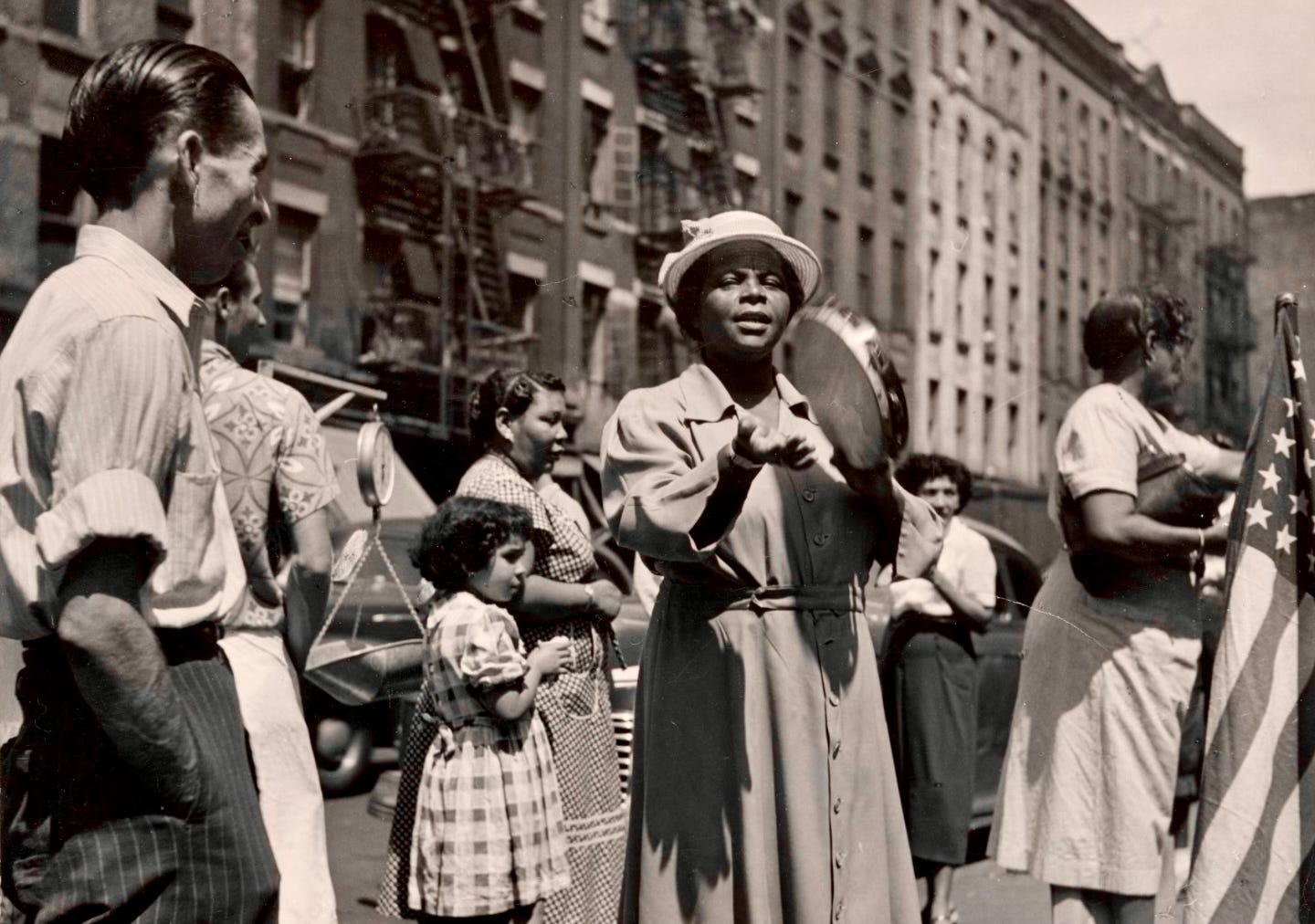
Above: detail of Crowded street scene with woman playing tambourine from the Schomburg Center for Research in Black Culture, Photographs and Prints Division, The New York Public Library. Used by permission.
But he doesn’t leave his “nation of friends” as a mere variable. Emerson rarely employs qualifiers, anyway. He prefers to speak in the absolute language of aphorisms, tempering them only by contradiction, ambiguity, misdirection, or other act of disassociation. He concludes this 1844 essay, “Politics,” by summarizing a recent conversation that we suspect inspires the essay:
. . . I have just been conversing with one man, to whom no weight of adverse experience will make it for a moment appear impossible, that thousands of human beings might exercise towards each other the grandest and simplest sentiments, as well as a knot of friends, or a pair of lovers.2
Can friendship so scale? Can a kind of friendship develop among thousands that would involve not just “the grandest and simplest sentiments” among them but also—and more importantly—the “exercise” of those sentiments among them?
Perhaps Emerson’s “nation of friends” can start small—in a city neighborhood. On urban activist Jane Jacobs’s block, for instance, a stranger grabs a dime from another stranger who has been holding it as part of his 15-cent bus fare. He chases after the thief, offering his nickel to him, too. He also has seen it all: a neighborhood boy fell through a plate-glass window and (the neighborhood learns later) is losing enough blood to threaten his life. In 1950s New York City, the first stranger needs the dime to call for an ambulance. Meanwhile, a third stranger is saving the boy by applying an expert tourniquet.
After the ambulance leaves and the boy starts down the road to recovery, no one in the neighborhood sees the three strangers again.3
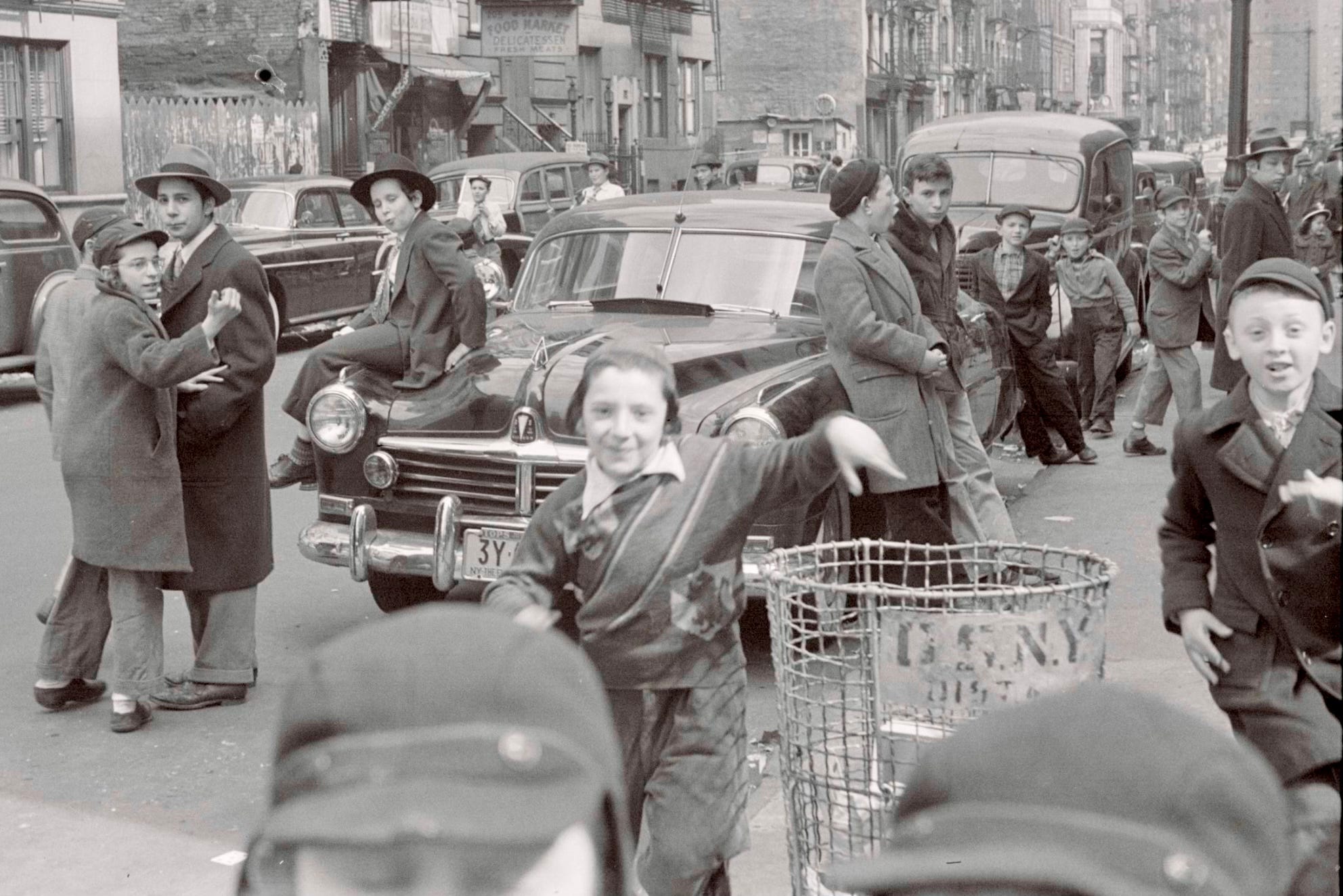
Above: detail of Children. New York, NY from the Miriam and Ira D. Wallach Division of Art, Prints and Photographs: Photography Collection, The New York Public Library. Used by permission.
Why does this all happen in Jacobs’s neighborhood? Her neighborhood, she says, fosters the public life that welcomes the strangers and many like them to play their public roles. Jacobs describes the “ballet” of small and often ritualized movements in her neighborhood that develops and sustains public life. One small part of this daily dance involves interactions she has for over ten years with the fruit vendor standing outside his doorway. As she passes him each morning on her way to work, they both look up and down the street, then smile at each other. Their smiles, Jacobs says, signal that “all is well.”4
Her relationship with the grocer, like her relationship with many of her neighbors, is merely public. But these public acquaintances protect one another’s privacy; in fact, these acquaintances often share in responsibilities that make private life possible.
Associating the word “friendship” with civic life isn’t just Emerson’s notion. Hannah Arendt refers to Aritstotle’s concept of philia politike, which she likens to “a kind of ‘friendship’ without intimacy and without closeness”5—suitable, perhaps, to any conceptualization of a “nation of friends.” Professor Luke Bretherton prefers to characterize “citizenship in terms of neighborliness rather than public friendship” because it “allows for both less and, where appropriate, more intense forms of direct concern of others.”6 A friendship by any other name, perhaps, would work just as well. Jacobs’s daily routine and her story of the strangers’ exceptional concern over the neighborhood’s injured boy correlate with Bretherton’s understanding of neighborliness.
Whether we call them friends or neighbors, such basic, nickel-and-dime public relationships are rare without a city’s mix of residences, businesses, and the strangers who are drawn over time to the businesses, to the diversity of uses, and to the spectacle of other people.
Public life is rare, then, in project housing. Like most suburban neighborhoods, city projects contain only residences and attract no strangers looking to share in public life. Consequently, most project residents, Jacobs says, are “faced with the choice of sharing much or nothing”—of developing close friendships or of maintaining complete distance from their fellow residents. Making acquaintances, on which public life thrives, isn’t often plausible in projects: residents often fear that making acquaintances will lead only to trouble.
Moderns tend to seek intimacy as a precondition to acting together in public matters, sociology professor Richard Sennett thinks. In his book The Fall of Public Man, Sennett claims that this tendency contributes to the loss of public life:
In community groups, for instance, people feel they need to get to know each other as persons in order to act together; they then get caught up in immobilizing processes of revealing themselves to each other as persons, and gradually lose the desire to act together.7
Public enervation, Sennett says, comes from people’s wish to be intimate friends before allowing themselves to be neighbors.
This primacy of private relations combines with single-use public environments to create an unhealthy cycle. Sennett points out that this unfortunate “intimate vision is induced in proportion as the public domain is abandoned as empty.” Sennett regrets the street-level space in New York’s Lever Square skyscraper, for instance, where “no diversity of activity takes place” despite its “miniature public square” design.8 The design is right, but the uses that would create public space aren’t present around it. Sennett’s skyscraper seems to resemble Jacobs’s projects and most suburban spaces in this regard.
Jacobs tells the story of a sociable project resident who, with a great deal of effort, becomes friends with all ninety of the mothers of young children in her building. Despite her friendships, when her own young son gets stuck in an elevator car and screams for two hours, no one helps him. This resident later complains about the episode to one of her new friends.
“Oh, was that your son?” her friend responds. “I didn’t know whose boy he was. If I had realized he was your son I would have helped him.”9
Which of these two neighborhoods—Jacobs’s or the project resident’s—is neighbor to its unfortunate young son?
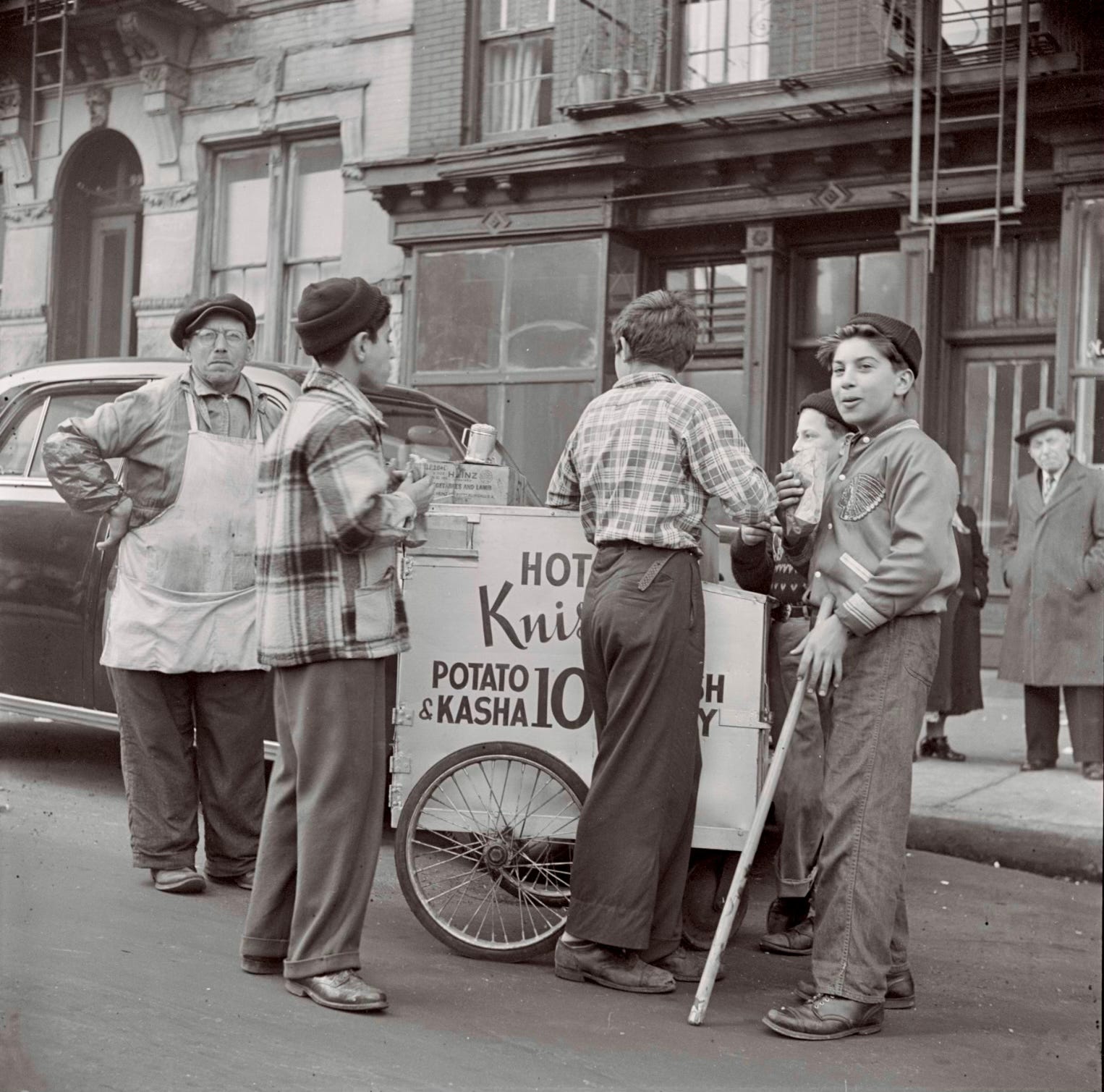
Above: New York, NY from the Miriam and Ira D. Wallach Division of Art, Prints and Photographs: Photography Collection, The New York Public Library. Used by permission.
The parable of the Good Samaritan plays with various forms of distance among people. The priest and the Levite know that they are obligated by law to help a crime victim, a fellow Jew, whom they run across, but they cross the road to avoid him. The Samaritan, by contrast, has no connection with the wounded Jew other than their shared humanity and—for as long as it takes for the Samaritan to help the Jew—their proximity.10
Neighborliness is not an inconsequential relationship; we know this from the second greatest commandment that Jesus’ parable examines. We know it also from the way Jesus’ question “Which was neighbour?” transforms the commandment’s concept of neighbor from a presumed relationship into a deliberate one.11 The parable’s three candidates for neighbor, of course, are strangers to the crime victim. “Neighbor,” the parable suggests, is a face-to-face relationship—not a private one, but an immediate and an active one.
“Neighbors” in this sense may be locals who don’t know one another well or even one-time visitors to a neighborhood, as in two of Jacobs’s examples. They may meet outside of their respective neighborhoods, as in Jesus’ example. And they may become a nation by the imaginative application of their encounters, such as the Samaritan’s, along the paths that connect their neighborhoods.
Discussion questions
Are Jacobs and her neighborhood’s grocer friends? In what sense, if any, could Jacobs and her grocer be said to share a covenant relationship?
What do these two accounts of neighborhood boys suggest about good city planning? What can a city or town do—or stop doing—to foster the public life Jacobs celebrates?
Can a housing project or a suburb move from what Jacobs calls a “togetherness or nothing” model to a public model, such as one Jacobs’s neighborhood fosters? What would it take?
Can an entire neighborhood resemble a neighbor, as the essay’s fourth-to-last paragraph implies? Does the question “Which of these was neighbor?” in the Good Samaritan parable help to inform the question “Which neighborhood was neighbor?” in that paragraph?
Can mixed uses help to develop a neighborhood’s moral character?
The essay’s last two paragraphs suggest a distinction between acquaintances and more private relationships. Would you use other terms for each form of relationship? Are your acquaintances merely potential friends, or are they important to you in their own right? Are they important to your public life?
One might argue that for Luke, roads lead to encounters in which someone is recognized. The road to Emmaus (Luke 24) and the road to Damascus (Acts 9), for instance, lead to characters recognizing the stranger as Messiah. Does anything like that happen on the road to Jericho in the Good Samaritan parable?
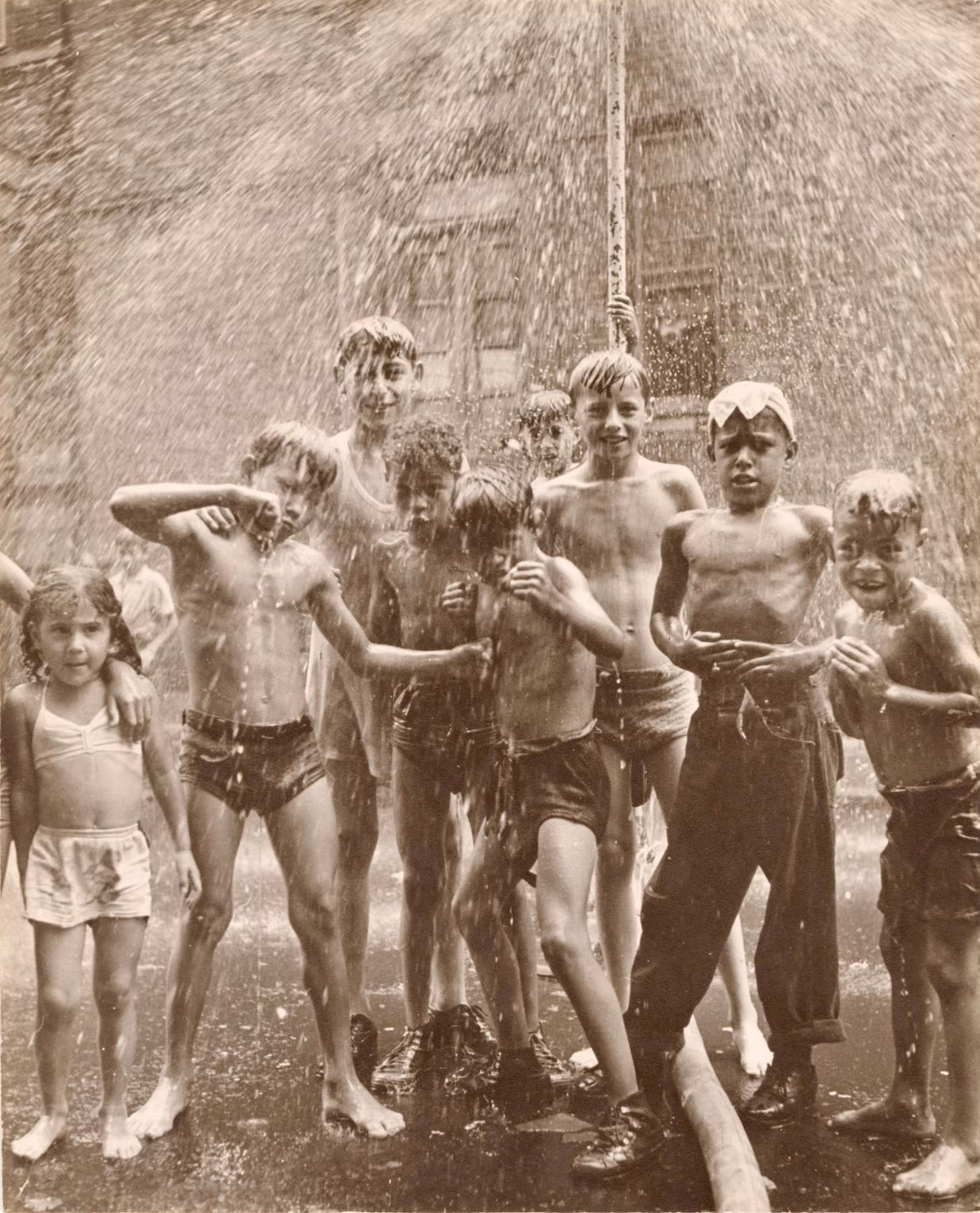
Above: Group of children, mostly boys, gathered under sprinkler, in East Harlem, New York City from the Schomburg Center for Research in Black Culture, Photographs and Prints Division, The New York Public Library. Used by permission. The short footnotes below refer to the full citations in the earlier manuscript’s and this Substack’s bibliography.
Emerson, “Politics,” 566-70.
Emerson, 570-71.
Jacobs, Death and Life, 54.
Jacobs, 51.
Arendt, Human Condition, 243.
Bretherton, Resurrecting Democracy, 97.
Sennett, Fall of Public Man, 11.
Sennett, 12.
Jacobs, 66.
There’s something more of Emerson’s “a nation of friends” in the Good Samaritan story. From an eschatalogical standpoint, the story reimagines the nation of Israel, N. T. Wright points out. The connection begins by associating “neighbor” with the lawyer’s first question: “What should I do to inherit the life of the coming age?” Luke 10:25 (Wright, Kingdom New Testament, 134). Israel in the age to come would include the Samaritan—the foreigner—because he fulfills the second-greatest commandment to love his neighbor as himself. By implication, Wright says, Jesus teaches that “. . . there was a way of being Israel which would be truly and radically faithful to the very centre of Torah, as summed up in the Shema. But this way, when pursued to the limits, would involve the redrawing of Israel’s boundaries, to include those normally reckoned beyond the pale.” Wright, Jesus and the Victory, 306-307.
Luke 10:36 (KJV, REB).
You are playing all my favorites. What I see running through most of the folk you cite is pragmatism. Truth is not in thought, but in experience, from Emerson through to Sennett. I’d suggest even Arendt, with her concepts of rootlessness, solves for it in effect with neighborliness.
You test Emerson’s “nation of friends” against urban life, public space, and neighborliness. The movement from aphorism to street, Samaritan to sidewalk, shows how political order can arise from shared action without intimacy, coercion--or moral theater. ! - Thanks yet again.