



What happens when a community organizer’s difficult background—the one that leads them into mentoring and community organizing in the first place—returns and threatens to destroy their work?
And when a community organizer’s life falls apart, what happens to the young people they’ve worked for years to mentor?
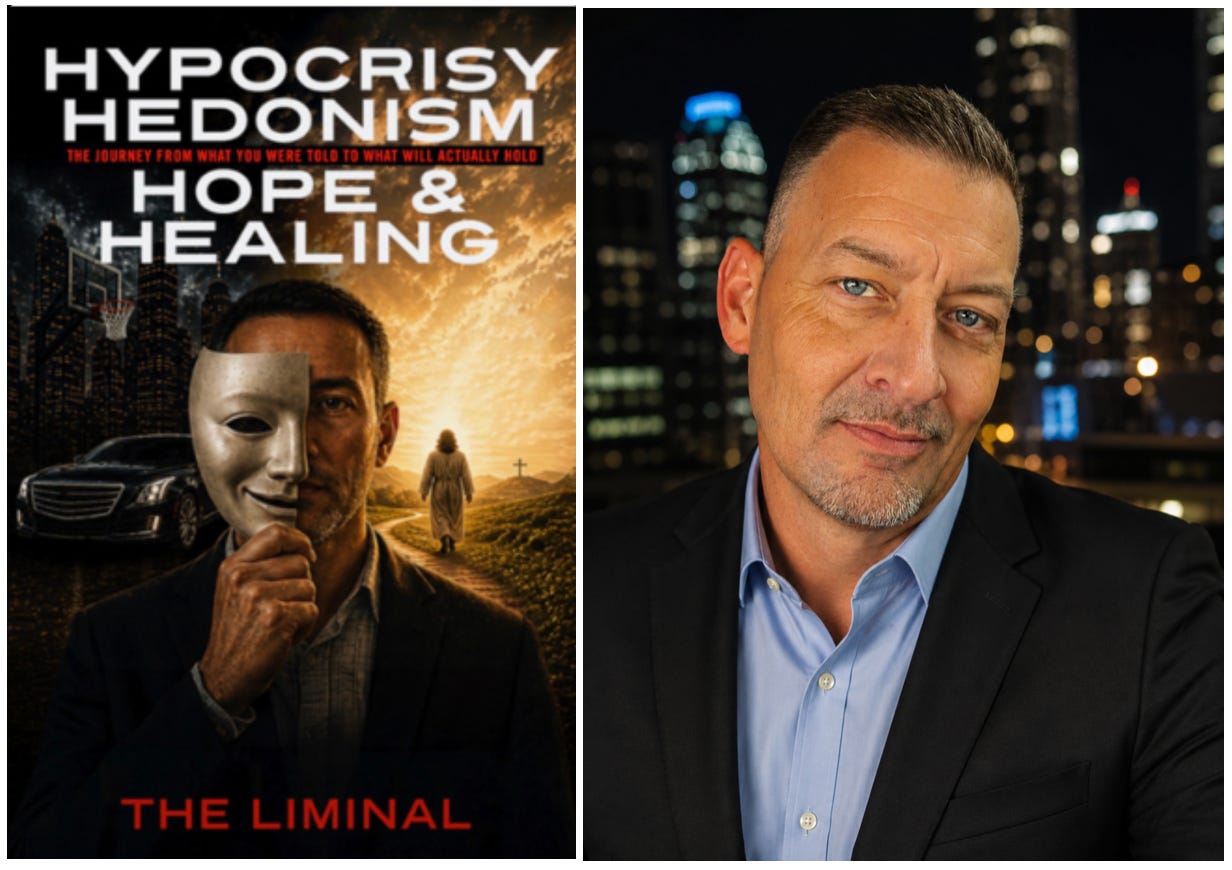
Jason Williams knows. After two decades of mentoring boys and young men and helping to organize Birmingham’s inner-city neighborhoods and schools, his life fell apart. And in public, for all the world to see. He just published a book about it: Hypocrisy, Hedonism, Hope & Healing.

At top, from left: Willie Walters, Xavier Taylor, Jaheim Goodwin, and Jason Williams. Above: Willie and Jason. Photos courtesy of Jason. Jason has mentored Willie, Xavier, and Jaheim for many years and considers them among his closest friends.
I recently spent a day shadowing Jason as he mentored and taught in school and worked with inner-city teachers and administrators. Then I interviewed him about his 2022 crisis, what he learned from it, and how it has impacted his public work.
I feel like Jason’s story and his insights require two very different podcast episodes. The first is a 14-minute audio episode, linked at the top of this page, that focuses on how different categories of people in Jason’s world treated him after his crisis. Spoiler: if you love the Christmas classic It’s a Wonderful Life, get ready for the real thing.
The second is a video of our full, hour-long interview, which you can see by clicking the YouTube video below. The interview covers more about Jason’s crisis and its aftermath as well as these and other topics:
What is a street pastor?
How do many churches discourage the transformation that conversion begins?
Why is proper mentoring always a two-way street?
The course of a sudden identity crisis
For a more complete registry of topics, see the timestamps listed below the video.
Whether you’re religious or not, and whether you work in community organizing or not, I think you’ll relate to Jason’s story. It comports with Elias Crim’s insight about those who respond to the “moral beauty” of the poor:
I’m not sure whether certain life experiences are needed in order to respond to moral beauty. But I suspect that everything depends on which one of the two great divisions of humanity you belong to—those whose hearts have been truly broken by the world and those not yet in that condition.1
Jason Williams’s heart has been broken twice over, once by his fatherless upbringing and again by the recent crisis that his upbringing helped to precipitate. The first led him to serve the poor. The second led the poor to serve him.
Timestamps on the video version:
00:01 — Introduction to Jason Williams
00:28 — Why Jason wrote Hypocrisy, Hedonism, Hope & Healing
01:23 — How his midlife crisis changed his theology
02:00 — Intellectual information about God hadn’t filtered down to his heart before his crisis
02:40 — A newfound confidence versus a previous, feigned certainty
05:00 — How he was called to inner-city service, and how he struggled with that calling
07:17 — The zealous-Christian-to-pastor pipeline
08:18 — Titles pigeonhole us and aren’t flexible enough
08:57 — His realization that he didn’t love the people he was working with
12:27 — The polo pastor and the street pastor
13:06 — Not trying to win God’s favor by loving the poor or advocating for justice
13:47 — What’s a street pastor? Jesus as an example
15:50 — Street pastoring and community organizing
16:10 — The structure of street life
16:34 — Mentoring as the usually ignored central ask of discipleship
17:48 — Mentoring doesn’t involve fixing people. It involves encountering Jesus.
18:50 — The mentoring organization that he founded and ran for ten years
19:05 — The immediate cause of his crash in 2022
20:08 — The authentic Jesus versus the container system that purports to house Jesus
20:56 — Categories of people and how they reacted to his collapse
21:33 — His mentees called him to accountability
22:34 — The need to end top-down ministry
23:56 — It takes a village of years and relationships
25:23 — The book doesn’t tell people what to believe. It’s an invitation to examine our inherited and sometimes unacknowledged beliefs.
28:39 — Deep confidence versus shallow certainty (redux)
29:34 — The book as a mirror
31:14 — Two ways to get to bedrock: collision or crisis
32:53 — Modern Western churches as silos
37:12 — The rejected ones redeem others
38:28 — Why he couldn’t run away from his crisis
39:26 — When no one approves of you
40:26 — Having to sit in the unknown for a long time
41:10 — The effect of many churches’ distaste for psychology and philosophy
41:58 — The effect of Jason’s not having a father
42:24 — God’s invitation to the hard work to understand what was motivating him
42:54 — “Walking in the Spirit” as cooperating with God’s healing us of effects of abandonment and sexual trauma
43:22 — The attraction to religious spaces that support dissonance
45:14 — Behavior modification is not the path to change
47:41 — “My life is centered on what can be restored”
51:20 — Jason’s community organizing work
53:46 — After his collapse, he leaves the results of his work to God
55:06 — After his collapse, he’s more open to changing his mind
55:39 — The slow start of his new business Purifico, which hires Birmingham youth, and his reaction to it
56:33 — Jason has stopped coming to conclusions about things prematurely
57:33 — What “a living sacrifice” suggests
59:31 — How churches tend to conform themselves to business-oriented thinking
1:00:12 — If we think we know it all, we can’t be transformed by our mind’s renewal
1:00:50 — What it takes to speak to someone’s pain
1:03:22 — What Jason would tell a community organizer having a personal crisis
1:05:35 — Jason’s new book that he’s currently writing
1:10:09 — Why his pen name is “The Liminal”
Other resources:
Jason Williams’s and Gerrel Jones’s Barbecuing Sacred Cows YouTube channel
Podcast episode on Renew Birmingham
Hypocrisy, Hedonism, Hope & Healing website
The Liminal Writes YouTube channel
Jason on LinkedIn and Instagram
This episode’s title, of course, is inspired by Henri Nouwen’s 1979 classic The Wounded Healer: Ministry in Contemporary Society. The book’s publisher, Random House, writes that “According to Nouwen, ministers are called to identify the suffering in their own hearts and make that recognition the starting point of their service.” In this episode, Jason demonstrates the hard work in the streets and in the heart required for a community organizer to fully answer that calling.
My thanks to Arend for the licensed use in the episode’s audio edition of “New Beginnings” from Uppbeat.
Elias Crim, Confessions of a Street Catholic: An Unauthorized Guide to the World Church (Solidarity Hall, 2026), 66.


