


Coptic Christians who have moved from their Egyptian homeland to the United States face an unusual quandary. Since 2015, they have become for many American politicians and churches stark evidence of worldwide Christian persecution. But America’s dominant culture—including some of these same politicians and churches—in practice often categorizes Copts as the undesirable Other. Although Copts practice the most ancient extant expression of Christianity, many Americans find its liturgy illegible. And though many Copts left Egypt under the threat of persecution, many Americans cannot distinguish them from Muslim migrants from the Middle East and North Africa.
How do Coptic migrants navigate between these narratives of exemplary martyrs and undesirable migrants? I interview anthropologist Candace Lukasik, who writes about these issues in her new book published by NYU Press, Martyrs and Migrants: Coptic Christians and the Persecution Politics of US Empire.
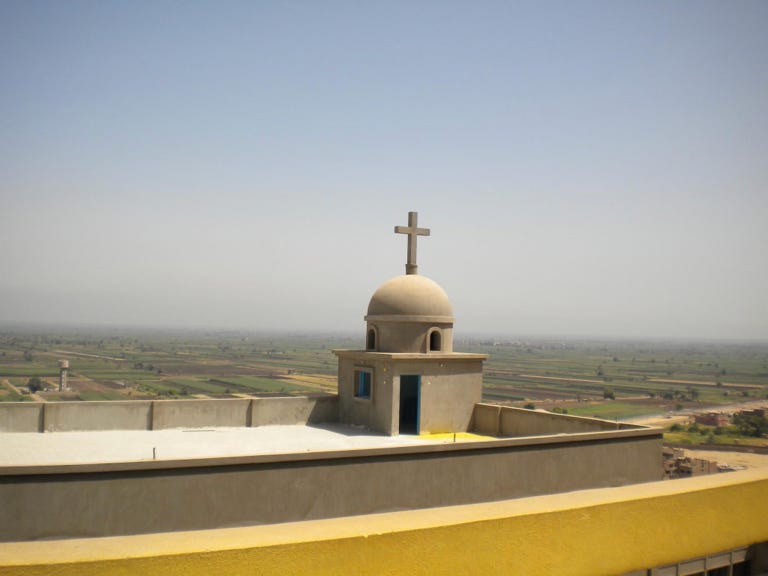
Above: View from a monastery in Upper Egypt, fall 2009. Photo by Candace Lukasik. Used by permission.
I met Dr. Lukasik last fall at the Political Theology Network’s biannual conference in Nashville. She co-facilitated our section “Up/Rootedness” about place and migration, themes dear to my heart. After choosing the section, I found that I had migrated to a land of anthropologists, and I got a three-day practicum there on ways that anthropology can inform political theology (and vice versa).
At first, our section seemed a bit like an Indiana Jones convention, full of professors who early in their respective movies seemed to trade in their tweed jackets and classrooms for fedoras and foreign fieldwork. Presenters discussed their extensive and often dangerous work in places such as Kashmir, the Columbian Amazon, Turkey, Lebanon, Israel/Palestine, and Egypt.
I discuss some of that anthropological adventure notion with Dr. Lukasik, who has a different perspective. For her, anthropology is both an intellectual and a spiritual practice, and it backgrounds any distance and difference between her work at the university and in the field. While reading her book and interviewing her, I found that anthropology also has led her to remarkable friendships, a subtler and more gracious view of the world, and a conversion to the Coptic Orthodox faith.
The video interview is lavishly punctuated with several of Dr. Lukasik’s striking photos from her fieldwork (see Photos & timestamps below).
I hope the interview inspires your own desire to cross borders and to learn from and support those you find on the other side.
Topics & timestamps
00:30 — Setting the scene of Martyrs and Migrants: the Copts as a Christian minority in Egypt and as an Egyptian minority in the United States; the Copts in the U.S. being understood as persecuted Christians and Middle-Eastern Other
01:35 — Lukasik’s book summary: What has migration to the West done for and to the Copts? What light does the Copts’ struggle shed on geopolitical issues? What issues about the practice of Christianity today do the Copts’ experiences raise?
04:30 — What drew Lukasik to her work with the Copts in Egypt and in the U.S.? Her background, her trip as a teen for an Arabic language program and her discovery of Coptic Christianity and its “in-between-ness” within Christianity.
06:30 — Her trips to Egypt and slow discovery of migration’s effects on the Coptic tradition
07:10 — Her growing relations with Coptic friends and families; her description of her fieldwork, particularly during the violence of 2017
09:00 — The effect of the martyrdom of the twenty Egyptian Christians and one Ghanaian in Libya in 2015 and subsequent violence in Egypt had on her ongoing work
12:00 — The effect of images of this violence on the Coptic diaspora and on transnational relations among Copts
13:10 — How fieldwork affects her teaching; how she presents anthropology to perspective students; how she has come to understand the interplay of classroom and fieldwork (versus Bryce’s “Indiana Jones” theory of the professor with the adventurous side students hear about but don’t experience); anthropology as attending to the messiness of the world
19:10 — The blend of her spiritual and intellectual journey involving her classroom, her research, and her fieldwork, including her conversion to Coptic Orthodoxy
20:45 — How the situations of Coptic Christians and Palestinian Christians compare with respect to the powerful Christian persecution narrative and the applicability of Lukasik’s concept of an “economy of blood.” The nature of narratives that make a people visible to empire.
24:50 — The “economy” of the “economy of blood” and the “blood” of the “economy of blood”; the “economy of blood” through theological and political lenses
29:20 — How asylum law as practiced with Coptic petitioners often differs from other, less legible Middle Eastern Christian petitioners because of the economy of blood
32:00 — The tension between the Christian persecution narrative and the need for specific harm in Coptic asylum application hearings to create legibility before the law
35:12 — Copts work in law enforcement often to create visibility within the police forces for Copts in the community and to help the forces differentiate between Copts and Egyptian Muslims. Copts work in law enforcement often in an attempt to keep Copts from being seen as the Other.
39:10 — Copts in law enforcement are somewhat like Irish emigres working for law enforcement to become legible as part of their new American community. A group’s distinction from Dangerous Others is part of becoming American.
40:42 — How the Coptic Orthodox Church serves as the governments’ point of contact with its Coptic population in both Egypt and in places like Nashville, Tennessee. The causes and downsides of such relationships: the church wants to play to the role that the broader geography expects of it, but that role is challenged by the needs and perspectives of poor and working-class Copts.
44:12 — The innovative work of Lydia Yousief and the Elmahaba Center in Nashville in community organizing and community support, work that makes up for the inattention to new Coptic migrants by the Coptic Church in Nashville
46:12 — The first Coptic migrants came to Nashville to build the next phase of Opryland
46:52 — How Tyson Foods covered up the exposure of Coptic workers to COVID; how the church discouraged the Tyson workers from unionizing and from forming coalitions with other migrant workers
47:22 — Elmahaba Center interrupts the neoliberal emphasis on who are—and who are not—members of the Body of Christ by emphasizing community needs and the need for different perspectives that a community carries
Photos & timestamps
00:31 — Cover of Martyrs and Migrants
05:44 — Candace Lukasik in 2009, visiting around 40 monasteries over four days with a Coptic Orthodox youth group in Cairo
09:36 — Coptic martyr blood behind glass at the Coptic Cathedral in Cairo
16:34 — An image on martyrdom in a Coptic church that Dr. Lukasik used in her class the day before the video. The image is from the bombing near Saint Mark’s Orthodox Coptic Cathedral in Cairo in December 2016.
17:56 — An image on martyrdom in a Coptic church that Dr. Lukasik used in her class the day before the video. The image is from a commemoration room at the Cathedral for the 21 martyrs of Libya.
19:31 — Bahjūra from a rooftop
26:43 — Image from a church in Upper Egypt. It might be seen as a metaphor for thinking about the economy as part of inclusion in the Body and reflection of the outside
27:44 — U.S. and Egyptian flags in a Staten Island home
29:07 — A Coptic Church in Jersey City
30:37 — One of the computers Copts use in Upper Egypt to enter in Green Card Lottery information
31:06 — A white board where Coptic migrants take their photos to apply to the Green Card Lottery in Upper Egypt
37:28 — “Honeywell Security / Proud to be a Coptic American”: issues of security and inclusion
43:47 — An image of St. Mina in a Nashville gas station where Copts work


