


I was nervous about this latest No Kings rally. For the first time, instead of heading into Nashville, we’d protest right here in our southern-Tennessee town. I had invited three neighbors to come, and it would be their first protest—or in the case of one neighbor, her first protest since the Sixties. The other two neighbors self-identify as Republicans. Their votes against the president in 2024, of course, make them outliers. Our town is the seat for a county that went for the president by 30 points.
I felt responsible for our three neighbors. But most of my angst involved turnout: I was expecting maybe a dozen people at our city hall meetup, and who knows how many counter-protesters. But around 400 of us showed up, and we saw maybe only six counter-protesters.
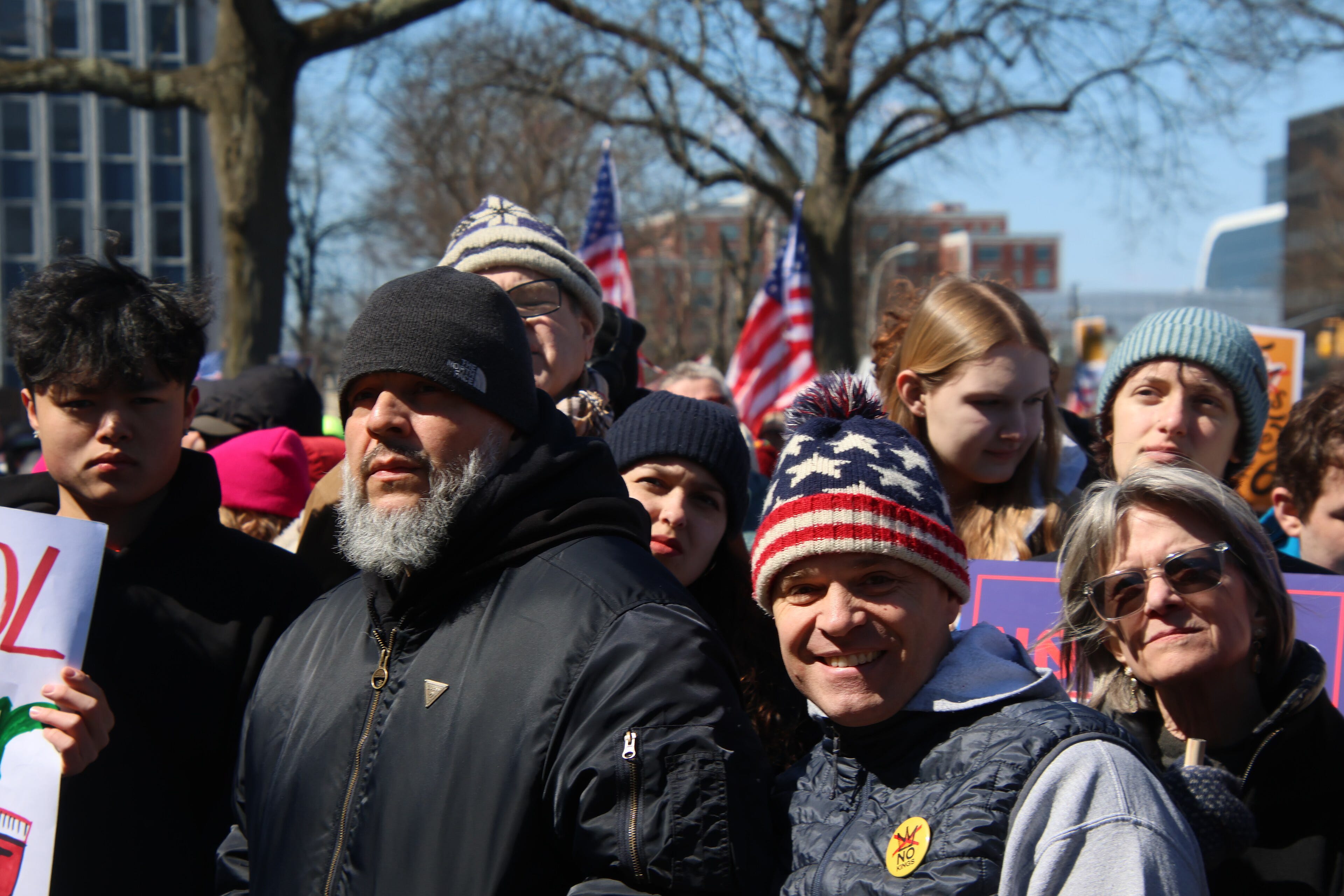
Above: “No Kings rally in Mineola, New York, 28 March 2026,” photograph by terryballard. Used by permission.

We lined the sidewalks downtown and waved our signs at the passing cars and pickups. Many vehicles honked back approvingly. Overall, too, the silent majority of drivers seemed to take our presence with grace.
Just as in Nashville, some guy with a megaphone paced along the sidewalks, leading us in chants. But one old favorite—“Whose streets?” “Our streets!”—was quite out of place. We crossed only at crosswalks and only when we had the green light. And after we had left—as in Nashville—there was no longer any sign that the streets, or the sidewalks, had ever been ours in any sense.
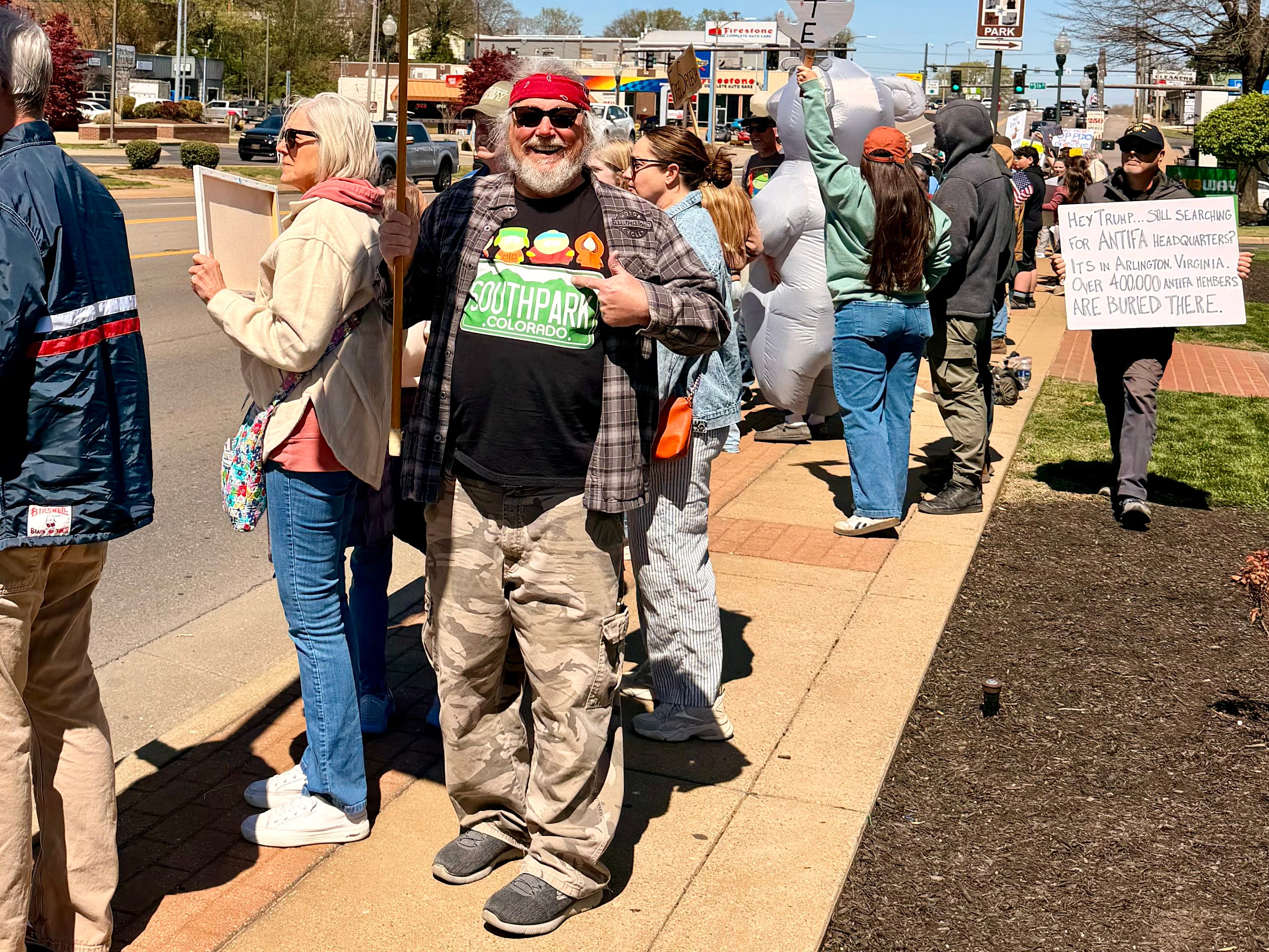
Above: at our town’s March 28 No Kings rally.
Many signs (and tee shirts) were thoughtful and clever. As would befit a small-town protest, no signs involved profanity. If they did, I didn’t see them. Still, I don’t think our signs were as effective with our ostensible, motoring audience as the nearby service station signs advertising fresh, sky-high gas prices.
I really don’t go to these rallies because I’m convinced they’ll make a difference. I’m not. The rallies may or may not help to rein in the president’s desire to reign. Now involving 2% of the population, the rallies may or may not eventually lead to approximately 3.5% of Americans protesting, the percentage associated with regime change in Erica Chenoweth’s frequently cited study of nonviolent movements from 1900 to 2006.
And even if it does, 3.5% involvement really doesn’t signal big, positive change anymore. Since 2006, mass movements approximating that size or larger haven’t fared nearly as well as those earlier ones Chenoweth cites. Our protests may look like our forebears’ protests, but as Zeynep Tufekci points out, pre-digital-age movements were forced to develop organizational capacity alongside their direct action. By contrast, today’s social-media-driven movements “lack both the culture and the infrastructure for making collective decisions.” Modern mass movements, therefore, generally don’t pivot well.1 Many of them never remove the training wheels of, say, infrequent afternoon protests.
Revolution—and even the reassertion of a revolution begun 250 years ago in the case of the United States—is complicated. Vincent Bevins studied the mass protests during the 2010s in ten countries and found that “seven of these countries experienced something worse than failure. Things went backward.” Bevins attributes these bad results in part to mass man’s belief in masses:
Too often, it seemed that the approach employed in the 2010s could be summed up, fittingly, in a tweet:
Protests and crackdowns lead to favorable media (social and traditional) coverage
Media coverage leads more people to protest
Repeat, until almost everyone is protesting
????
A better society2
Even Chenoweth, in a later report, points out that, using her own framework and accounting, the success rate of nonviolent protests dipped from 65% during the 1990s to 34% in the 2010s.
So the No Kings protests alone may not bring what most people might consider to be success.
But the keys to balancing this reality check may be the words “alone” and “success.” If we add other means of direct action and community organization to protests and look at success from the standpoint of process and not just product, maybe we see a brighter picture. Activist Tim Hjersted summarizes what protests may lead to:
Protests rarely achieve their maximalist demands on their own. But they do things nothing else can: they shift public discourse (Occupy didn’t break up the banks, but the language of the “99%” permanently changed how Americans talk about inequality), they energize waves of downstream organizing (the Women’s March fed directly into the candidate recruitment and voter mobilization that flipped the House in 2018), they build relationships between people and groups who might never have connected otherwise, and they make visible the scale of opposition in a way that no online petition or social media post ever will.
This sanguine summary comes from Hjersted’s piece “How To View Protests Like an Organizer.” But how about viewing the No Kings protests like a denizen of what Jesus calls the kingdom of heaven?
The No Kings protests may not lead to what I long for—functioning models of God’s just and participatory community. They don’t, for instance, live out what they desire, as did the early church’s modeling of God’s messianic kingdom. (Using Dan Swain’s term, they don’t involve themselves in “ends-effacing prefiguration,” in which the group’s desired future changes as they learn from seeking to live it out.3)
The No Kings protests also have no plans to organize in small groups and take responsibility for their localities, as the Israelites did under the Torah’s constitution. This Jewish vision of the messianic era, as Daniel J. Elazar describes it, involves “a restoration of Israel’s tribal system.”4 Jefferson’s plan for village-states approximates this approach. It must be said, however, that the proliferation of No Kings events—now up to 3,300 in rural, suburban, and small-town locations as well as urban ones—suggests to the imagination something like Jefferson’s wish to divide the country’s counties into small wards for the purpose of spreading republican government to the country’s citizens.
So at these No Kings rallies, I kind of channel the old people present when the foundation of Jerusalem’s second temple was completed. The young focused on the limited freedom that the temple represented and shouted for joy. But the old remembered the fuller freedom that the pre-exilic, original temple represented and “wept and wailed aloud.”5
But from a messianic standpoint, there’s also reason to cheer. The No Kings protests perform three vital, foundational tasks toward the re-establishment of public life. Remarkably, these three tasks seem to coalesce around the thought of Italian philosopher Giorgio Agamben, who has instructed the church on messianic time.
Why “remarkably”? I think any confluence of political task and philosophy is remarkable. Agamben, true to a philosopher’s form when addressing politics, resists being pinned down to application, to a particular political program. But Agamben does offer one application in his 1990 book The Coming Community—the 1989 Tiananmen Square protests. Those protests exemplify the three tasks he identifies and that I find also in the No Kings protests.
The first task is to challenge state sovereignty. As the phrase “no kings” suggests, the No Kings rallies organize themselves around the idea of rejecting sovereignty and supporting the U.S. Constitution’s balance of powers. The Bible organizes itself around the same concept: God alone is king. When God raises Jesus from the dead, he declares his judgment against all forms of earthy sovereignty and the dark spiritual forces that support them. I can get behind the “no kings” of No Kings.
Agamben finds the same overall assertion of political freedom against sovereignty in the then-recent Tiananmen protests:
What was most striking about the demonstrations of the Chinese May was the relative absence of determinate contents in their demands (democracy and freedom are notions too generic and broadly defined to constitute the real object of a conflict . . .6
Many participants of both No Kings and Tiananmen advocate for specific policies that a state would implement, but the overall thrust (democracy, “no kings”) suggests something more foundational: a way of doing politics without the state. Pointing to Tiananmen, Agamben gestures toward this deeper conflict between the now and the desired future:
The novelty of the coming politics is that it will no longer be a struggle for the conquest or control of the State, but a struggle between the State and the non-State (humanity), an insurmountable disjunction between whatever sovereignty and the State organization.7
This “whatever” as in Agamben’s notion of “whatever singularity”—the key concept in The Coming Community—isn’t an indifference to the things that we might use to organize ourselves into communities (Agamben at every turn exemplifies this tendency with examples such as “being red, being French, being Muslim”). Agamben’s “whatever” doesn’t reject the universal for the specific or the specific for the universal. Instead, it describes a way of actively loving the world as a lover loves their beloved (a particular universal), including their particular traits, but not based on their particular traits.8 This love, expressed as community, is what Agamben says the state cannot abide:
What the State cannot tolerate in any way, however, is that the singularities form a community without affirming an identity, that humans co-belong without any representable condition of belonging . . .9
Our intolerance for separation as a means of belonging, one that finds no need for the nation-state’s binding, brings me to the second task of the No Kings protests: to demonstrate this undifferentiated belonging. The No Kings protests attract people from many actual or would-be “identity groups.” The protests involve all ages, races, and sexual orientations, for instance. Protesters come from many walks of life and categorize themselves by different social and political labels.
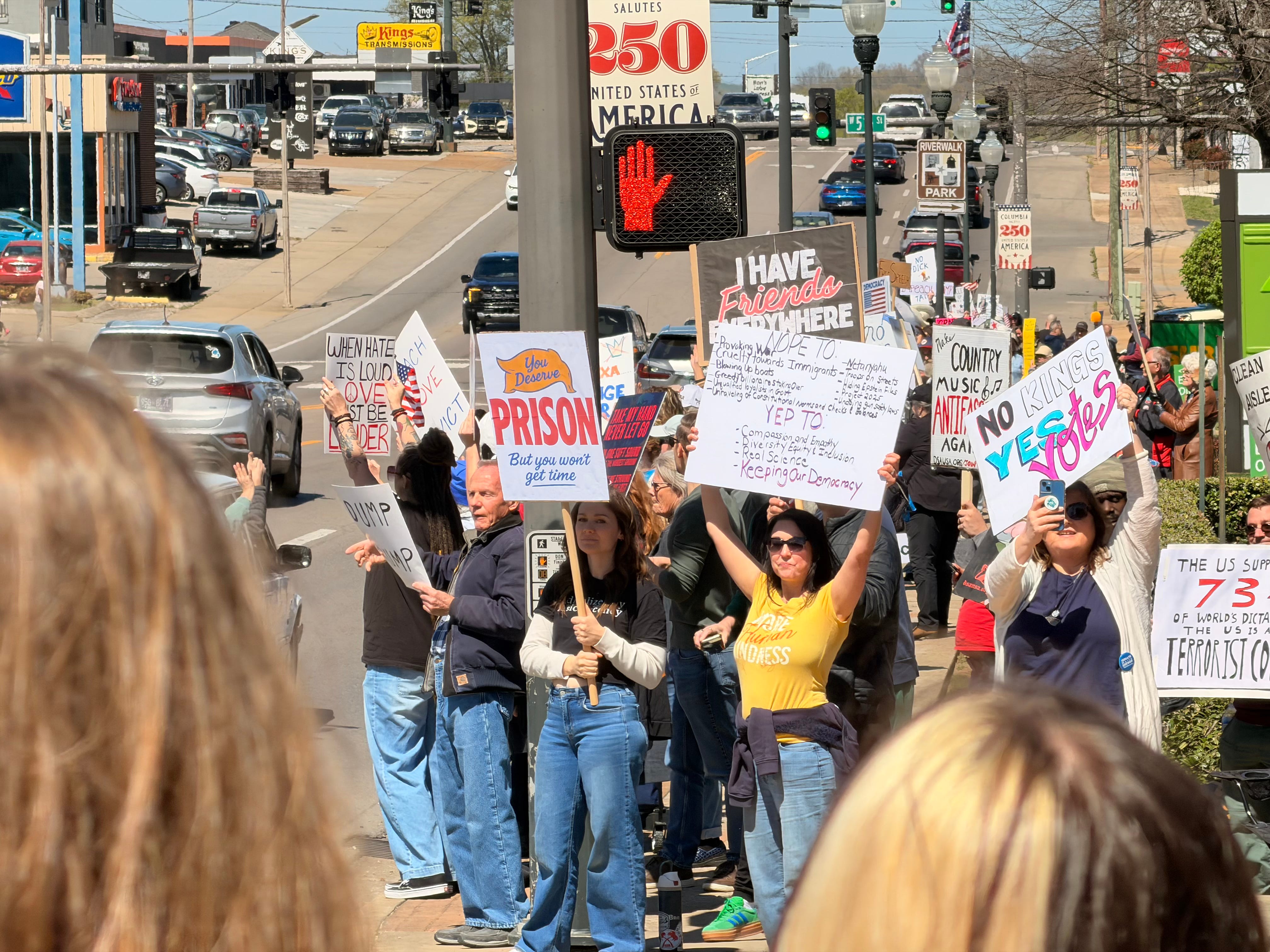
Above: also at our town’s March 28 No Kings rally.
Agamben doesn’t reject these and other categories. He finds, in fact, that contemporary politics wrongfully “unhinges and empties traditions and beliefs, ideologies and religions, identities and communities.”10 But he argues that to use such categories as the basis for a political movement—and eventually as the basis for a new or a revised state—would attempt to oppose the state with the state’s own logic. If we adopted this nation-state strategy—if we grounded the political community in the notion of a particular identity or of a coalition of identities—any success in that endeavor would eventually replicate the state’s failure.
What’s left without categories? Agamben doesn’t counter communities that make particular categories of identity a condition of belonging with notions of a “negative community,” which he defines as a community mediated by “the simple absence of conditions.” The coming political community, instead of being based on conditions or on an absence of conditions, will be based on unconditional “belonging itself.”11
This political belonging is located in our faces, Agamben says:
My face is my outside . . . In the face, I exist with all of my properties (my being brown, tall, pale, proud, emotional . . .), but this happens without any of these properties essentially identifying me or belonging to me.12
This understanding of political community processes Tiananmen as a threshold, or what Agamben calls “the event of an outside.”13 When he counsels us to “Be only your face. Go to the threshold,” he insists that we reclaim our political life from the mere spectacle that politicians and media establishments (now including social media) present to reduce public life.14
A spectacle is a single visage. Spectacle fools us into thinking that the true substance is the unseen person behind the visage. Spectacle teaches us that the face is a simulacrum, something that hides the truth.
But true politics isn’t spectacle. Politics is located not in the visage but in the face, “the simultaneity [the simultas] of the visages, that is, the restless power that keeps them together and constitutes their being in common.” Politics teaches us that when we come together face to face, we encounter together something like the face of God, a face that Agamben describes as “the simultas of human faces” and that Dante describes as “our effigy.”15
This is No Kings’ third task. The protests get us over our thresholds and into public life, even if just to show our faces to one another.
Showing our faces means more than just showing our signs. Politics can’t be reduced to merely communicating messages. Real politics communicates ourselves as communicators,16 and at this early stage of our recovery from spectacle, I thought I’d point the way to this distinction with some meta-protest.
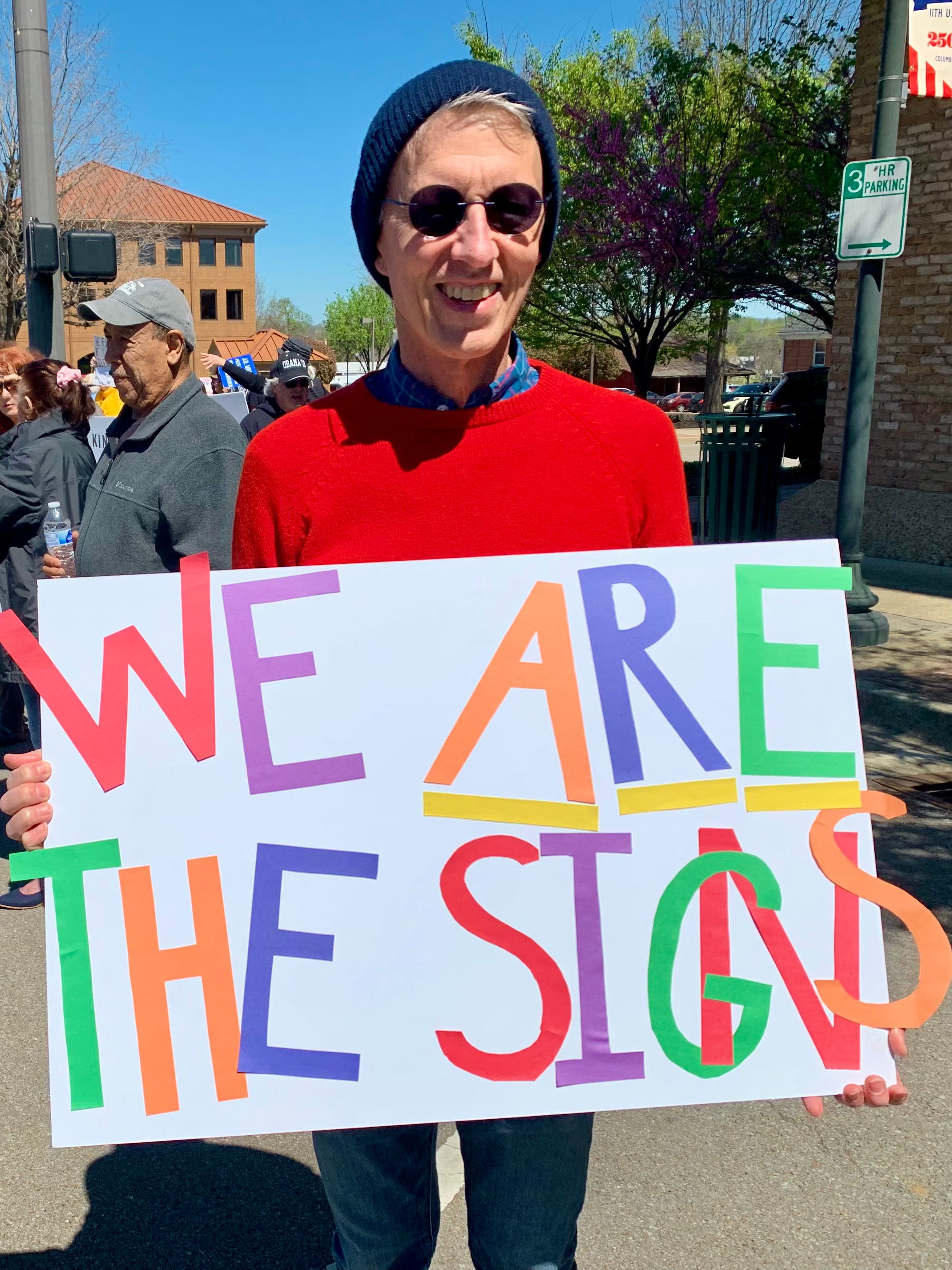
Above: Yours truly, at our town’s March 28 No Kings rally.
Admittedly, my “We are the signs” sign signals that my signage hasn’t advanced much since my “I don’t have time for this” sign that I waved in 2010 at Jon Stewart and Stephen Colbert’s “Rally to Restore Sanity and/or Fear.” Those on the left who criticized the 2010 rally, I think, missed the rally’s implicit invitation to public life and its foundational message about public freedom. They missed the comedians’ reflection on what Shakespeare calls man’s “glassy essence,” something Ann E. Berthoff picks up on:
Man is a Sign. Salvation lies in agapism . . . The agapastic process moves beyond individual man and out of our circle of society, that “loosely compacted person,” into futurity . . .17
Here, in semiotic terms, Berthoff echos Agamben’s idea of love in public life, the notion of a lover moving beyond both the universal (“individual man”) and the specific (“our circle of society”) and into the coming community.
And here, Agamben says, is where the State sends in the tanks.18
Rejecting sovereignty, coming together in diversity, and showing our faces to one another in public spaces might not seem like much. It’s not a political program. But these tasks amount to the ontological foundations of any healthy political program. More importantly, they also point to the coming community.
Agamben identifies these tasks, finds them happening in the Tiananmen protests, and asks for nothing more. His foundational approach helps me celebrate No Kings for what it is while acknowledging, at this early stage of crossing our thresholds, what it isn’t. As the prophet asks those rebuilding the temple, “Does anyone scorn a day of small beginnings?”19
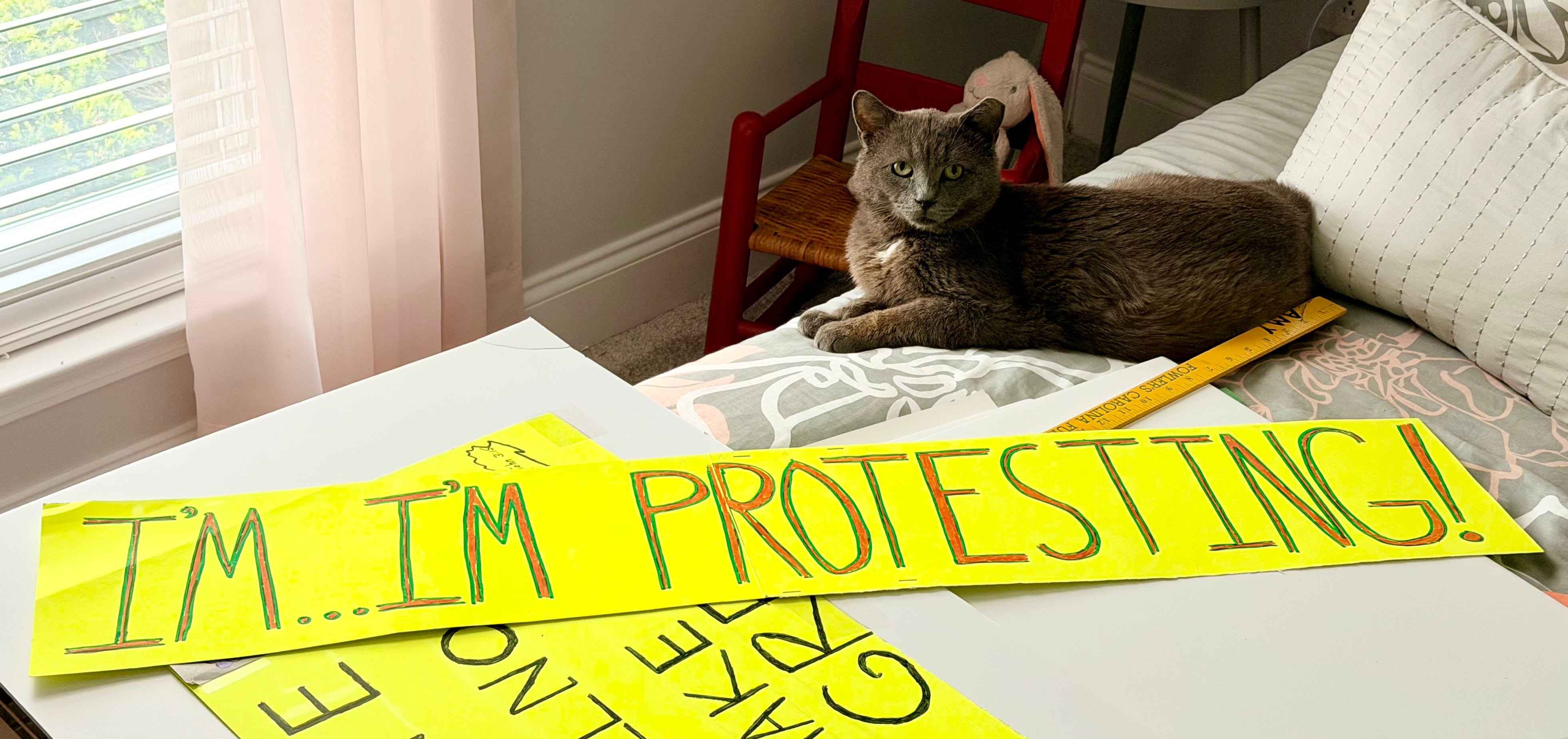
Above: my other No Kings meta-sign. Cat-Cat himself protests by twitching his tail and offering us his butt. Agamben explains why the cat doesn’t need my sign: “Exposition is the location of politics. If there is no animal politics, that is perhaps because animals are always already in the open and do not try to take possession of their own exposition; they simply live in it without caring about it. That is why they are not interested in mirrors, in the image as image.” Agamben, Means without End, 93. My meta-sign is my perfect mirror, my claim to my own exposition.
The short footnotes below refer to the full citations in my earlier manuscript’s and this Substack’s bibliography.
Zeynep Tufekci, Twitter and Tear Gas: The Power and Fragility of Networked Protest (Yale University Press, 2017), 70-71.
Vincent Bevins, If We Burn: The Mass Protest Decade and the Missing Revolution (PublicAffairs, 2023), 258-59.
Dan Swain, “Not Not but Not Yet: Present and Future in Prefigurative Politics,” Political Studies 67, no. 1 (2019): 47–62, https://doi.org/10.1177/0032321717741233.
Elazar, “Althusius’ Grand Design,” xxxxvii.
Ezra 3:10-13 REB.
Giorgio Agamben, The Coming Community, 6th printing, Theory Out of Bounds 1 (Univ. of Minnesota Press, 2007), 85.
Agamben, 85. Italics in the original.
Agamben, 1-2.
Agamben, 86.
Agamben, 83.
Agamben, 85-87.
Giorgio Agamben, Means without End: Notes on Politics, Theory out of Bounds, v. 20 (University of Minnesota Press, 2000), 99.
Agamben, Coming Community, 67-68.
Agamben, Means without End, 99-100.
Agamben, 99.
Agamben points this out: “But because what human beings have to communicate to each other is above all a pure communicability (that is, language), politics then arises as the communicative emptiness in which the human face emerges as such. Agamben, 95-96.
Ann E. Berthoff, The Mysterious Barricades: Language and Its Limits, Toronto Studies in Semiotics (University of Toronto Press, 1999), 68-71.
Agamben, Coming Community, 87.
Zechariah 4:10, Jewish Study Bible, 1242.
A wonderful historical and philosophical rumination on No Kings.
It occurs to me that Paul had something to say about the themes you identify in his first letter to the Corinthians, something about through a glass darkly, i.e. doom scrolling on screens, but then face-to-face, i.e., in the crowd — indeed, in the presence of God.