


Readers: I’ve finished an unscheduled break. Two months ago, while walking in our neighborhood, a car swerved off the road and hit me. I’ve convalesced while reading lots of Martin Buber. I’m doing much better now, and I’m grateful to be alive. I’ve begun writing again.
I and Thou starts as Genesis starts. The opening language of Martin Buber’s 1923 classic is clinical, almost cleansed of feeling, as we might feel ontology should be. What the first part of I and Thou says of relation—the ground of Buber’s dialogical philosophy—could be said of the book’s first part itself: “here is the cradle of actual life.”1
“In the beginning is the relation,” I and Thou likewise claims, and more than once,2 perhaps echoing, in Buber’s mind, the Gospel of John’s opening “In the beginning was the Word” more than it does Genesis’s “In the beginning God created.” Taken together, word and relation amount to dialogue.
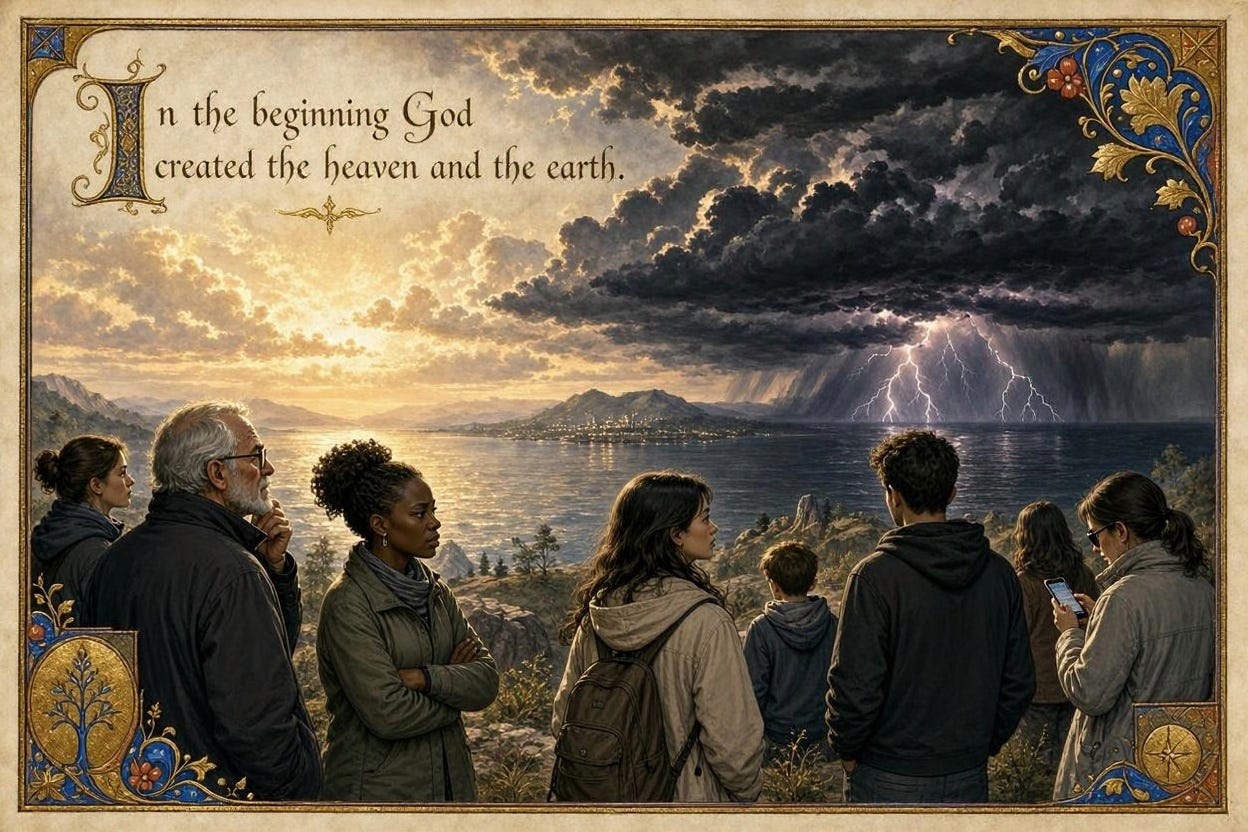
But word and relation also create. In Genesis, the word creates everything: “And God said, Let there be light: and there was light.”3 Likewise, in I and Thou‘s ontology, word is deed. We become ourselves in what Buber alternatively calls “the world of relation”4 and “the dialogical world”5 by saying “I-You” with our whole being: “I require a You to become; becoming I, I say You.” Speaking the basic word I-You, Buber says, “is a deed of my whole being, is my essential deed.”6
Buber understands Genesis—understands all of the Hebrew Bible, really—as a dialogue between God and people.7 Buber’s philosophy of history, based on this dialogical reading of the Bible, is different than what he calls the philosophy of world history. In the heart of world history, “only the conquerors have value,” Buber observes in his 1928 lecture “Biblical Leadership.”8 The Bible, by contrast, conceals its characters’ individuality by generally providing scant information about them. The Bible instead emphasizes the situations and choices the characters face in their ongoing dialogue with God.9 Unlike world history, which is “the history of successes,” the Bible’s history involves characters who are enclosed “in failure, in obscurity.” Even when a character is successful, the Bible is “duty-bound to announce in complete detail the failure involved in the success.”10
Like his books, Buber never fit well into any academic discipline. When he left Nazi Germany for Israel in 1938 and tried to join the Hebrew University of Jerusalem, its academic committees at first prevented him from becoming more than an adjunct professor. Paul Mendes-Flohr summarizes the committees’ quandary: “Was he a philosopher, a biblical scholar, a historian of Jewish mysticism and Hasidism? Or was he perhaps a scholar of comparative religion (Religionswissenschaft)?”11
I and Thou positions Buber as a philosopher, but books such as Kingship of God and The Prophetic Faith position him as a biblical scholar. By putting I and Thou in dialogue with some of Buber’s biblical commentary and scholarship, I’ll put Buber’s philosophy of dialogue in dialogue with his philosophy of history.12 I’ll frame this dialogue of Buber’s philosophies with Genesis’s creation story. Dialogue, like creation, never ends. (Even the Hebrew Messiah, Buber tells us, like all men “stands before God in indestructible dialogue.”)13 And a dialogical history, like Moses’ work and his failures alluded to in “Biblical Leadership,” offers “a hope which is beyond all these failures.”14
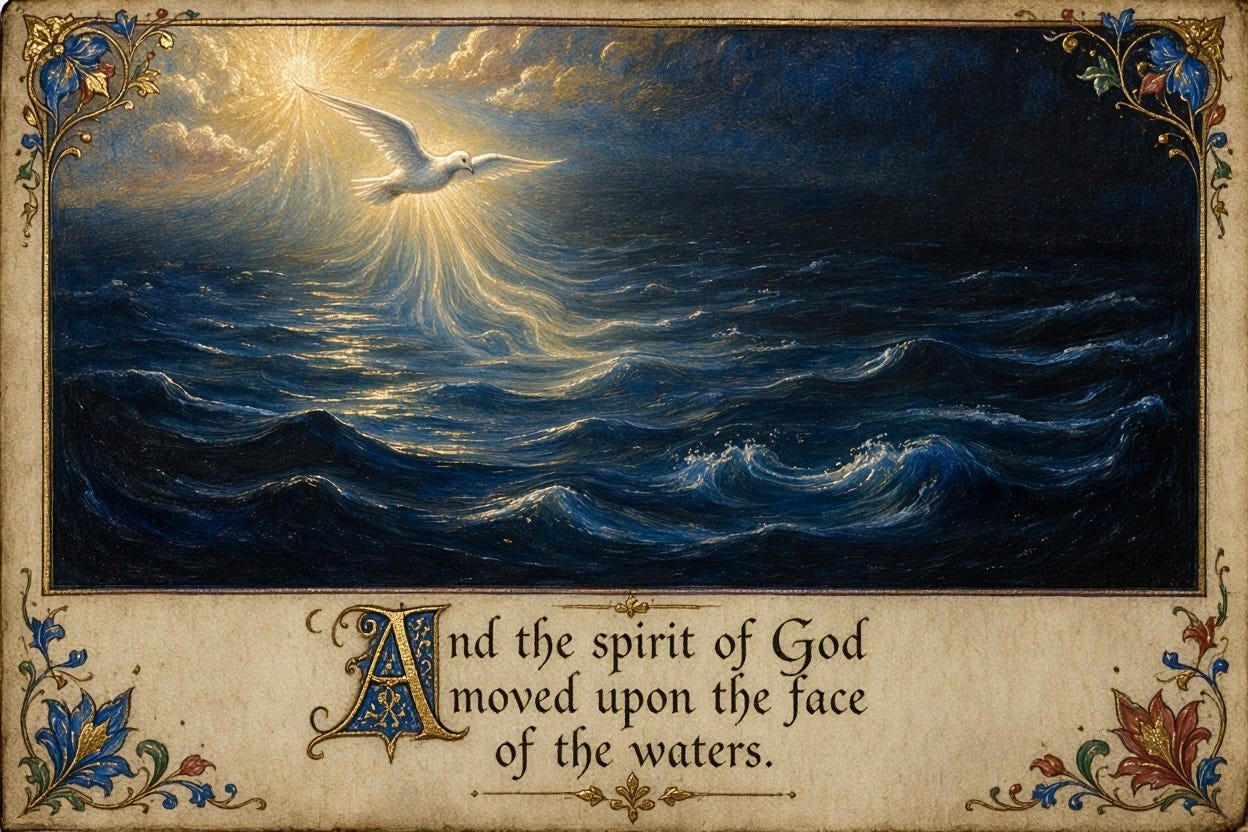
In I and Thou, Buber distinguishes between history and spirit, which amounts to a distinction between world history and biblical history. In developing this distinction, Buber twice cites the phrase that ends the Bible’s second verse, “rushing-spirit of God hovering over the face of the waters.”15 Buber associates the primeval “waters” with the economy and the state, two instruments of world history that tend to drive us from “true community” and our agency. God’s own agency and his dialogue, of course, don’t begin until the following verse (“Let there be light”), but the presence of God’s spirit as hope hovering over history seems to encourage God in his word and work.
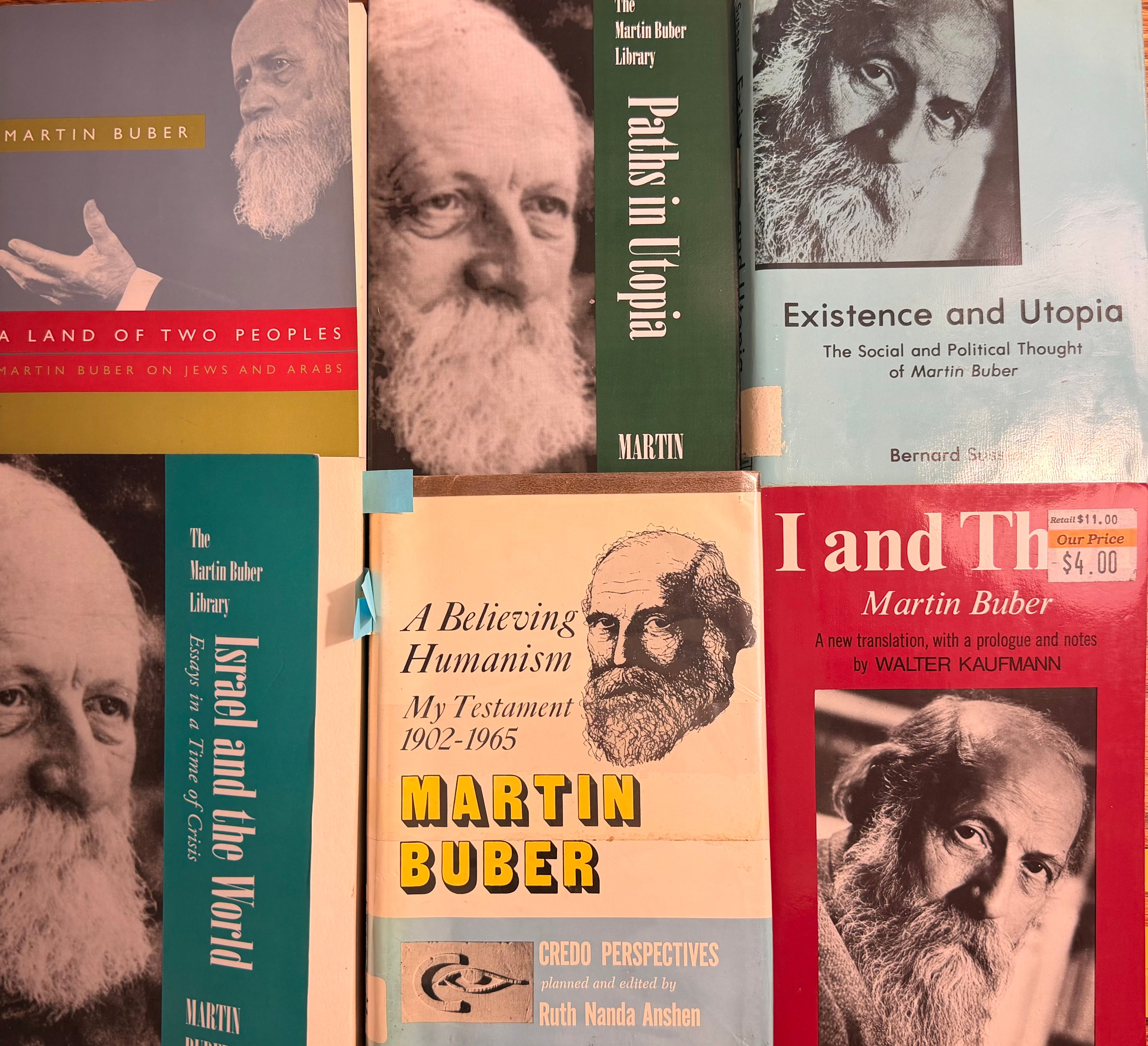
Above: a few of my Buber books. Pics of Buber online suggest that 20% were taken when he was around 20, and the remaining 80% when he was around 80.
I’ll first place this distinction between history and spirit, which develops in “Biblical Leadership” and in I and Thou’s second part, in the context of the book’s more well-known distinctions found in its first part. Most of these early distinctions concern the individual, but they apply also to communities and to humanity in general. As I and Thou says in a different context, “Thus the history of the individual, thus the history of the [human] race.”16
I and Thou’s opening makes one fundamental distinction, much as Genesis divides the light from the darkness, and it puts that distinction to work, much as Genesis divides the six days of creation with a chorus of “and the evening and the morning.” I and Thou starts by separating the world’s two “basic words,” I-You and I-It, each establishing “a mode of existence.”17 I and Thou then distinguishes our I-It experiences of learning about others and using others from our I-You encounters with others, in which (as I’ve mentioned) we become ourselves.
Genesis’s cool, orderly creation, in which the primeval waters are divided by God’s word to make way for dry land, contrasts with the Psalms’ more violent creation accounts. There, God’s dividing and stilling the chaotic waters are accompanied by his defeat of sea monsters.18 Likewise, I-It experiences may be attended with a variety of feelings, some of them strong. I-You encounters also may involve feelings, but these encounters are defined by love for the You. Love often involves feelings, but feelings don’t reach love’s essence: “Feelings dwell in man, but man dwells in his love.”19 I and Thou’s Genesis-like tone supports Buber’s emphasis on I-You encounters, an emphasis he makes because we moderns try to do without these encounters.
We can’t do without I-It experiences, Buber says, even though “Those who experience do not participate in the world.”20 In an experience, we treat people and things like objects. “Treating people like objects,” though, sounds worse than an I-It experience often is. The I-It experience comes down to some fundamental ways of thinking, few of them inherently unethical:
I perceive something. I feel something. I imagine something. I want something. I sense something. I think something.21
An I-You encounter doesn’t erase these experiences of I-It thinking. In an I-You encounter, “There is nothing that I must not see in order to see, and there is no knowledge that I must forget.”22 However, in an I-You encounter, “Before the immediacy of the relationship everything mediate becomes negligible.”23 Experience remains, but it fades from view. Experience becomes like a memory.
Experience is, after all, oriented in the past. “In other words,” Buber says,
insofar as a human being makes do with the things that he experiences and uses, he lives in the past, and his moment has no presence.24
An I-You encounter, though, is oriented in the present, a present that brings presence into being.25
History also is mediated and (of course) oriented in the past, but spirit is immediate—the present’s presence. But can anything fit into an immediacy? In an I-You encounter, spirit is the only thing between “I” and “You.”26 For Buber, this immediate-yet-between contradiction defines spirit: “Spirit in its human manifestation is man’s response to his You.” Spirit is concomitant with “I say You,” that dialogical aspect of an I-You encounter. Buber concentrates the point further: “Spirit is word,” he says,27 so when “I say You” with my whole being,28 I “live in the spirit.”29
By contrast, history—a person’s or the human race’s history—signifies “a progressive increase of the It-world.”30 History’s mindset crowds out a person’s or a society’s ability to recognize and value I-You encounters.
An individual or a society “imprisoned” in history has lost its agency; for them, “. . . causality holds unlimited sway.” With causality, “everything is linked invincibly with everything else, and there is nowhere a break where [someone] can take hold.”31 Causality therefore “grows into an oppressive and crushing doom,” making our individual or collective situations seem hopeless. By contrast, “Only those who know relation and who know the presence of the You have the capacity for decision.”32
Biblical decisions are never final, so a history modeled on biblical dialogue has no predetermined ending or outcome. To make this point, Buber distinguishes between the Bible’s prophetic and apocalyptic writings. Apocalyptic writers describe fixed endings, Buber says. But prophets speak into specific situations and always express or imply a choice. Jeremiah, for instance, demonstrates a “depth of dialogical reciprocity between heaven and earth”:
Thus we hear Jeremiah time after time speak to this people in the most direct manner when he delivers to them the concise saying of God: “Better your ways and your affairs and I shall allow you to dwell in this place.” But when those so appealed to persistently resist the call, he no longer proclaims the alternative but announces the approaching catastrophe as an unalterable doom. Yet even in this threat the gate of grace still remains open for man when he turns his whole being back to God. 33
Buber summarizes this back-and-forth dialogue between God and a people with “Who knows?” Buber likes the mystery and surprise embedded in the “Who knows?” of the prophet Joel as well as of Jonah’s audience, the king of Nineveh. Joel: “Who knows but He may turn and relent / And leave a blessing behind . . .”34 Nineveh’s king: “Who knows but that God may turn and relent? He may turn back from His wrath, so that we do not perish.”35
The Bible’s “Who knows?” suggests that the power to choose makes people “suited to be God’s partner in the dialogue of history.” That’s because “the unique being, man, is created to be a centre of surprise in creation.”36 This concept of humanity as the source of surprise is a good deal like Hannah Arendt’s concept of natality: each person is “a beginning and a beginner.” Arendt, whose language is usually far less religious than Buber’s, nevertheless prefers the word “miracle” to Buber’s “surprise” to describe the effect of a person’s public agency:
Hence it is not in the least superstitious, it is even a counsel of realism, to look for the unforeseeable and unpredictable, to be prepared for and to expect “miracles” in the political realm.37
For both Buber and Arendt, humanity is designed to interrupt “historical processes of stagnation [that] can last and creep on for centuries” (Arendt’s words).38 According to Buber, decisions and the dialogue that demands them make the present matter. The Bible’s dialogue suggests to Buber that the Bible’s approach to history is not oriented to a stagnated past but to the present, according to Yemima Hadad:
. . . it did not remain a magnificent story about a glorious and ideal past but, like all utopian views, sought actualization and fulfillment in the future or, to be precise, in the historical present.39
How does this “actualization and fulfillment” work in the “historical present”? A person “lives in the spirit,” Buber says, when they are “able to respond” to their You. Sadly, however, this needed response also tends to turn the You “into an object.” Perhaps the “object” is a history book or a Bible story. But spirit can break history’s spell and return the object to an I-You encounter:
Ever again—that was the intention in that hour of the spirit when it bestowed itself upon man and begot the response in him—the object shall catch fire and become present, returning to the element from which it issued, to be beheld and lived by men as present.40
Buber’s alternative understanding of history as the recurring “hour of the spirit” has its parallel in Walter Benjamin’s philosophy of history:
To articulate the past historically does not mean to recognize it “the way it really was” (Ranke). It means to seize hold of a memory as it flashes up at a moment of danger.41
Buber’s “catch fire” is much like Benjamin’s “flashes up,” and Buber’s “to be held and lived by men as present” is much like Benjamin’s “at a moment of danger.”
Both Buber and Benjamin find that the powerful are served by the fixed and predominant understanding of history. Benjamin sets this history in opposition to the “tradition of the oppressed.”42 Buber sets it in opposition to “the weak and the humble.” In the Bible, Buber says,
It is always the same story. The purpose of God is fulfilled, as the Bible itself says in one place, not by might, nor by power, but “by my spirit.”43
God gets across his will “again and again to changing generations, certainly but simply as reply to a question.” This continuing dialogue between God and people happens “in the freedom of His surging spirit, through every one whom His spirit seizes.”44
The spirit, which Buber also refers to as the anointing45 and ruach46 demands of those seized by it to acknowledge God’s sovereignty in specific situations. This demand causes those seized by the spirit to be drawn out of their community:
. . . it is the same story, whether it is a wandering over the earth like Abraham’s, or a becoming utterly alone in the midst of the people like the prophets’.47
The leader’s anointing, then, becomes the divide between a fixed history mediated by the powerful and a biblical understanding of history:
The history of the great religions, and in general all great history, is bound up with the problem: How do human beings stand the test of what is here called anointing?48
The leader’s “inner contradiction of human existence” from being drawn out of their community, and the leader’s failure to live up to the test of their anointing, ironically signal humanity’s eventual victory over history:
But this ever widening gulf between leader and community, the ever greater failure of the leader, the leader’s ever greater incompatibility with “history”—this means, from the biblical standpoint, the gradual overcoming of history.49
Buber’s great expression of this “overcoming of history” is messianism, which he defines as “the belief in the anointed king who realizes the promise of his anointing.”50 This messianic belief is dialogical: it is the belief “in the setting right of the dialogue, in God’s disappointment being at an end.”51
Leaders who fail to live up to God’s spirit that seizes them still serve as the foreshadowings of the Messiah, whom Buber calls “the dialogical man,” the person “who commits his whole being to God’s dialogue with the world, and who stands firm throughout this dialogue.”52
These leaders, drawn out of their community and its reliance on history, seek true community. And for Buber, Israel’s “wait for the Messiah is the wait for the true community”:
So long, therefore, as the kingdom of God has not come, Judaism will not recognize any man as the true Messiah, yet it will never cease to expect redemption to come from man, for it is man’s task to establish God’s power on earth.53
Buber’s generational, dialogical, and communal account of the messianic resembles Benjamin’s account. Benjamin also uses the concept of the messianic to describe our means of participating in the eventual overcoming of history:
Our coming was expected on earth. Like every generation that preceded us, we have been endowed with a weak Messianic power, a power to which the past has a claim. This claim cannot be settled cheaply.54
Buber would agree that we share in the Messiah’s power. For Buber, m essianism signifies
. . . not a community of detached spirits but a community of men, that is, a true community of true men; “a new heaven and a new earth” (Isaiah 65:17), but founded on the renewal of the human being.55
Buber would agree also that our anointing (or our “Messianic power”) doesn’t come cheaply. Holding ourselves open to dialogue involves "“the risk of giving oneself, of inner transformation.” Inner transformation means working in the given circumstance to surpass “one’s present factual constitution.” In the process, “. . . the customary soul enlarges and transfigures itself into the surprise soul.”56
Buber outlines two essential and opposing reactions someone might have to being “confronted by an hour which has a special and even an especially questionable connection with his personal future”:
The man I speak of can the next instant renounce the beaten track, draw forth forgotten primal forces from their hiding-places, and make the decision that answers the situation; he cherishes the until-now-unsuspected certainty of thus being able to participate on the ground of becoming, in the factual decision that will be made about the make-up of the next hour, and thereby in some measure also about the make-up of future hours. Or, in contrast, he may banish all such impulses and resolve, as one says, not to let himself be fooled—not by the situation, which is just an embroilment, and not by himself, who is just a man come to grief . . .57
Buber characterizes this decision as one between decision and no decision. He also puts the decision this way: “Do I dare the definitely impossible or do I adapt myself to the unavoidable?”58
Buber, Arendt, and Benjamin, all Jews, all left Nazi Germany. Benjamin didn’t make it to freedom. But reading their biographies, I’m struck by how Buber’s account of inner transformation applies to them all.
The Bible’s leaders, despite their failings, dared the “definitely impossible” in public life. The result was often, but not always, miraculous.
This essay provides a foundation for several other possible Martin Buber essays.
Martin Buber, I and Thou, 46. print., 1. Touchstone ed, trans. Walter Kaufmann, A Touchstone Book (Simon & Schuster, 1996), 60.
Buber, 69, 78.
Genesis 1:3 KJV.
Buber, 56.
Martin Buber, “Biblical Leadership,” in Israel and the World: Essays in a Time of Crisis, by Martin Buber, The Martin Buber Library (1928; 1st Syracuse University Press ed, Syracuse University Press, 1997), 132.
Buber, I and Thou, 62.
Hannah Arendt in 1935 recognizes that “. . . the demands of the ‘Thou’ of God toward the ‘I’ of man—to use Buber’s terminology—are found in Genesis and the Psalms, in the Prophets and the Book of Job.” Hannah Arendt, “A Guide for Youth: Martin Buber,” in The Jewish Writings, by Hannah Arendt (Schocken Books, 2007), 32.
Buber, “Biblical Leadership,” 125.
Buber, 119, 127.
Buber, 125.
Paul Mendes-Flohr, “The Kingdom of God. Martin Buber’s Critique of Messianic Politics,” Behemoth 1, no. 2 (2008): 26–38, accessed November 23, 2026, https://doi.org/10.1524/behe.2008.0013, 27n5.
Yemima Hadad points out that “Buber never made his philosophy of history explicit.”Yemima Hadad, “Martin Buber’s Dialogical History: Theopolitics as a Critique of the History of Human Power,” The Jewish Quarterly Review 113, no. 2 (2023): 249–72, 256.
Martin Buber, The Prophetic Faith, First Princeton University Press paperback edition (Princeton University Press, 2016), 191.
Buber, “Biblical Leadership,” 125.
Genesis 1:2 in Everett Fox, The Five Books of Moses: Genesis, Exodus, Leviticus, Numbers, Deuteronomy; a New Translation with Introductions, Commentary, and Notes, trans. Everett Fox (Schocken Books, 1995), 12; Buber, I and Thou, 97-98.
Buber, 82. See also Buber’s essay “Prophecy, Apocalyptic, and the Historical Hour” in which he makes the same equation: “As in the life of a single person, so also in the life of the human race . . .” Martin Buber, “Prophecy, Apocalyptic, and the Historical Hour,” in Pointing the Way: Collected Essays, by Martin Buber, trans. Maurice S. Friedman (1954; Harper Torchbooks, 1957), 206.
Buber, I and Thou, 53.
Psalm 74:13-17; Psalm 89:9-12.
Buber, 66.
Buber, 56.
Buber, 54.
Buber, 58.
Buber, 63.
Buber, 63-64.
Buber, 63.
“Spirit is not in the I but between I and You,” Buber says. Buber, 89.
Buber, 89. Buber may have picked up this equation from Jesus, whom Buber cites approvingly elsewhere. “. . . the words that I have spoken to you are spirit . . .” John 6:63 NNAS.
Buber, 62.
Buber, 89.
Buber, 87-88.
Buber, “Prophecy, Apocalyptic,” 192.
Buber, I and Thou, 100-101.
Buber, “Prophecy, Apocalyptic,” 192. See also Buber, Prophetic Faith, 129-131.
Joel 2:14, Adele Berlin and Marc Zvi Brettler, eds., The Jewish Study Bible: Jewish Publication Society Tanakh Translation, 2. ed (Oxford Univ. Press, 2014), 1159.
Jonah 3:9, Berlin and Brettler, Jewish Study Bible, 1191.
Buber, “Prophecy, Apocalyptic,” 197-98.
Hannah Arendt, Between Past and Future: Eight Exercises in Political Thought, Penguin Classics (Penguin Books, 2006), 169.
Arendt, 167.
Hadad, 249-50.
Buber, I and Thou, 89-90.
Walter Benjamin, “Theses on the Philosophy of History,” in Illuminations, by Walter Benjamin, ed. Hannah Arendt, trans. Harry Zohn (Schocken Books, 1986), 255.
Benjamin, 257.
Buber, “Biblical Leadership,” 124.
Martin Buber, Kingship of God, trans. Richard Scheimann (Harper Torchbooks, 1973), 119.
Buber, “Biblical Leadership,” 130.
Buber, Kingship of God, 160-61.
Buber, “Biblical Leadership,” 132-33.
Buber, 130.
Buber, 133.
Buber, 130.
Buber, 131.
Buber, 131-32.
Martin Buber, “The Holy Way: A Word to the Jews and to the Nations,” in On Judaism, by Martin Buber (Schocken Books, 1996), 130-31.
Benjamin, 254. Italics in the original.
Buber, “Holy Way,” 139.
Buber, “Prophecy, Apocalyptic,” 206.
Buber, 192.
Buber, 193.
A hearty welcome back Bryce. Great choice of reading therapy. I can't help but see the parallel with the concept of xenia, as I've learned it the watching of The Odyssey. Xenia, the law of Zeus, the relation of the host and guest, and much more, seeing in the stranger the potential of a god. It seems very I and Thou to me. Having never read The Odyssey I must now. Buber will be a guide. Again, welcome back.