


The Bible’s story of the Tower of Babel is, among other things, a critique of ancient building materials. Canaanites, and the Israelites with them, build with stones, but the Mesopotamians, who share the ancient Near East with the Canaanites and Israelites, build with bricks.
The story of the tower, scholars now understand, describes a Babylonian ziggurat,1 a terraced, brick temple in the service of Babylon’s gods. Genesis presents the temple-tower “as an imperial embodiment of pride and self-sufficiency,” theologian Walter Brueggemann says.2 The bricks stand out in the story’s confused and rough language used to describe the city’s and the tower’s building process. One literal translation, Hebraist Robert Alter says, is “Come, let us brick bricks and burn for a burning”—language that Alter suggests is as fractured in the original Hebrew as it is in modern English.3 Genesis further emphasizes the builders’ material by contrasting it with biblical building norms: “And they used brick for stone, and they used tar for mortar.”4
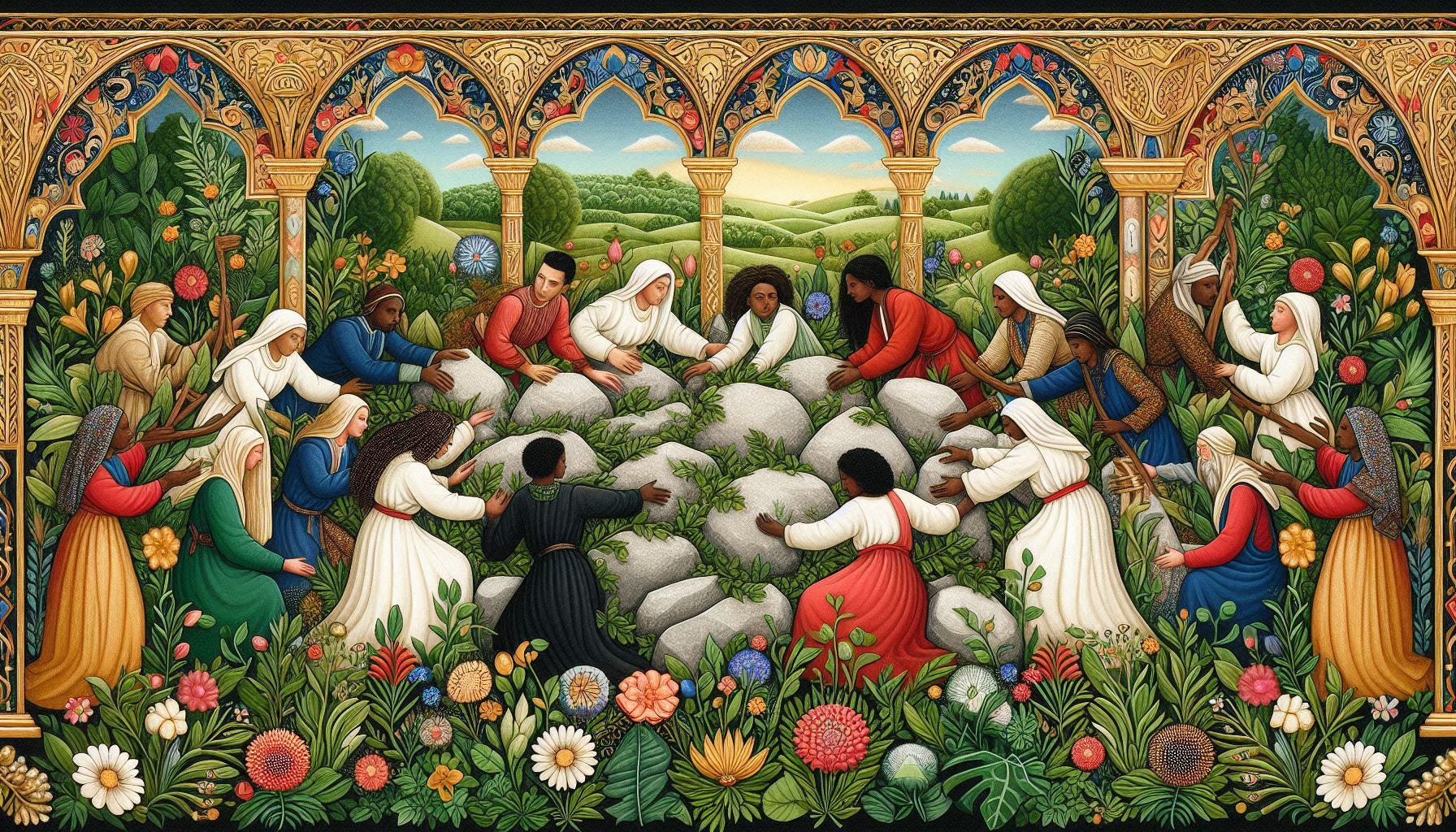
Bricks are fired, but stones are found. Bricks are uniform, but stones are unique. The bricks described in the Tower of Babel story were made uniform and strong, historians of the period tell us, by a violent and homogenizing process of molding clay that has been mixed with “sand, water, mud, and organic material, husks or straw” and of firing this mixture in a kiln.5
The Torah impliedly contrasts Babylon’s incoherent brickmaking with what Alter calls “the language of stones.”6 Jacob, for example, uses a stone to demarcate a pact and a border between him and his father-in-law Laban. God commemorates his covenant with Israel by giving Moses two stone tablets with the Ten Commandments “written with the finger of God.”7 Stones are later prescribed: when Israel wishes to make God an altar, Exodus tells us, the alter must be of stones.8
This stone-language speaks of a more indigenous politics. The Hopi and Maori peoples share a “story of four sacred stone tablets that contained their laws for living and their prophecies,” according to Unangan Kuuyux Ilarion Merculieff.9 When indigenous peoples start communities, they often connect with their land by way of identifying—and identifying with—a foundational rock.10
Israel, surrounded by some of the world’s first civilizations, struggles in the Bible’s pages to keep its connection with something more permanent than civilization and empires.11 Genesis gets it, referring to God as “the Stone of Israel”12 and to a single stone as God’s house.13 But the struggles return in the prophets. Soon after Assyria takes Israel captive, the prophet Isaiah refers to God as “a stone to strike and a rock to stumble over”—God as an offense to Israel. Isaiah also refers to a future “just, firm-founded city” (Alter’s words)14 in the language of stones: “I lay in Zion for a foundation a stone, a tried stone, a precious corner stone, a sure foundation: he that believeth shall not make haste.”15
The Bible’s bricks and stones, then, suggest two ways of building communities.

The Tower story’s account of languages and scattered peoples draws comparisons with the New Testament’s day of Pentecost. In Genesis, God famously confuses the language of the tower’s builders. Unable to communicate with one another, Babel’s occupants scatter over the face of the earth. In Acts, though, the Jewish diaspora comes together from many nations in Jerusalem to celebrate an ancient feast.
In a sense, Pentecost is Babel in reverse. The Spirit speaks to the people of each nationality in its own tongue, but the various tongues don’t divide the nations the way God earlier divides and scatters the speakers and nations in Genesis. Instead, the Spirit unifies the diaspora while honoring their differences. The diaspora describes Pentecost’s miracle in the language of unity and diversity: “. . . all of us hear them telling in our own tongues the great things God has done.”16
While telling the story of Babel in reverse, then, the story of Pentecost doesn’t seek to re-establish a pre-Babel world in which everyone speaks one language. Instead, the disciples’ miraculous communication with these dispersed peoples in their own languages leaves intact those languages and the peoples and cultures those languages represent. This unity-in-plurality, theologian Michael Welker argues, constitutes the political meaning of Pentecost:
The point of the Pentecostal experience and of the outpouring of the Spirit is not the unintelligibility of glossolalia but instead a miraculous intelligibility. Without dissolving or suspending the different languages, the different loyalties and historical customs, a differentiated, differentiation-protecting experience of community is established.17
Like the Spirit, Peter on Pentecost also protects the nascent community’s plurality, but he does so by citing the prophet Joel, who foresees the Spirit’s outpouring on women as well as men, on young as well as old, on slaves as well as free. Welker finds in Joel’s prophecy a promise that “takes a giant step beyond all concepts of community which stop with sameness (where a specific group may dictate just how unity and equality are going to be provided).”18 Welker pictures the politics of Pentecost: community isn’t built by uniformity.
By contrast, as Luke was writing Acts, the Roman Empire was uniting the world by conquering it, uprooting and enslaving the world’s peoples, and gradually offering citizenship to these newly uniform slaves stripped of the context of their families, clans, tribes, tongues, and lands. This violent process blurred the division between Romans and outsiders, according to historian Mary Beard,19 so making peace—or at least establishing the Pax Romana. That kind of peace earns Rome a role as Revelation’s Babylon.20
Unlike the Pax Romana, God’s peaceable kingdom doesn’t destroy plurality. It never turns the lions into lambs. Instead, it causes the lion and the lamb to lie down together.21 Reverting to the language of stones, we may say that God never forms and fires us into uniform bricks. We stay stones, the “living stones” of the “spiritual house” Peter describes,22 vibrant in all of our plurality, as the Spirit builds us into a community.

Despite the striking contrasts between Pentecost and Babel, Pentecost isn’t Babel’s chief biblical foil. That honor belongs to New Jerusalem. The city of New Jerusalem in the Bible’s last book replaces Babel’s abandoned city and tower in the Bible’s first book.
Like Luke on Pentecost, John’s vision of New Jerusalem seems to tell the Tower of Babel in reverse. The two cities, for instance, move in opposite directions. Babel’s tower was to rise “with its top in the heavens,”23 while John sees New Jerusalem “coming down out of heaven from God.”24 The horizontal movements are different, too: Babylon’s movement is centrifugal, but New Jerusalem’s movement is centripetal. Babylon’s efforts to unite humanity in empire results in scattering (“the Lord scattered people over the face of the earth”),25 but people from every nation will gather in New Jerusalem and walk in the city’s light.26 Here’s another contrast: Babylon was to have a permanent temple—the Tower of Babel—but New Jerusalem has no temple because “its temple was the sovereign Lord God and the Lamb.”27
The greatest contrast between the two cities, though, brings us back to building materials. Revelation tells us that, instead of Babel’s brick, “the foundations of [New Jerusalem’s] city wall were adorned with precious stones of every kind . . .”28 We are the precious stones of New Jerusalem, a city introduced to John as “the bride, the wife of the Lamb.”29 As the stones in the city’s walls, we are God’s city, God’s community.
Paul contrasts precious stones with the stuff of bricks when he tells the Corinthians how to build their common life around Jesus, the cornerstone of God’s flesh-and-blood habitation:30
If anyone builds on that foundation with gold, silver, and precious stones, or with wood, hay, and straw, the work that each does will at last be brought to light; the day of judgement will expose it.31
Hay and straw make bricks, representing the forced conformity of mass culture and empire. The twelve distinct and precious stones found in New Jerusalem (e.g., chalcedony, sardonyx and chrysoprase, my personal favorites) suggest another form of unity, one that celebrates the gifts, points of view, and personages of each member.32
Exodus gives us an engineering lesson similar to Paul’s. In building God’s altar, the stones used must not be hewn, “for your sword you would brandish over it and profane it.”33 This translation by Alter is a departure: most English translations render the Hebrew word for Alter’s “sword” as “tool” because the verse employs the object to cut stone. But Alter insists that the word “patently means ‘sword.’” The Hebrew word for sword, he says, is “pointedly used because of its association with killing.”34 Violence and conformity, the tools of empire, never build God’s communities.
Discussion questions
What are the most important differences between bricks and stones in this devotion—or in your way of thinking?
What parallels or contrasts do you find in Genesis’s account of the Tower of Babel and Acts’s account of Pentecost?
What does Messiah require or expect of the nations he comes to free? How much, if any, of the nations’ culture would he change? Do you agree with Michael Welker about the political meaning of the Pentecost account in Acts?
What would it be like to encounter a spiritual home that honors the peoples’ “different languages, the different loyalties and historical customs”? How would such a home foster such cultures?
Is it possible for a political community to be founded and built without violence?
The short footnotes below refer to the full citations in the earlier manuscript’s and this Substack’s bibliography.
Cassuto, Commentary on Genesis, Part 2, 227-29.
Brueggemann, Genesis, 98. Theologian Richard A. Horsely similarly summarizes what the tower symbolizes: “the rise of an arrogant imperial civilization in Mesopotamia . . . that is condemned to destruction and dispersal.” Horsley, You Shall Not Bow, 174. N. T. Wright also understands the story as a critique of empire. Wright, Paul and the Faithfulness (Pts. 3 & 4), 740.
Alter, Hebrew Bible, Vol. 1, 38n3.
Genesis 11:3 NNAS.
Pavlic, “The History of Bricks.”
Alter, 117n45.
Exodus 31:18 KJV.
Exodus 20:25.
Jamail, “Ilarion Merculieff (Unangan),” 38.
Quinault Indian Nation President Fawn Sharp refers to this use of rocks: “ . . . when the Earth suffers, we suffer. In contrast, if someone moves to another area, there’s no foundational rock or any sort of connection to it that they value and appreciate. So when we see the climate crisis, there is a sense of responsibility, and an inherent quality of feeling a deep sense of responsibility to seven generations out.” Jamail, “President Fawn Sharp (Quinault),” 13-14.
Professor Moshe David Cassuto surmises that the sources for the Bible’s account of the Tower were written after the destruction of Babylon by the Hittites. Part of the account’s evident satire involves the Babylonians’ wish to establish a permanent city as part of its empire. Cassuto, Commentary on Genesis, Part 2, 229-30.
Genesis 49:24 NNAS.
Genesis 28:22.
Alter, Hebrew Bible, Vol. 2, 710n16.
Isaiah 28:16 KJV.
Acts 2:11 REB.
Welker, “Also upon the Menservants,” 60.
Welker, 59.
Beard, SPQR, 199.
Revelation’s Babylon is a not-entirely hidden critique of the Roman Empire. See gen. Horsley, You Shall Not Bow, 204-9; Bretherton, Christ and the Common Life, 243.
Isaiah 11:6; 65:25.
1 Peter 2:5 NNAS.
Genesis 11:4 REB.
Revelation 21:10 REB.
Genesis 11:9 REB.
Revelation 21:24.
Revelation 21:22 REB.
Revelation 21:19 REB.
Revelation 21:9-10 REB.
Ephesians 2:19-22.
1 Corinthians 3:12-13 REB. Many Christians apply these two verses about building materials as guidance for their individual lives. The verses’ context, though, is Paul’s instruction concerning the Corinthians’ common life. 1 Corinthians 3:1-21.
Paul says much the same thing later in 1 Corinthians but in a corporeal rather than a building metaphor: “The body is not a single organ but many.” 1 Corinthians 12:14 REB.
Exodus 20:25-26, translated by Robert Alter. Alter, Hebrew Bible, Vol. 1, 299.
Alter, Hebrew Bible, vol. 1, 299.
Cort, these are wonderful associations. Stones as witnesses -- as hearers and as ways of knowing. Thanks.
Installed in sidewalks with brass plates, commemorating holocaust victims throughout Europe.
• LEED building standards. Incorporating new materials and engineering in construction of buildings literally to save the planet.
Corner stones of a practice and epistemology.