


Binding and loosing seems an unpromising subject for our theopolitical imagination.1 The field is crowded. All kinds of theologians gravitate to Jesus’ abstraction here in Matthew 18:
Truly I say to you, whatever you bind on earth shall have been bound in heaven; and whatever you loose on earth shall have been loosed in heaven.2
Theologians gravitate also to the same language in Matthew 16, which applies to Peter instead of to Jesus’ entire community.3
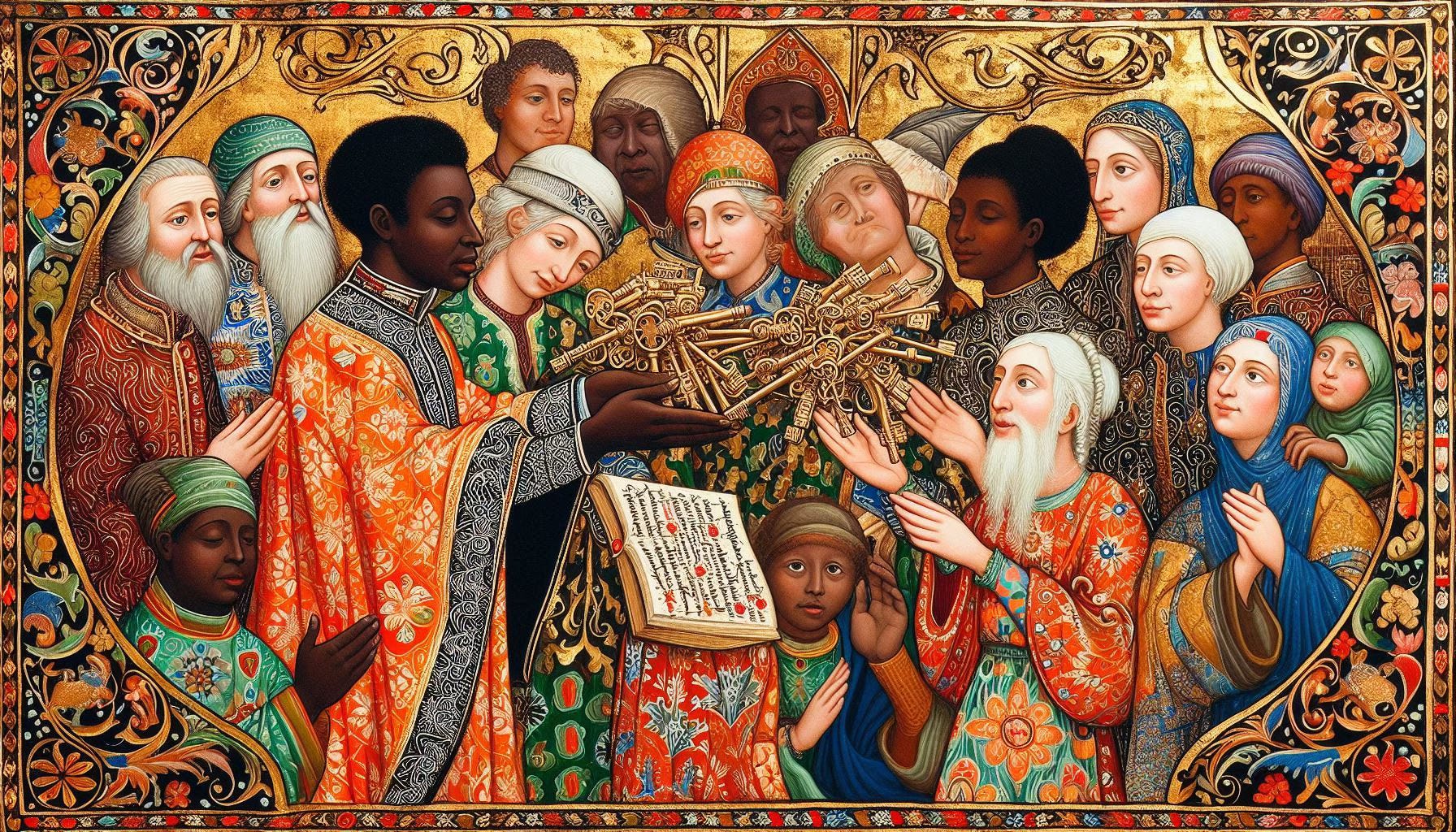
Outside of these two verses, the meaning of binding and loosing in the New Testament is not particularly abstract or debatable. In the 41 other uses of “bind” (δέω, or deō) and the 40 other uses of “loose” (λύω, or lyō), the context leaves little doubt about what the words mean. The meanings for each word, though, differ depending on how they’re employed. The semantic range of “bind” (deō) stretches from the binding of prisoners and of Satan to the binding in covenant.4 The semantic range of “loose” (lyō) stretches from forgiving debt to delivering from bondage to destroying something.5
These different meanings give us a lot to work with when we return to Matthew 18:18, the catalyst of this devotion. The meanings suggest that one or more of them might fit each of our verse’s more open-ended “whatever you bind” and “whatever you loose” categories. But which, and what to make of the results?
The various meanings cause theologians to draw various conclusions about the verse as a whole. Do “whatever you bind” and “whatever you loose” refer to the apostles’ power to excommunicate? Do they echo the disciples’ authority, found in John’s Gospel, to forgive or retain sins? Do they refer to the binding of demons and the freeing of people possessed by them? Do they institute the Roman Catholic Church?6
Or whether you believe or don’t believe they do any or all of the above, could “bind” and “loose” also reconstitute what we call political theology? Despite the crowds of theologians surrounding Matthew 18:18, this possibility is worth expending some theopolitical imagination.
And more importantly—and for those of us with only a small stake in the interdisciplinary field known as political theology—could “bind” and “loose” help us restore the public realm?
I think so, with help from rabbinic teaching, from Matthew 18:18’s context, and from Jewish political theorist Hannah Arendt.
Let’s start with the most prevalent current view of “whatever you bind” and “whatever you loose”: Jesus, consistent with (arguably) contemporary rabbinic teaching, is referring to his disciples’ “halakhic authority”—that is, to their authority to decide how, if at all, a given mitzvah (command) applies to a given situation:
In this practice of halakhic binding and loosing, rabbis uphold the law as eternal and universal but recognize that new contexts require new decisions about how to bind or loose particular behaviors.7
This kind of binding and loosing is necessary. Of course, it can also get pretty punctilious. KindaLee Pfremmer DeLong provides an example:
. . . certain rabbis allow a hot bath on Sabbath but “bind” washing and “loose” sweating. In other words, if a person soaks in a warm bath on Sabbath, scrubbing is considered work—a violation of the divine command to honor the Sabbath—but sweating is not.8
Jesus, of course, isn’t exactly known for engaging in punctilio, and it’s not likely that his enigmatic statement pertains merely to authorizing his disciples’ engagement in it. But Jesus is, on perhaps a deeper level, asking his disciples to work out communal norms, which is a form of binding and an aspect of covenant. In the New Testament, after all, binding in covenant is a frequent meaning of deō.
Another source of finding how “bind” and “loose” work in Matthew 18:18 is the verse’s fuller, political context.9 Though the verse makes “bind” and “loose” into abstractions, Jesus places his abstracting remark itself in a concrete communal context.
Jesus’ binding and loosing remark comes just before and after he speaks about covenanting and forgiving in community life. Right before the remark, he speaks about the number of witnesses necessary for the assembly to hear and adjudicate about someone’s sins. Implicit in this context is both covenant, present in the assembly’s formation, and forgiveness, which the assembly is ready and willing to offer.10 Then, right after the binding and loosing remark, Jesus speaks of two or three that “agree on earth”—that covenant, or that act under their preexisting covenant—will have their request granted “from my Father in the heavens.”11
Then Jesus returns to forgiveness. Jesus answers Peter’s question about how many times he must forgive his brother.12 This conversation about forgiveness leads DeLong and others to conclude that “loosing” in verse 18 also includes forgiveness.13 In the conversation, Peter seems to be asking for, and receiving, clarification about loosing, part of what two chapters earlier in Matthew were seemingly his exclusive rights as the person holding “the keys of the kingdom of heaven.”14 But here in chapter 18, Jesus implies that we all have the keys of the kingdom—the authority to bind and loose, to covenant and to forgive.
Jesus’ “whatever you bind” refers to covenanting. Jesus’ “whatever you loose” refers to forgiveness. These phrases surely refer to other things as well. The verse invites us to explore layers of meaning.
But could Jesus be presenting covenant and forgiveness to humankind as keys to a public realm he calls the kingdom of God?
If so, may we accept these keys? May we, in the first place, engage our theopolitical imaginations when reading the Bible? And may we, in this particular act of imagination, read the Bible to find guidance on and inspiration for political and community life? Arendt bemoans how Jesus’ sayings, many of which “sprang from experiences in the small and closely knit community of his followers” and constitute challenges to his community’s political authorities, “have been neglected because of their allegedly exclusively religious nature.”15 Consistent with Arendt’s observation, our modern understanding of religion as separate from politics makes many of us relegate the stretch of Matthew 18 in question here, including our enigmatic verse 18, entirely to theology and its subset ecclesiology—to “church life” and “church government.”
But as Arendt seems to have intuited, Jesus’ assemblies—the one he started and the ones later started by the likes of Peter, James, and Paul—are at once political and religious communities. They offer public freedom and an alternative to the larger political and religious community known as the Roman Empire.
After the Roman Empire collapsed, some political thinkers came close to returning to this fuller understanding of Jesus’ ancient communities. In late medieval and modern times, political theorists and movements have accessed both the Hebrew Bible and the New Testament to explore new means of conducting civic life together. The early-modern republicans, for instance, studied the Bible for over a century and discovered a model republic there. Both Walter Brueggemann and Nicholas Wolterstorff use the Hebrew Bible and the New Testament to flesh out political concepts involving covenant, justice, and mercy.16
Carl Schmitt, the Nazi political theorist credited with inspiring our new interdisciplinary field of political theology, is only one of the recent influential thinkers to at least partially ground their political theory in the Bible’s pages.
Arendt, who escaped the Nazis’ grasp twice, is another. She suggests that Abraham discovers the power inherent in covenant. With her tongue perhaps only partially lodged in her cheek, Arendt offers this summary of Abraham’s wanderings:
. . . [Abraham’s] whole story, as the Bible tells it, shows such a passionate drive toward making covenants that it is as though he departed from his country for no other reason than to try out the power of mutual promise in the wilderness of the world, until eventually God himself agreed to make a Covenant with him.17
Likewise, Arendt credits Jesus with discovering “the role of forgiveness in the realm of human affairs.”18 She points out that Jesus’ miracle of healing a paralyzed man was proof that “the Son of man hath power upon earth to forgive sins.”19 This power to forgive is “upon earth,” Arendt emphasizes, and “must be mobilized by men toward each other before they can hope to be forgiven by God also.”20
Just as Jesus links binding and loosing to covenanting and forgiving, so also Arendt links covenanting and forgiving to each other. To be clear, Arendt, as far as I know, never references Jesus’ remarks about binding and loosing. But her insights into Abraham and Jesus as fellow political thinkers serve as lenses we might use to understand Jesus’ remarks about binding and loosing in this more theopolitical light.
Arendt views both covenanting and forgiving from the standpoint of action, the “sharing of words and deeds.” Action is vital to Arendt’s concept of public spaces: action “not only has the most intimate relationship to the public part of the world common to us all, but is the one activity which constitutes it.”21 For Arendt, covenanting and forgiving aren’t merely instances of the Bible teaching us about elements of healthy political life together. For her, on these two faculties—covenanting and forgiving—hang all that is necessary to protect us from the potential harmful consequences of our public action:
The two faculties [of covenant and forgiveness] belong together in so far as one of them, forgiveness, serves to undo the deeds of the past, whose “sins” hang like Damocles’ sword over every new generation; and the other, binding oneself through promises, serves to set up in the ocean of uncertainty, which the future is by definition, islands of security without which not even continuity, let alone durability of any kind, would be possible in the relationships between men.22
Unpredictability and irreversibility, Arendt argues, are the strengths but also the burdens of action.23 Enter covenants and forgiveness. Covenants counter unpredictability, and forgiveness counters irreversibility.
For Arendt, forgiveness doesn’t erase the past so much as it redeems it: the community learns from its mistakes and moves into the present together. Likewise, covenant doesn’t fear the future but stabilizes it through a chosen public kinship. Redeeming the past and covenanting the future allow the seeds of public speech and action to germinate in the present.
Arendt claims that action has ontological roots, and her claim reinforces the ontological earth-and-heaven language that Jesus employs in Matthew 18. By describing action as “ontologically rooted,” Arendt means that our very being—and our being together—ground our public freedom:
The miracle that saves the world . . . is, in other words, the birth of new men and the new beginning, the action they are capable of by virtue of being born. Only the full experience of this capacity can bestow upon human affairs faith and hope . . . It is this faith in and hope for the world that found perhaps its most glorious and most succinct expression in the few words with which the Gospels announced their “glad tidings”: “A child has been born unto us.”24
In this public world of speech and action, she says, the relevant aspects of morality must arise from this ontology. Only two forms of morality do this, Arendt says: covenanting and forgiving:
[Public morality needs] no more to support itself than the good will to counter the enormous risks of action by readiness to forgive and to be forgiven, to make promises and to keep them.25
Arendt insists that Jesus preaches not behavior, strictly speaking, but action.26 In this regard, Jesus’ binding and loosing set out a morality of action that allows his communities to create a future and redeem the past in order to make his community’s political and religious action possible in the present.
Compare this Abraham/Jesus/Arendt ontology with that of Schmitt, known as the founder of political theology.27 Schmitt famously defines the sovereign as “he who decides on the exception.”28 With Schmitt, the possibility of an exception—an emergency decree—becomes “a general concept in the theory of the state,” setting aside covenant even before an emergency arises. Schmitt argues that the exception is analogous to a biblical miracle, presumably because a miracle constitutes an exception to the general course of nature. This “miracle” of the exception makes the sovereign analogous to the omnipotent God. Compare Schmitt’s association of miracles with tyranny to Jesus’ association of miracles with forgiveness, or compare it to Arendt’s association of miracles with natality. Arendt’s natality gives humankind its ontological standing to overturn the kind of oppressive structures that Schmitt’s theory champions.
In Jesus’ terms, Schmitt sets aside binding in covenant and absolutizes loosing—not the loosing of forgiveness but the loosing of destruction. Time under Schmitt’s political theology isn’t hopeful and redemptive, as it is with Jesus’s binding and loosing, but becomes a pathological form of an earthly eternity, without past or future.
Jesus’ binding and loosing, when cross-pollenated with Arendt’s twin faculties of covenant and forgiveness, offers an ontological foundation for political theology and public life that would set aside Schmitt’s theoretical, if not historical, claim to the same.
The first action Jesus preaches is to repent and believe the gospel of God’s realm.29 Surely part of that repentance is to re-adopt the good will “to forgive and to be forgiven, to make promises and to keep them,”30 and to find ourselves in political communities small enough to make forgiveness and covenant lived encounters with other people.
The short footnotes below refer to the full citations in the earlier manuscript’s and this Substack’s bibliography.
William T. Cavanaugh develops his concept of theopolitical imagination in his book Theopolitical Imagination.
Matthew 18:18 NNAS.
Matthew 16:19.
Examples of “bind” (deō) for the binding of prisoners and of Satan: Matthew 14:3, Matthew 27:2, Acts 21:11, and Revelation 20:2. Examples of “bind” (deō) for the binding in covenant: Romans 7:2, 1 Corinthians 7:27, and 1 Corinthians 7:39.
Example of “loose” (lyō) for forgiving debt: Matthew 18:27. Example of “loose” (lyō) for the delivering from bondage: Luke 13:10-17. Example of “loose” (lyō) for destroying something: 1 John 3:8.
Richard H. Hiers, “‘Binding’ and ‘Loosing’: The Matthean Authorizations,” Journal of Biblical Literature 104, no. 2 (1985): 233-250, accessed March 4, 2026, https://doi.org/10.2307/3260965, 233-36; Barber, “Jesus as the Davidic Temple Builder and Peter’s Priestly Role in Matthew 16:16-19,” Journal of Biblical Literature 132, no. 4 (2013): 935–53, accessed March 4, 2026, https://doi.org/10.2307/42912475; KindaLee Pfremmer DeLong, “Matthew 16.19: Binding and Loosing in the Church Today,” sec. 8, Leaven 19, no. 2 (2011), accessed March 4, 2026, https://digitalcommons.pepperdine.edu/cgi/viewcontent.cgi?article=1119&context=leaven,
DeLong, 93. Italics in the original.
DeLong, 92-93.
DeLong emphasizes the verse’s context, noting that “Since Matthew 18.18 (which matches 16.19 exactly) appears in the midst of instruction about how to interact with a wayward community member, it offers a good contextual reason to view binding and loosing as referring not to halakhah but rather to accountability.” DeLong, 96.
Matthew 18:15-17.
Matthew 18:19, Hart, New Testament, 36.
Matthew 18:21-35. It occurs to me that Peter approaches Jesus as one would a rabbi whom the community has vested with halakhic authority. By responding that Peter should forgive a brother 490 times (seventy times seven), Jesus “binds” not always forgiving. Or you might say that he binds any failure to loose.
DeLong, 96.
Matthew 16:19.
Arendt, Human Condition, 238-39.
See, for instance, Brueggemann, God, Neighbor, Empire and Nicholas Wolterstorff, Justice: Rights and Wrongs (Princeton University Press, 2008).
Arendt, 243-44.
Arendt, 238-39.
Arendt, 239n77.
Arendt, 239. Cf. Matthew 18:32-35.
Arendt, 198.
Arendt, 236-37. Cf. Walter Brueggemann, who speaks of “the routines of forgiveness that make public life possible.” Brueggemann, 23.
Arendt, 237, 233.
Arendt, 247.
Arendt, 245.
Arendt, 318.
Schmitt’s claim to founding political theology is based on his other famous theory that “All significant concepts of the modern theory of the state are secularized concepts . . .” Carl Schmitt, Political Theology: Four Chapters on the Concept of Sovereignty, University of Chicago Press ed (University of Chicago Press, 2005), 36. This theory is itself only partly original: he argued for a structural homology between present political and past theological concepts. But the part of his theory that makes him the father of political theology is his claim to have discovered the theological roots of political concepts, something republican and proto-liberal theorists before Baruch Spinoza had been doing for a long time.
Schmitt, 5.
Mark 1:15.
Arendt, 245.
Bryce, I really appreciate two things about your approach. First, your interpretation of “binding and loosing” as covenant and forgiveness, considered together with Arendt’s ideas of promise and pardon, puts the passage clearly in the context of public life. Second, your comparison with Schmitt is timely. A politics built on promise and forgiveness offers a strong alternative to sovereignty defined by the exception. This is helpful—thank you.