


Political violence, Hannah Arendt might say, is in one sense an oxymoron. A country’s use of violence against its citizens threatens its political places, places that institutionalize the public space between us where we speak and act. The objective of such violence—a police state—represents the victory of violence over the political places and the public spaces they protect.1
While a nation-state doesn’t constitute what Arendt describes as a political place, a properly functioning nation-state may contain such places.
ICE’s recent killings of two citizens in Minneapolis, the circumstances of which the federal government is attempting to distort,2 threaten the United States’ political structure as a nation-state. The killings represent the clearest evidence to date that the federal government intends to encourage ICE’s violence against United States citizens and operate ICE as a police force answerable to no court.
Arendt died in 1975, long before ICE was established and long before the present administration encouraged ICE’s agents to act without appropriate restraint in its community sweeps and in its on-the-street patrols. But she scrutinized and critiqued uncannily similar European police forces working to deport stateless people3 during the Interwar Period. She concluded that these police forces undermined the nation-states in which they operated, first by compromising the nation-states’ rule of law.
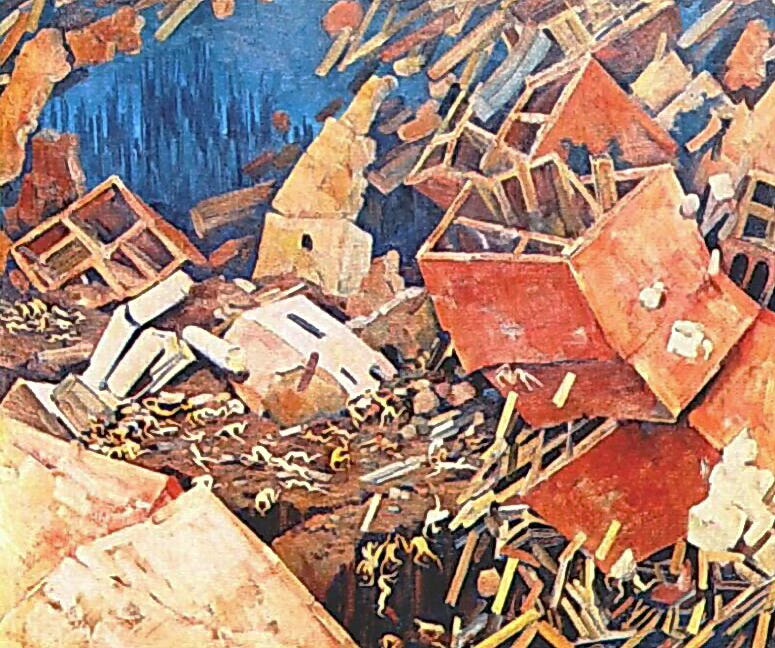
Above: Konstantin Yuon, The Symphony of Action (1922). Public domain.
According to Arendt in her 1951 book The Origins of Totalitarianism, police deporting stateless people from European nations before World War II helped to undermine the rule of law in those nations in four ways:
1. The police charged with arresting and deporting immigrants began to rule directly over the populations:
This was the first time the police in Western Europe had received authority to act on its own, to rule directly over people; in one sphere of public life it was no longer an instrument to carry out and enforce the law, but had become a ruling authority independent of government and ministries.4
Over the past year, the United States has seen ICE transform into a law-enforcement agency with little effective government oversight.5 It has broadened its scope by arresting and detaining over 170 U.S. citizens.6
2. The stateless people were put in internment camps, where they had far fewer rights than if they were incarcerated in a normal jail or penitentiary:
The same man who was in jail yesterday because of his mere presence in this world, who had no rights whatever and lived under threat of deportation, or who was dispatched without sentence and without trial to some kind of internment because he had tried to work and make a living, may become almost a full-fledged citizen because of a little theft. Even if he is penniless he can now get a lawyer, complain about his jailers, and he will be listened to respectfully. He is no longer the scum of the earth but important enough to be informed of all the details of the law under which he will be tried. He has become a respectable person.7
America has established such camps. Many people detained in these camps were arrested by ICE agents while pursuing a change in immigration status in courts. Despite a federal statute requiring immigration jails to allow members of Congress access to the facilities unannounced, the administration currently refuses to permit such visits. Previous visits by members of Congress and testimony by people incarcerated in these jails suggest widespread overcrowding, malnourishment, and physical abuse in several of these jails.8
3. The police in these countries became used to cooperating with their counterparts in Nazi Germany, so when the Nazis conquered their countries, the countries’ police were willing accomplices to Nazi rule there:
That the Nazis eventually met with so disgracefully little resistance from the police in the countries they occupied, and that they were able to organize terror as much as they did with the assistance of these local police forces, was due at least in part to the powerful position which the police had achieved over the years in their unrestricted and arbitrary domination of stateless and refugees.9
4. Because the police in Eastern European countries effectively weren’t answerable to courts on deportation matters, those countries’ populations grew accustomed to a state not bound by the rule of law. As a result, the countries gave in more to the temptation of police rule over its citizens:
The clearer the proof of their [the states’] inability to treat stateless people as legal persons and the greater the extension of arbitrary rule by police decree, the more difficult it is for states to resist the temptation to deprive all citizens of legal status and rule them with an omnipotent police.10
Making legal distinctions among classes of people, Arendt suggests, is a nation-state’s kryptonite. When the nation-state turns to nationalism and takes away the rights of minorities and stateless people, the state built around that nation can no longer effectively exercise its core mission of providing equality before the law. When this happens, the nation swallows the state, and the country is no longer, strictly speaking, a nation-state:
Without this legal equality, which originally was destined to replace the older laws and orders of the feudal society, the nation dissolves into an anarchic mass of over- and underprivileged individuals. Laws that are not equal for all revert to rights and privileges, something contradictory to the very nature of nation-states.11
In America, such a “mass of over- and underprivileged individuals” seems have started by terrorizing the aliens in our midst and incarcerating many of them, some in prisons outside the United States and outside the aliens’ countries of origin. But it hasn’t stopped there. The administration recently announced that federal funding will end this month for sanctuary cities and states, even though city and state policies of non-cooperation with ICE are legal.12
We Christians are exiles, a political status we hold for the healing of the nations. If we deny our political calling and, as citizens of a nation-state, countenance the persecution of our fellow exiles, we’ll lose the country we think we serve.
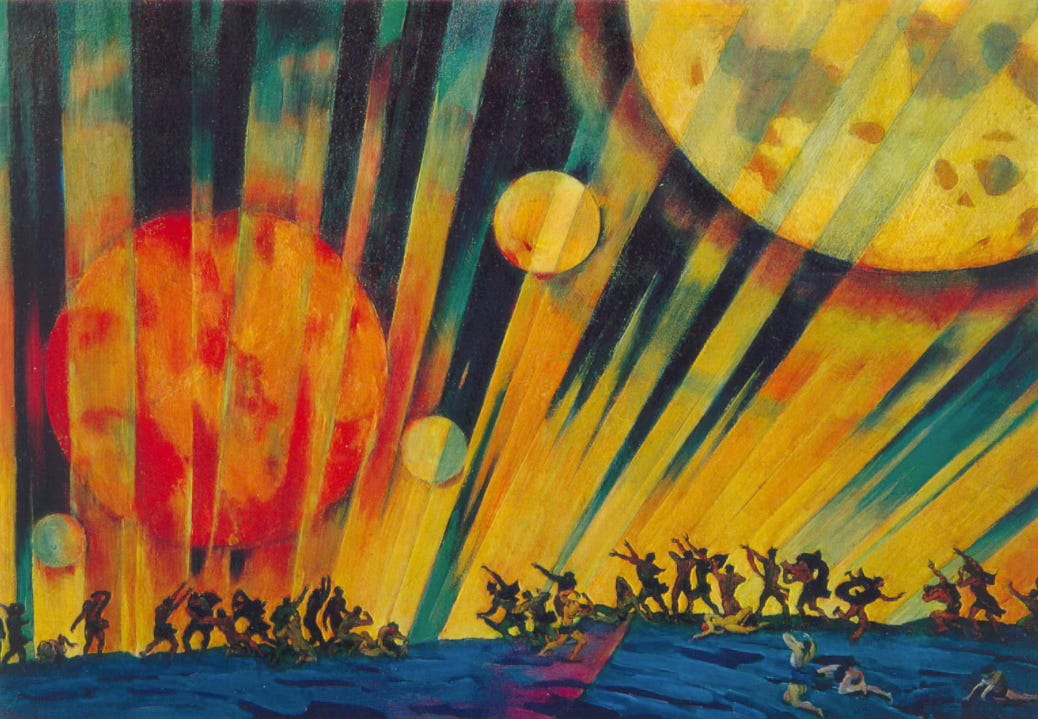
Above: Konstantin Yuon, The New Planet (1921). Public domain. The short footnotes below refer to the full citations in the earlier manuscript’s and this Substack’s bibliography.
See gen. Arendt, Human Condition, 192-207. Here’s the clearest distinction I’ve discovered in Arendt’s writings between public space and political place: “This public space does not become political until it is secured within a city, is bound, that is, to a concrete place that itself survives both those memorable deeds and the names of the memorable men who performed them and thus can pass them on to posterity over generations. This city, which offers a permanent abode for mortal men and their transient deeds and words, is the polis . . .” Arendt, Promise of Politics, 123.
Ang Li et al., “Video Analysis of ICE Shooting Sheds Light on Contested Moments,” The New York Times, January 15, 2026, accessed January 26, 2026 [Gift article]; Brenna T. Smith et al., “Videos Contradict U.S. Account of Minneapolis Shooting by Federal Agents,” The Wall Street Journal, January 24, 2026, accessed January 26, 2026 [Gift article]; Hanna Rosin, “Another Death in Minneapolis,” The Atlantic, The Atlantic Monthly Group, January 25, 2026, accessed January 26, 2026.
Arendt insists on describing a person as stateless if the person’s country of origin “either refuses to recognize the prospective repatriate as a citizen, or, on the contrary, urgently wants him back for punishment.” Hannah Arendt, The Origins of Totalitarianism, A Harvest Book (Harcourt Brace Jovanovich, 1994), 280.
Arendt, 287.
José Olivares and Will Craft, “Revealed: ICE Violates Its Own Policy by Holding People in Secretive Rooms for Days or Weeks,” US News, The Guardian, October 30, 2025, accessed January 26, 2026.
Nicole Foy and Sarahbeth Maney, “More Than 170 U.S. Citizens Have Been Held by Immigration Agents. They’ve Been Kicked, Dragged and Detained for Days.,” ProPublica, October 16, 2025, accessed January 26, 2026.
Arendt, 286.
Isaac Chotiner, “How Donald Trump Has Transformed ICE,” The New Yorker, January 14, 2026, accessed January 26, 2026.
Arendt, 290.
Arendt, 290.
Arendt, 290.
Cheyanne M. Daniels, “White House to End Funding to Sanctuary Cities and States on Feb. 1,” Politico, January 13, 2026.
Doing your homework. Nicely done, Bryce. Arendt is so on point on policing. Lynching, that unique American voice in a chorus of violence, has now been introduced. Though it’s a straight line, from Emmett Till to Ahmaud Arbery to Alex Pretti. Colonization practice come home, Césaire’s boomerang.
I appreciate the use of Arendt to test claims about force, law, and rule. Without anachronism, the post links ICE practice to patterns she traced. The turn to exile names a duty that can’t hide behind slogans or party talk (OR, I would add: the new separatism of evangelical moralism: e.g., the Benedict Option). - Thanks for this timely post!