


In September 1983, long before this century’s flash mobs, the body of Christ suddenly appeared in Santiago before a clandestine prison full of other missing bodies. It unfurled a banner: A MAN IS BEING TORTURED HERE.
The body of Christ blocked traffic. It “read a litany of regime abuses, handed out leaflets signed ‘Movement against Torture,’ and sang,” according to William T. Cavanaugh in Torture and Eucharist, his 1998 book analyzing the church’s responses to the Pinochet regime. That day, twenty-four of the seventy nuns, priests, and laypersons who constituted the body of Christ were arrested.1

Above: “Disappear” by annalisa ceolin. Used by permission.
Two months later, the regime disappeared two children. Their father, in an act of protest and despondency, set himself on fire at the foot of a cathedral’s outdoor cross, confessing his sin to a priest who was drawn to the flames. The Movement against Torture, first seen exposing the prison, took on the parent’s name, becoming the Sebastián Acevedo Movement against Torture.
The movement grew to include more people than just Christians, and it was considered secular—that is, not an official part of the Chilean Catholic church. More sitings of this augmented body of Christ, sometimes involving close to 150 people, followed its initial prison appearance. Each of the body’s appearances, Cavanaugh says, was liturgical:
Until the Movement began, public denunciation of torture had been carried on primarily at the level of words and in doomed judicial proceedings. What was so different and disruptive about the Sebastián Acevedo Movement was its sense of liturgy . . .”2
In liturgy, symbolism matters, and “locations were chosen for their symbolic importance”—locations like courts, media centers, and more clandestine prisons. Also liturgical were the movement’s activities. Members might sing or they might read or recite a litany of the injustices surrounding a particular person’s disappearance.

Above: A stumbling sticker, designed by Sushmita Mazumdar, on an Arlington County, Virginia sidewalk indicating where ICE abducted an Arlington resident.
How have churches in the United States responded to their neighbors’ removals, and in some cases, enforced disappearance, refoulement, and subjection to state-sponsored violence in third countries?3
One church in Arlington, Virginia, recently participated in street liturgies on spots where masked ICE agents had abducted seven of its neighbors.
Arlington Presbyterian Church’s pastor, Ashley Goff, worked on the idea with an Arlington artist, Sushmita Mazumdar. Mazumdar and Goff drew on their past attendance at the installation of some of Arlington’s stumbling stones, small plaques honoring African Americans who had been enslaved where the plaques had been installed.
Arlington’s stumbling-stone initiative, in turn, was inspired by Germany’s Stolpersteine, or “stumbling stones,” small plaques installed in front of over 70,000 Holocaust victims’ last-known residences.
Mazumdar designed stumbling stickers commemorating Arlington’s disappeared neighbors, and Goff wrote the brief ceremony for placing the stickers on or near the spots where Arlington neighbors were seen being disappeared or last seen before they were disappeared.
Excerpts from my interview of Suzi Wackerbarth,4 a member of Arlington Presbyterian Church who attended one of the ceremonies, suggest the ceremonies’ mix of prepared text and participant interaction:
The “stumbling” in stumbling stones implies a pedestrian’s initial physical interaction with the stones, which have offended far-right sensibilities here and in Germany. Gunter Demnig, the artist who creates the plaques in Germany, explains the “stumbling” reference: “You won’t fall. But if you stumble and look, you must bow down with your head and your heart.”5 This posture of curiosity and reverence applies to Arlington’s stumbling stickers, too.
The “stumbling” also suggests Isaiah’s “. . . he shall be . . .for a stone of stumbling and for a rock of offense,” the prophet’s metaphor of a stone just below our line of sight that trips us.6 Isaiah’s rock of offense is often associated in Christian teachings with the Psalmist’s “stone which the builders refused” that becomes “the head stone of the corner,” or the “chief cornerstone.”7
Arlington’s stumbling stones keep us from forgetting the past. And Arlington’s stumbling stickers keep us from ignoring the present. Part of Goff’s liturgy makes this clear in the ceremony performed at the spot of each abduction:
A person was taken. A family was harmed. Neighbors faced fear.
We mark this place in mourning and protest – so this story is not erased. So ICE does not get the last word.
Arlington’s stumbling stones and stumbling stickers, as well as the ceremonies installing them, give public witness to the justice promised in the Hebrew and Christian scriptures for those marginalized, imprisoned, or killed by the powerful or by the rich.
Power and wealth have gradually affected our culture’s receptivity to liturgy. The influential liturgical scholar Aidan Kavanagh complains that liturgy today, “hemmed in by state sacrality on one side and bourgeois profanity on the other, . . . attracts few and generates obsessive neuroses even among these.”8 Why not, then, let liturgy spill over into the streets, as it used to?9 Let it trip up and offend what Kavanagh here identifies as the worship of the nation-state and the concomitant and profane privacy of the bourgeois.
Street liturgy as some citizens of Arlington practice it not only helps to keep us from forgetting our disappeared neighbors. It also helps to keep us from disappearing from public space and from permitting rulers to dominate there instead. So by participating in street liturgy, we renew our public lives together as stumbling stones, as rocks of offense.

Above: “Venice disappear” by by annalisa ceolin. Used by permission.
The appearances of Christ’s body in Santiago were always quick, lasting usually “no more than five or ten minutes,” Cavanaugh says.10 They were even quicker if the police arrested the body’s members before they disappeared into the crowds or the street traffic.
But before the movement began, the body of Christ had been slow. Its first public appearance in front of the clandestine prison came a full decade after Pinochet’s CIA-supported coup. By 1983, most of the regime’s 3,216 murders and enforced disappearances had already happened.11 Church leaders and other members had done a lot of brave things, but they usually acted individually and through channels that the state had allowed to remain open for individuals or leaders to communicate with the regime.
The reason for the slowness? The body of Christ in Chile had not come to terms with who it was. Put in more academic language, it had to unlearn “a set of ecclesiological presuppositions firmly engrained in the Chilean Catholic church,” Cavanaugh says.12
Starting in the 1930s, due to the spread of Catholic Action, the encyclicals of Pope Pius XI, and the writings of French Catholic philosopher Jacques Maritain, the Chilean church had come to understand itself as what it called a mystical body. Cavanaugh summarizes this self-understanding:
The Kingdom hovers above history, entering it only in the soul. Christians enter the temporal world as individuals; the church does not act as a body in the temporal realm. The church does not have a political body but only a religious body, a mystical body, which unites all Christians above the rough and tumble of the temporal.13
During the early years of Pinochet’s regime, the church therefore worked for “a mystical communion of Chileans above the party political fray,” a goal that coincided with the regime’s own goal—a united, depoliticized Chile. Consequently,
. . . the church’s stress on subsuming conflict into the organic unit of Chile had the effect of causing the church to identify its own interests with those of the nation-state.14
In fact, the church’s “. . . bishops assumed that the church and state stood in organic relationship as the twin guardians of the Chilean national heritage. The bishops assumed the imagination of the nation-state . . .”15 The church in Chile saw the junta as the nation-state’s body and itself as its soul.16 It fell into line with the nation-state imaginary.
This imaginary leads to rationalizations about disappearance and torture. “Torture isn’t everything,” one Chilean bishop argued, reasoning that focusing on the regime’s excesses would detract from its “accomplishments in achieving order.”17 One major 1975 statement by Chilean bishops claimed that “Jesus was a patriot.” Had Jesus lived in Chile, the statement reads, he would have been “one hundred percent Chilean . . . an authentic son of our people and our land.”18
But “the pedagogy of terror,” Cavanaugh writes, began to teach the Chilean church “how to be oppressed and thus become incarnate in opposition to the state.”
As long as the church limits itself to the care of people’s souls and supports the state’s claimed authority over people’s bodies, it submits to the nation-state imaginary and to the disappearance of itself “as a visible, social body.”19
But the Bible teaches that soul and body can’t be placed under separate sovereignties. The body is a “temple of the Holy Spirit” and belongs to God.20 Disappearance and torture contest God’s claim to bodies.
Disappearance isn’t just an attempt by the state to enforce its imaginary territorial boundaries against immigration, which according to the Torah, is bad enough.21 It’s also an attempt to control its population from both a juridical and a psychological perspective.
From a juridical perspective, disappearances accustom a state’s population to the state’s claims that even within its borders, it may act lawlessly. The state starts its descent from the rule of law by asserting sovereignty over people who the state claims have no rights. Hannah Arendt describes this tactic as the first step to totalitarianism:
The first essential step on the road to total domination is to kill the juridical person in man. This was done . . . by putting certain categories of people outside the protection of the law and forcing at the same time, through the instrument of denationalization, the nontotalitarian world into recognition of lawlessness . . .22
Many American Christians are taken in by this nation-state imaginary. They reason that, while the Bible specifically commands us to treat aliens as we would natural-born citizens,23 the logic of the nation-state trumps the Bible. “Face it: we live in a nation,” many Christians reason. “Fundamental to its sovereignty is the enforcement of its borders against undesirable immigrants.” But Jesus’ crucifixion and resurrection demonstrate that only God is sovereign. In addition, the example of my ancestors and those of many others—people who came to America without the original inhabitants’ permission—should also make us question the nation-state’s logic from the perspective of both history and hypocrisy.
Once the state’s lawless conduct to a segment of its population is accepted, more segments become unprotected by law, as Arendt points out.24 One better understands German Christians singing in church as the gas chambers killed their Jewish neighbors.
Beyond its deleterious effects on a polity’s expectation of justice and the rule of law, disappearance by the state is a form of psychological control, and not just of those who are disappeared, as Cavanaugh explains:
The very occult nature of disappearance—the way it obfuscates knowledge of what is really going on—augments the fear and anxiety which separates people from each other. Disappearance works to discipline the family and friends of the victim. The relatives of disappeared persons, with no body to prove what has happened, live in a limbo world between fantasy and reality. On the one hand, to believe that the person is still alive is to prolong visions of torment to which the victim has undoubtedly been subjected. . . .
On the other hand, to decide to assume the disappeared person is dead is, in effect, to kill him in one’s own mind. In the face of official denials, the death becomes the family’s own invention. The dilemma is exceedingly cruel. It disturbs the normal processes of grief and mourning, and it often succeeds in buying the silence of the victim’s family and friends. Unable to know the whereabouts of the victim and thus unable to give up hope, hope is controlled for the regime’s purposes, as the relatives cooperate with the authorities for fear that their actions could bring reprisals on their loved ones.25
Kashmir mothers and wives protesting the enforced disappearances by the Indian government, however, treat their missing sons and husbands as if they were dead—in part because they almost certainly are. In monthly protests, the Association of Parents of Disappeared Persons (APDP) often practices what anthropology professor Ather Zia calls “affective politics,” which is “a ritualistic public mourning, marked alternately by funereal silence and lamentation for the disappeared men.”26
By identifying themselves as mourners, these Muslim women create a culturally acceptable way of appearing in public spaces traditionally filled by only men. Their lamentation also “becomes part of the counterspectacle to the spectacle of enforced disappearances.”27
While Zia focuses on protest in terms of spectacle and counterspectacle, Cavanaugh focuses on protest in terms of liturgy and anti-liturgy. Cavanaugh understands disappearings and torture as a form of “perverse liturgy”:
Torture is liturgy—or, perhaps better said, “anti-liturgy”—because it involves bodies and bodily movements in an enacted drama which both makes real the power of the state and constitutes an act of worship of that mysterious power. It is essential to this ritual enactment that it not be public . . .28
But the imaginary of the Eucharist is different from the nation-state imaginary of disappearance and torture. The ritual of the Eucharist is public, not private. It involves a body’s appearance—the appearance of the body of Christ—not its disappearance. This is true even though “Christianity itself is founded in a disappearance,” as Cavanaugh points out in his book’s last paragraph:
The tomb is empty, the body is gone. At Emmaus (Luke 24:13-35), Jesus blesses bread, breaks it, and gives it to His companions, but then vanishes from their sight. And yet the disappearance is not the last word.29
Disappearance is not the last word. This is the message of the street liturgies performed by Kashmir’s APDP and by Chile’s Sebastián Acevedo Movement against Torture. It’s also the message of the simple street liturgy performed recently at seven spots in Arlington where neighbors had been disappeared.
There will come a day. And as Paul never tires of reminding us, the presence of Christ’s body demonstrates that the day has also come.

Any appropriate and effective street liturgy for the disappeared will be influenced by a host of factors. The legality and social acceptance of protest, for instance, differed in Chile, Kashmir, and Arlington. The relationship of the protestors to the disappeared—fellow citizens in Chile, husbands and sons in Kashmir, and neighbors in Arlington—also differed. The culture’s religious dynamics and the protesters’ religious backgrounds and affiliations, of course, also matter a great deal.
But here’s a working model. It’s inspired by Imagining Argentina, a novel about Argentina’s 1970s-era disappearings. In it, after Carlos Rueda’s wife is disappeared, he gains powers of imagination to see into the struggles and sometimes the fates of many of those that Argentina’s regime disappeared from Buenos Aires. In one scene, Carlos is tempted while swimming to accept the generals’ narrative and to surrender to the current’s downward pull. But he realizes then that his death would also kill his wife, wherever she is. That’s because, at that point in the novel’s more faithful narrative, she was alive only in his imagination.
Imagining Argentina isn’t a “Christian” novel. But it speaks to the power of our collective imagination to involve ourselves in “casting down imaginations, and every high thing that exalteth itself against the knowledge of God,”30 including the imaginaries of nation-states.
This liturgy is written mostly in a Christian idiom because I’m immersed in that tradition. You might revise it for your own tradition, circumstances, and proposed action. I hope the occasion of revising it will lead to some fruitful discussion and action.
We come today to grieve,
to protest, and to demonstrate
the kingdom of God together.
The rulers of darkness
and their human clients31
have disappeared our neighbor[s]
[name the name or names].
[Sing a song together]
If you know our missing neighbors,
please share something about them
if you’d like to.
[Space for sharing]
We’ll be silent for a minute
and pray for our missing neighbors
and for their families and friends
and neighbors who love them.
[Silence and individual prayer]
If you’d like to, please lead us
in a prayer for our disappeared
neighbors and for our community.
[Space for public prayer]
We are here to stand and walk
in the public world we imagine,
a world in which neighbors
appear in public together
to care for one another
and for the earth.
We imagine a people who love
the immigrants among them,32 a people
who don’t disappear into their homes
when their neighbors disappear
from their own homes.
We also acknowledge and decry
the injustice of disappearings
and the harm they do
to our neighbors and to our community.
Sometimes we fear the worst
for our neighbors and for our community.
But we say that the worst
isn’t the first or the last.
So we climb the mountain together
where Moses and Elijah
—those who disappeared—
conferred with him who would
also disappear from a tomb.33
We stand together in that place
of death and disappearance where
Mary’s first question to Jesus
was “Where have you taken him?”
and where Jesus’ response
was “Mary.”34
So we say our missing
neighbors’ names again, too.
[name the name or names].
We may not know
where our neighbors are
or how they fare
or what is happening to them,
but you know them, Lord,
and their names remain on our lips.
Their lives stay here in our hearts.
We cry out, Lord, for your mercy.
We cry out for justice for our
neighbors. And as part of that justice,
we pledge to support our neighbors
who remain and whose lives
have been disrupted by disappearings
or by the threat of being taken.
[Network and organize
to help our community.]
Besides protest and public liturgy, we have many other nonviolent ways to support our neighbors threatened by the prospect of deportation or of being disappeared (or both). I’ve volunteered for the Tennessee Immigrant and Refugee Rights Coalition. Your state may have a comparable organization. Court watching is also supportive, and the Public Spaces podcast will have an episode on this soon.
Amica Center for Immigrant Rights (amicacenter.org) organizes visits to jails, staffs a detention hotline, and provides interpreters for the preparation of court cases. They also need help with letter writing, research, and transcription.
In Northern Virginia, La ColectiVA (lacolectiva.org), “an inclusive collaborative led by gentle Latinx who are committed to upholding social justice and equity,” organizes the community to, among other things, discourage ICE activities in Arlington and improve conditions at the ICE detention center in Farmville, Virginia.
Chicago is now the focus ICE arrests, and community members there have developed many nonviolent methods for supporting one another. Charlotte and Raleigh, too, have responded with creativity to recent ICE violence and disappearings.
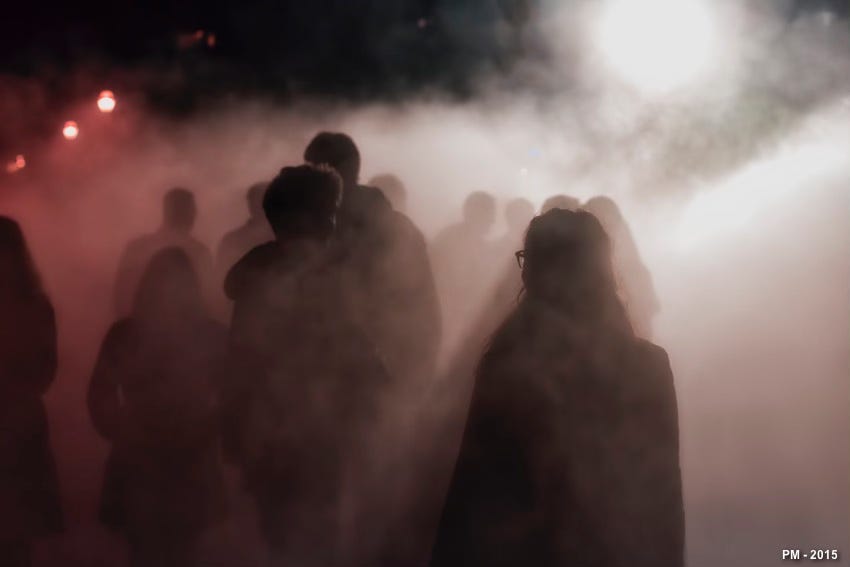
Above: “ghosts” by Patrick Marioné. Used by permission. The short footnotes below refer to the full citations in the earlier manuscript’s and this Substack’s bibliography.
William T. Cavanaugh, Torture and Eucharist: Theology, Politics, and the Body of Christ, Repr, Challenges in Contemporary Theology (Blackwell Publishing, 2009), 273.
Cavanaugh, 274-75.
See also the November 8, 2025 New York Times article “‘You Are All Terrorists’: Four Months in a Salvadorian Prison” as well as the United Nations Facts Sheet on enforced disappearances. The current national administration has made four significant shifts from the last previous administration’s policies. First, much immigration enforcement has shifted from those just entering the country to those who have put down roots in the country. Second, the current administration “has deemed millions of noncitizens subject to mandatory detention, bypassing the longstanding practice in prior administrations of allowing most people identified for removal to remain free or on alternatives to detention while their case proceeds in immigration court.” Most people (71%) detained by ICE this year have no criminal record. Muzaffar Chishti and Valerie Lacarte, “U.S. Immigrant Detention Grows to Record Heights under Trump Administration,” Migration Policy Institute, October 29, 2025. Third, the current administration has flown immigrants to third-party countries against their will and against court orders preventing the government from taking such measures. Fourth, the current administration has ignored “one of the most basic and sacrosanct concepts in both U.S. and international law: non-refoulement. This principle means that no nation should intentionally deport or expel people to a place where they are likely to face torture, persecution, death, or other grave harms.” Sarah Stillman, “Disappeared to a Foreign Prison,” The New Yorker, November 24, 2025.
Here’s a link to Suzi Wackerbarth’s earlier interview on NBC News 4 Washington.
Eliza Apperly, “The Holocaust Memorial of 70,000 Stones,” BBC, March 29, 2019, https://www.bbc.com/travel/article/20190328-the-holocaust-memorial-of-70000-stones.
Isaiah 8:14-15 KJV.
Psalm 118:22 KJV and NNAS. The Jewish Study Bible notes that this segment of Psalm 118 amounts to a “metaphor of reversal of expectations.” 1401n22. The writer of 1 Peter joins these two stones and claims that they both speak of Jesus. The church, he says, is a spiritual house made up of us, living stones, joined to Jesus, who from the “stone which the builders refused” became the house’s chief cornerstone. Like Jesus, the spiritual house progresses from invisibility to irritation and rejection and finally to honor.
Aidan Kavanagh, On Liturgical Theology, Repr., The Hale Memorial Lectures of Seabury-Western Theological Seminary 1981 (Pueblo Publ. Co, 1992), 171.
Kavanagh, 107.
Cavanaugh, 275.
“50 Years on from the 11 September Coup in Chile,” Amnesty International, September 8, 2023, https://www.amnesty.org/en/latest/news/2023/09/chile-50-years-coup-historical-memory/; Cavanaugh, 73.
Cavanaugh, 73.
Cavanaugh, 79.
Cavanaugh, 85-93.
Cavanaugh, 74.
Cavanaugh, 85-86.
Cavanaugh, 93-94.
Cavanaugh, 98.
Cavanaugh, 74.
1 Corinthians 6:18-19. See also 6:13-15; Romans 6:12-13; 2 Corinthians 4:10.
“When an alien resides with you in your land, you must not oppress him. He is to be treated as a native born among you. Love him as yourself, because you were aliens in Egypt. I am the Lord your God.” Leviticus 19:33-34 REB.
Hannah Arendt, The Origins of Totalitarianism, A Harvest Book (Harcourt Brace Jovanovich, 1994), 447.
Leviticus 19:33-34.
In fact, the U.S. president has stated that he hopes to send U.S. citizens to prisons in a foreign country, a patently illegal act.
Cavanaugh, 52-53.
Ather Zia, Resisting Disappearance: Military Occupation and Women’s Activism in Kashmir, First edition, Decolonizing Feminisms (University of Washington Press, 2019), 6, 66-69, 212-13.
Zia, 68-69. Zia’s understanding of protest as counterspectacle against the spectacle of disappearance finds its echo in Goff’s stumbling sticker service: “We place this sticker not for spectacle, not to identify a home, but to say: This happened here.”
Cavanaugh, 3.
Cavanaugh, 281.
2 Corinthians 10:5 KJV. On the understanding of the nation-state as a modern-day principality and power referred to in Paul’s letter, see William Stringfellow, An Ethic for Christians and Other Aliens in a Strange Land, 2004 ed (Wipf & Stock, 2004).
N.T. Wright points out that the principalities and powers referred to in Paul’s letters involve both spiritual forces and human rulers. Wright, Paul and the faithfulness (Pts. 3 & 4), 1286.
Leviticus 19:34.
Luke 9:28-36.
John 20:14-17.
What stays with me is your insistence that liturgy is not expression but interruption—embodied, brief, and risky. The Chilean case shows how long it took the Church to unlearn the nation-state’s script, which makes the Arlington and Kashmir examples feel earned rather than borrowed. What you’re tracing is a discipline: learning again how bodies appear in public when disappearance is the strategy. - Thanks for another thoughtful post, Bryce.
As I wrote to several friends with whom I've shared this, I was moved by this post and it has made me think a good deal. Of particular importance to us now, I think,, is your comment about the way Christian groups have often allowed a division between "soul" and "body," ceding authority over the body to the nation-state. Not only does this make us complicit, it perverts our understanding of who we are as Christians and human beings. We certainly see this in the ways MAGA "Christians" now define their religion, but everyone who acquiesces and does nothing is failing to act on their baptismal vows and on their calling. My recent trip to Europe underscored this, where there is such a long history of abuse and distortion of the Gospel by the Church and the clergy (some, not all by any means), and at the same time, martyr-saints revered in every city and village for their refusal to deny Christ. I don't know if this hypocrisy can ever be overcome now, but if it is, the challenge will probably come from the grassroots up, and street liturgy is one step in that direction. Thank you for writing this piece.