


My first dialogue! We find ourselves at Vanderbilt University’s Neely Auditorium a week before the opening of Albert Camus’s The Stranger. The students discuss hypocrisy from the standpoint of their concentrations: Phil (philosophy), Divya (divinity), and Acton (theater).1
Acton: This used to be the school chapel.
Phil: Walking in, I thought it was a cathedral.2
Divya: Making a chapel a theatre isn’t such a big transformation. Take out the communion rail, put up a raised stage.
Acton: No raised stage here, though, unless we want a traditional proscenium. We can also make a theater in the round like last spring. We use movable seating risers to design different spaces and involve the audience more.
Phil: Woah, Transformers’ alt-mode! But it’s all the same, right? No matter how you manipulate it, the stage is the stage, and the audience remains spectators.
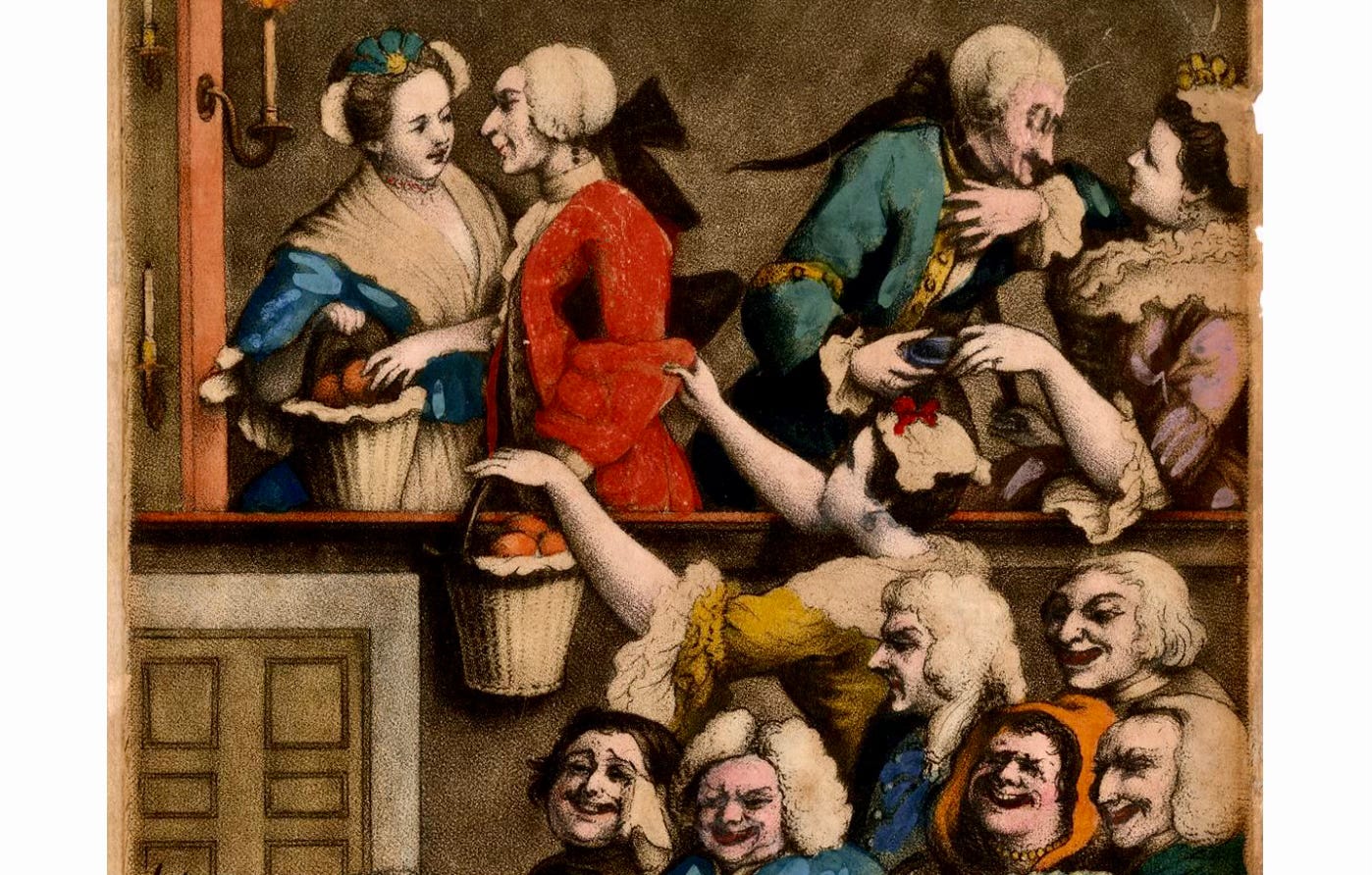
Above: Detail of The Laughing Audience (1733) by William Hogarth.

Acton: You’re saying the fourth wall stands.
Phil: Sure, the fourth wall. Sounds untouchable, like the third rail.
Acton: Pretty much. Diderot came up with it. Aren’t you a philosophy major?
Phil: I read a dialogue Diderot wrote about the theater, but it didn’t mention any wall.3 Are you going back to the house anytime soon?
Acton: I’ll probably be here all night. Remember last fall’s show?
Divya: What’s the fourth wall?
Phil: I thought The Stranger was a novel.
Acton and Divya: It is.
Divya: But Acton’s troupe is transforming it into a play. So what’s the fourth wall?
Acton: Diderot says actors should imagine a wall between them and the audience. Eliminating audience distraction would allow players to concentrate on acting well.4
Phil: Acting well is also the point of Diderot’s dialogue. Two guys argue over whether actors should get emotional or whether they should be calculating—whether they should think through every inflection and gesture and do it the same effective way each performance.
Divya: Who wins the argument?
Phil: Diderot wins. The Enlightenment philosopher writes the dialogue, right? So guess what. Forget sensibility. Be rational, even on the stage giving an emotionally charged performance. Diderot calls it the paradox of acting. That’s what he named his dialogue, too.
Divya: Was his fourth wall descriptive or prescriptive?
Phil: The stranger was convicted for smoking at his mother’s funeral, right?
Acton: Not exactly. [Turning to Divya] Phil doesn’t know what “prescriptive” means. Long before Diderot, Shakespeare had a fourth wall if you don’t count the asides and soliloquies. Or the groundlings shouting at the actors. So maybe descriptive.
Phil: Okay, ready for this? Prescriptive, too. It was like Diderot’s encyclopedia, which he said was meant to change how people think.5 The 18th-century theater had loads of audience interaction. In Paris and London, patrons walked around on stage with the actors and waved to their pals up in the boxes. Audience members would scream and wail during death scenes, too. Diderot wanted to change that.
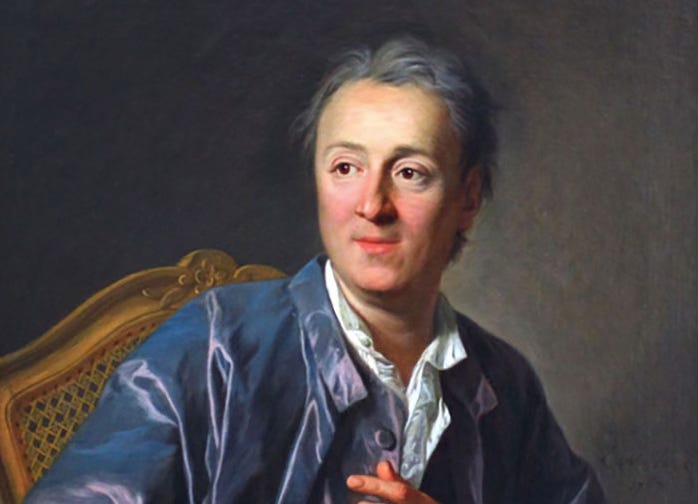
Above: Detail of Portrait of Denis Diderot (1767) by Louis Michael van Loo.
Divya: How did the patrons get away with it?
Phil: Actors had the social rank of servants. At home, people undressed in front of their servants because the servants didn’t count. At the theater, people would act up because actors didn’t count.6
Divya: How could the actors possibly act?
Phil: Diderot’s point exactly.
Divya: It also sounds like we can trace our actor worship back to Diderot.
Acton: Probably. Before him, people focused on the lines. Theatre-goers knew what was coming—what was coming on stage, anyway. Few plays opened in Diderot’s day. People would see the same shows over and over and would respond to them each time in similar ways. But the similar ways weren’t exactly the same each time.7
Divya: Sounds like liturgy.
Phil: Liturgy’s a good analogy. Until Diderot, a play was seen as one way of getting across text. The actors were considered rhetoricians, and so were priests. The priests in church were the best rhetoricians because they had the best text.8
Divya: “Liturgy” means the work of the people, and the people sure seem to have done more “work” in the 18th-century theater than in more modern ones.
Phil: One sociologist thinks Diderot’s debate between actors’ sentiment and their artifice broke the connection between acting out the text and the authority of the text.9 People stop judging a sermon, say, by the compunction it causes. Instead, people start judging it by its oratory.10
Acton: I was going to say pre-Diderot theater is like The Rocky Horror Picture Show. My grandfather saw it all through college. The movie bombed after like the first week, so the theaters started showing the movie only at midnight. But people came again and again at midnight wearing wild but predictable costumes and throwing the same props in response to the same lines. When a particular character proposes a toast, as he seems to do each viewing, people throw dry toast.11 Rocky Horror became the longest running movie ever.12
Phil: Yeah, Rocky Horror’s the revenge of the 18th century. The audience was making the movie genre into a joke. Or I guess the joke wasn’t the movie. The joke was the idea of sitting silently in public watching a movie.
Acton: The joke was the fourth wall. The fourth wall makes us go out in public only to watch actors develop their characters’ inner lives.13 Some public encounter.

Above: Victoria (right) and her friend Lyneve in costume for a Boy George and Culture Club concert in April 1984 in Nashville.
Divya: That’s why the stranger was executed.
Phil: For throwing shit during a theatrical production?
Divya: Not exactly, Phil. Meursault—the stranger and first-person narrator—has no inner life for the jury to hear about. He smokes during the vigil in front of his mother’s casket. He sleeps with a new girl the day after the funeral. The murder, of course, has nothing to do with any of this. But the prosecution wants to show that Meursault doesn’t follow social conventions. Based on the facts, the jury should convict him of something like second-degree murder. Instead they sentence him to death.
Phil: He doesn’t follow social conventions, so he must’ve planned the murder.
Acton: Right. The court and the prosecutor pry into his private life. They want interior theater, like our fourth-wall moviegoers. And Meursault won’t oblige them.
Phil: So the court reenacts Robespierre’s hunt for hypocrisy. Camus was French, right?
Acton: Yeah, but . . .
Phil: Words and deeds are the stuff of public appearance, Hannah Arendt famously claimed. But the motives behind words and deeds are cloaked in the heart’s darkness and should remain there. All motives become suspicious in public daylight.14 Are you guys doing The Stranger straight up or art nouveau?
Divya: “The heart is deceitful above all things, and desperately wicked: who can know it?”
Phil: Jesus?
Divya: Jeremiah.15
Acton: Toss in that jeremiad when you defend your M.Div. thesis, Div. [To Phil] Art nouveau, Phil, if you will. If you must.
Phil: Robespierre made patriotism a heart matter, so he shined the public light on the hearts of his enemies and allies alike. Dark hearts lead to rolling heads.16
Divya: And to Meursault’s execution, I guess. Though his heart wasn’t exactly dark. It was just illegible. “Who can know it?”
Acton: Maybe Robespierre was channeling Jesus. Didn’t Jesus rail against hypocrisy?
Divya: Not as we understand “hypocrisy”—or as the members of Robespierre’s Committee of Public Safety understood it. The Greek word we transliterate into “hypocrisy” didn’t begin to refer to the inconsistency between private behavior and public presentation until the second century A.D.17
Phil: What did “hypocrisy” mean before then? I’ve heard Jesus was essentially calling the Pharisees actors—as people playing public roles.18
Divya: Right. But “actors” wasn’t the word’s primary meaning.19 Back in Attic Greece, hupocritēs meant someone who recited or declaimed Greek poetry or drama. In Jesus’ day and for centuries leading up to it, it also meant someone who interpreted text, including an actor. Hupocritēs derives from the Greek verb krinein, which is concerned with interpretation. Krinein gives us English words like “critic,” “criterion” and “discern,” all having to do with interpretation. The association of hupocritēs with acting was derived from an actor’s role in interpreting.20
Phil: So Jesus wasn’t calling the scribes and Pharisees hypocrites?
Divya: He was calling them hupocritēs, which is better translated as hypercritical, not hypocritical, interpreters.21 Matthew’s Anchor Bible translates the “woe” lines in chapter 23 as “Away with you, you pettifogging Pharisee lawyers!”22
Phil: “Pettifogging”? Was Jesus British?
Divya: Pettifogging. Quibble about petty stuff. A fog machine belching out pettiness.
Phil: Will your art nouveau production use fog machines? Hey, stage noir . . .
Acton: No. But we’re making the audience the mourners at the funeral and the jury at the trial. They did this ten years ago in a German production.23
Phil: Rocky Horror!
Divya: Liturgy!
Acton: So what was Jesus’ deal with the Pharisee lawyers?
Divya: They were interpreting the Mosaic covenant narrowly and oppressively. One of his seven woe’s captures this best: they tithed even their herbs but they neglected—Jesus charged—justice, mercy, and faithfulness.
Phil: Wasn’t that hypocrisy as we understand it?
Divya: Not really. When Jesus points to a discrepancy, it’s between the scribes’ and Pharisees’ public personae, like their long public prayers, and their systemic public injustice, such as forcing poor widows to pay so much in tithes and taxes that they lose their homes. But you could say that their interpretations were private in one sense: their interpretations of scripture were outside of the great tradition advocated by the Hebrew prophets and later by Jesus.
Acton: So the Greek word for hypocrisy has mutated like modern theater. Both started out having to do with the text’s interpretation. Then both had to do with an actor’s inner state, whether that state is emotional or calculating.
Phil: Performance mirrors philology.
Divya: Something like that. And the transitions in both cases have to do with the fourth wall. Jesus wants everyone participating in public life. His first “Away with you” addresses this directly: the Pharisee lawyers have shut the door to God’s kingdom in people’s faces.
Phil: If the kingdom is no longer about text, speech and action,24 then it’s solely about the human heart. And the public light on the human heart brings a pandemic of suspicion. Hunts for hypocrisy in the modern sense keep people out of public life, too.
Divya: Jesus addressed the human heart, of course. But he wasn’t making the Mosaic law more private. He was diagnosing why public life keeps going wrong: contempt, greed, lust for honor.
Phil: How will you guys deal with Meursault’s suspicious and unknowable human heart?
Acton: The director in the 2016 German production made Meursault into a community. Three actors played him. We’re doing the same.
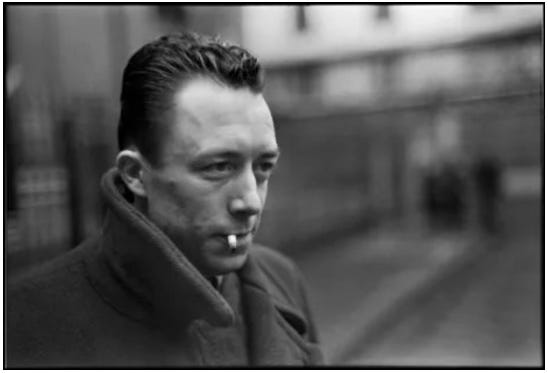
Above: Photograph of Albert Camus.
Phil: Each actor gets his own night?
Acton: No, all actors play Meursault every night. They’re passing around his lines based on which part of Meursault is best suited to land them—or, because it’s Meursault, to fail to land them. The dialogue among the Meursaults becomes a functioning Greek chorus of sorts, a voice of the community of Meursault.
Divya: How will that challenge the community’s Robespierre-like hypocrite hunt? What will it say about the jury’s sentencing of Meursault based on his suspicious interior life?
Acton: If a court defendant’s thoughts are portrayed as three people, an “interior” public life isn’t possible. Meaning isn’t within but among. Spaces of interpretation open up among the Meursaults. The chorus, as always, serves as a public mirror, but here the public—the healthy, meaning-making public—is itself on trial. Meursault’s death sentence suggests the death of public life.
Divya: The inversion of Jesus’ death, which inaugurates God’s reign.
Acton: I suppose so.
Phil: I’m going to bed.
Acton: Wait. Grab me some pizza. Get some for Meursault, too.
Phil: I’m not feeding a chorus.
Divya: I’ll go in on it. We’ll be back in a minute.
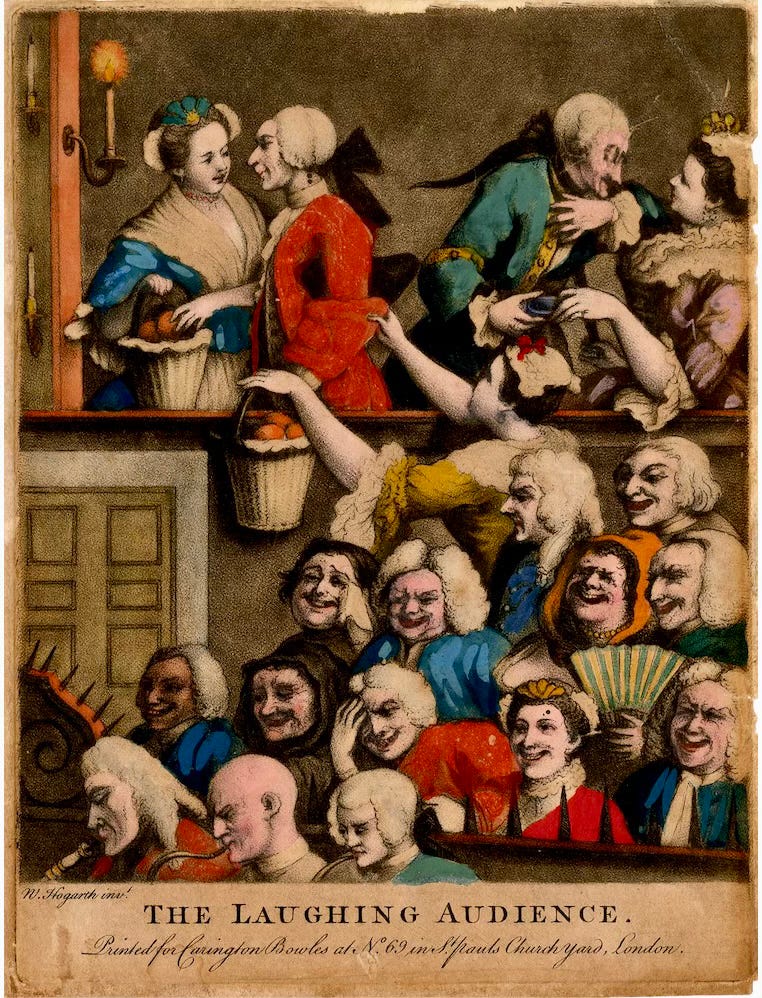
Above: The Laughing Audience (1733), here in its glorious entirety, by William Hogarth.
Political Devotions news
I don’t use artificial intelligence to write, revise or edit anything. But I’ve been using Bing Image Creator for many of my posts’ illustrations, the ones in the style of illuminated manuscripts. I’m also now using Claude to help me research. It’s fun! Claude’s a boon companion, though he needs to be challenged often. To err is human, I guess. And when Claude is shown to be wrong, he’s forthcoming and contrite.
I’m also had ElevenLabs generate the audio version of this dialogue. Claude helped me through using ElevenLabs for this purpose: making a dialogue into an audio file with three distinct voices isn’t something that comes easily to ElevenLabs. Claude even helped me pick out suitable voices on ElevenLabs based on how I described our three characters. I hope you like the audio, though I can’t say the voice acting is too good.
But the biggest news of all: Political Devotions has new office space! Substack wants us all to put mailing addresses out there, and it seems beneath the dignity of my own Substack to use our home address. So I went to the nearest town and snapped up P. O. Box 29.
In Northern Virginia where I’m from, renting a P. O. Box with a number as low as four digits is an accomplishment. My new, two-digit address makes me feel like a big shot around these parts, like a former mayor or an absentee landowner or something. (The town—Mount Pleasant—has lots of three-digit P. O. boxes to support my illusion of instant entrenchment.)
All to say that my writerly self now lives out its corporeal existence in this venerable, fusty box:

So do it the hard way. Drop me a line at:
Bryce Tolpen
P. O. Box 29
Mount Pleasant TN 38474-0029
William Green’s recent, thought-provoking essay “Saving Appearances” inspired me to research and write this dialogue. My thanks to BBC Sound Effects for the background to the audio version of this dialogue.
Our students are at Vanderbilt University’s Neely Auditorium (photo of exterior).

Phil is referring to Denis Diderot’s dialogue The Paradox of Acting, written in 1773. My dialogue here is in part an answer to Diderot’s dialogue.
Background on Diderot’s fourth wall can be found at Britannica.
Diderot hoped, he said, that his encyclopedia would be influential in “changing the common mode of thinking.”
Richard Sennett, The Fall of Public Man (W.W. Norton, 1996), 75-76.
Sennett, 74.
Sennett, 110-11.
“Diderot broke this connection between acting, rhetoric, and the substance of the text. In his Paradox [of Acting] he created a theory of drama divorced from ritual; he was the first to conceive of performing as an art form in and of itself, without reference to what was to be performed.” Sennett, 110-11.
Sennett, 114.
Sennett asserts a correlation between theater and street life “in a society with a strong public life.” Sennett, 37-38. Rocky Horror Picture Show would amount to a perfect expression of “speech as sign” through conventions in both theater and street: speech as sign “was activity at a distance from the self; on the street a general language about generalities; in the theater one was aroused not according to personal whim or flush of feeling but only at the proper and conventional moments.” Sennett, 87. Throwing toast when a character proposes a toast is such a conventional moment.
You can still catch The Rocky Horror Picture Show today. The Belcourt in Nashville, for instance, screens it two weekends a year.
Going out in public to silently watch the portrayal of others’ inner lives was unknown until the 19th century, according to Sennett. The 19th century brought the “spectator,” a middle-class patron who stayed silent in the theater and on the street, someone who “did not participate in public life so much as he steeled himself to observe it.” Sennett, 195-96, 205-218.
“And not only is the human heart a place of darkness which, with certainty, no human eye can penetrate; the qualities of the heart need darkness and protection against the light of the public to grow and to remain what they are meant to be, innermost motives which are not for public display. However deeply heartfelt a motive may be, once it is brought out and exposed for public inspection it becomes an object of suspicion rather than insight . . .” Hannah Arendt, On Revolution (Penguin Books, 2006), 86-87.
Jeremiah 17:9 KJV.
Arendt, 88-89.
William Foxwell Albright and Christopher Stephen Mann, eds., Matthew: Introduction, Translation, and Notes, First Yale University Press impression, The Anchor Bible, volume 26 (Yale University Press, 2011), cxvii.
Albright and Mann, cxii.
'“‘Hypocrites’ is simply the Gr. hupocritēs, and such has been the influence of translation that two results have followed: (1) the assumption that the Greek precisely denotes one self-consciously playing a part, an actor, whose whole way of life and even convictions may be at variance with the role in which he is cast, or in which he has cast himself; and (2) that the ‘hypocrisy’ or play acting of the scribes and Pharisees so castigated casts a doubt on the continued validity of the Law in the mind and teaching of Jesus. We have rejected the translation ‘hypocrite’ in this commentary because it is merely the Greek word, and its primary meaning in Greek is not ‘actor.’ . . . . According to context our translations of hypocrisies (Matt xxiii 28, RSV ‘hypocrisy’) and hupocritēs, hupocritai (Matt vi 2, etc., RSV ‘hypocrite,’ ‘hypocrites’) are varied, but . . . all are based on an understanding of the words as denoting an overscrupulous, pettifogging concern with the minutiae of law.” Albright and Mann, cxii. See also Albright and Mann, cxvi-cxvii.
See gen. “Appendix: Hupokrisis, Hupokritēs, Hupokrinesthai” in Albright and Mann, cxv-cxxiii.
Albright and Mann, cxvii.
Albright and Mann, 276-78.
Acton is referring to the 2016 Schaubühne production of The Stranger. All of Acton’s information about that production comes from the Schaubühne’s interview of the production’s director, Philipp Preuss.
Luke describes his Gospel as an account of “all that Jesus began to do and teach.” Acts 1:1 NNAS.
What a lark this post must have been to create!
And fascinating about Diderot's "role" in the invention of acting.
The dialogue resonted with my reading of Simon Critchley's book about Greek tragedy as the collision of different views of justice, in violent scenes of moral ambiguity--a condition of "disappointed or decayed" democracy which Plato could not abide. (Presumably the scribes and Pharisees would have agreed.)
I like Critchley's argument that Athenian drama was a space in which all the citizens were actors, creating the glue of democracy and the spectacle of politics looking at itself. No pettifogging attempts at universalism can "fix" it.
More of these not-exactly-Platonic dialogues, please!
Three things stand out: the redefinition of hypocrisy as interpretation rather than duplicity, the link between the fourth wall and modern suspicion of interior life, and the striking use of Meursault as a communal voice. I especially appreciate the first—it sharpens the moral argument without moralizing. - Thanks, of course, for the acknowledgement of “Saving Appearances.” - Intriguing work here, again, Bryce!