


While hunting in south Alabama, a boy spots a bird with an acrobatic flight. It moves horizontally as effortlessly as an arrow. Then it furls its wings and drops like a rock. The boy, amazed, asks his hunting party’s local guide the bird’s name. The guide says it’s a blue-dollar hawk. Not willing to embarrass the guide, the boy’s father waits until they get home to tell him that the guide got it wrong: it was a blue darter hawk. The boy is crestfallen.1
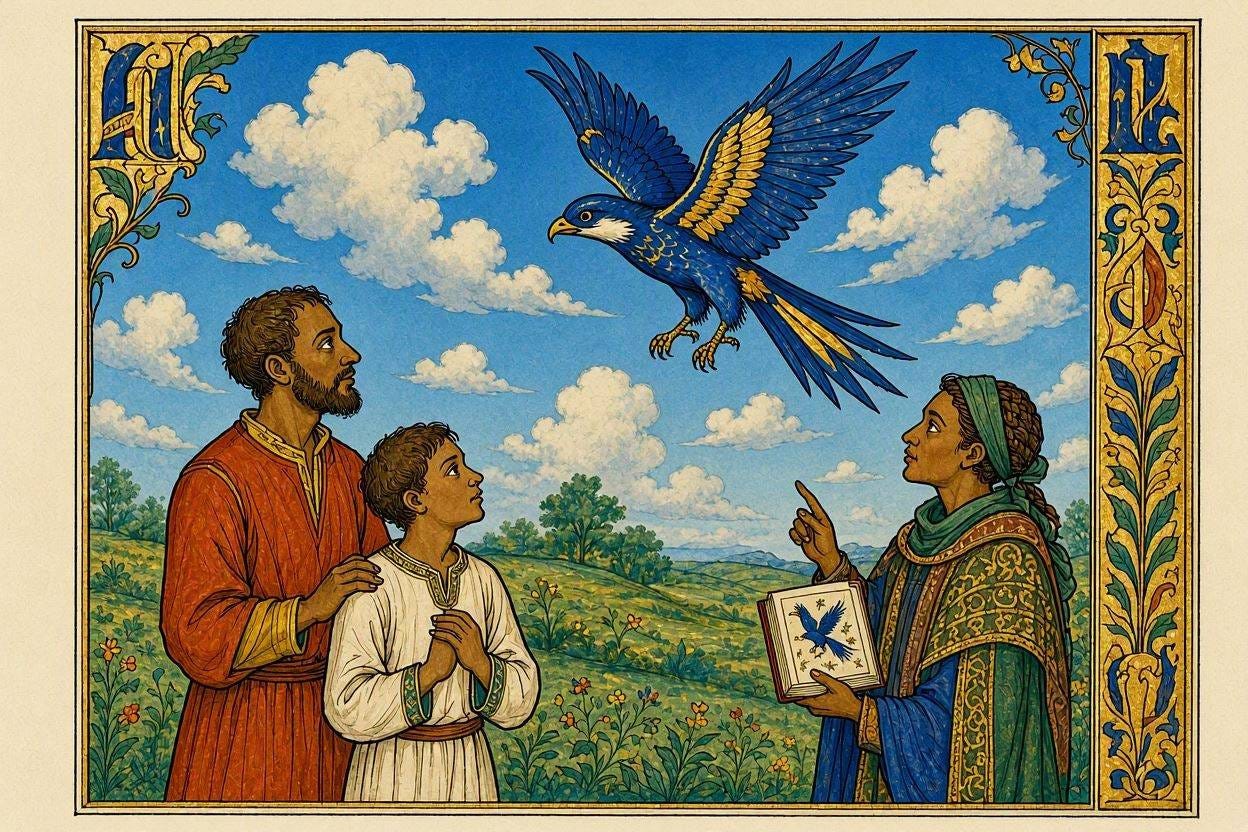
The boy, Walker Percy, grows up and writes an essay about this encounter with the bird and its wrong name. In the essay, Percy recalls the bird’s distinctive presence, an “incommunicable something” beyond the bird’s communicable traits. To describe his apprehension of the bird, he uses the poet Gerard Manley Hopkins’s term “inscape,” by which Hopkins means “the unspeakable stress of pitch, distinctiveness, selving” in something or someone.2
The younger Percy feels the bird’s inscape. He perceives the bird “perfectly,”3 but this perception amounts only to his private apprehension of the bird. He wants to know the bird’s name, as children will, because he wants entrance into the public world that will share his private apprehension. For Percy, naming is public validation:
Everything depends on this distinction between the thing privately apprehended and the thing apprehended and validated for you and me by naming.4
The name turns the boy’s private apprehension and the bird’s inscape into a public encounter.
Perhaps such instantiations of a public world are why the creator God suddenly takes a back seat to Adam, whom God watches in implicit wonder as Adam names each creature. God, who is Being, enjoys Adam’s encounter with each creature’s being:
Out of the ground the LORD God formed every beast of the field and every bird of the sky, and brought them to the man to see what he would call them; and whatever the man called a living creature, that was its name.5
It also may explain why my wife and I continue to say “bastick” and “buhdult” decades after our first daughter, then aged three, used these terms to refer to what we commonly call baskets and adults. Her neologisms aren’t just cute; they’re wonderful. My wife and I seem to remain as arrested as God was with Adam’s naming.
God’s creation is, in a sense, only God’s private apprehension until Adam’s naming makes creation a public encounter. Adam’s naming makes the world public—makes it what Hannah Arendt calls “everything between us.”6
Everything public starts with naming.
“Blue-dollar hawk” is a lot like “bastick.” It works because, like the bird it names, it’s “something else”:
Blue-dollar is not applicable as a modifier at all, for it refers to a something else besides the bird, a something which occupies the same ontological status as the bird.7
By contrast, the correction by young Percy’s father robs Percy of his encounter with the bird and substitutes for it only what the bird looks like, does, and is classified: it is blue, it darts, and it’s a hawk. In Martin Buber’s terms, the boy’s I-You encounter with the bird (an encounter with Being) devolves into an I-It experience with the bird.8 The father’s correction solves the kind of mystery that shouldn’t be solved at all but only encountered.
Naming doesn’t always succeed apprehension. Simply learning words for things is a frequent classroom experience, and this substitute of experiences for encounters is one reason classrooms often feel oppressive.
For Buber, an I-It experience is not an encounter because “those who experience do not participate in the world. For the experience is ‘in them’ and not between them and the world.”9 Buber here, in essence, makes the same distinction as does Percy. Percy’s distinction between private apprehension, on the one hand, and public apprehension and validation, on the other, maps onto Buber’s distinction between private experience and public encounter.
Buber’s own account of encounter and naming describes the world that leads to our public self-apprehension:
The basic word I-You can be spoken only with one’s whole being. The concentration and fusion into a whole being can never be accomplished by me, can never be accomplished without me. I require a You to become; becoming I, I say You.10
Covenants resemble naming in this regard: they elaborate the created world between us. Covenant is never “by me” and never “without me,” which is the paradox and strength of covenant relationship. Encountering in covenant, I become “I” when “I say You.”
Percy calls this affirmation of self by community a “yes-saying” inherent in naming:
When the child understands that by the word “ball” his father means the round thing, his understanding is of the nature of a yes-saying. Helen Keller’s memorable revelation [of “water” as a naming word] was the affirmation of the water as being what it is. But an affirmation requires two persons, the namer and the hearer. This is water, means that this is water for you and for me. Only a person may say yes, and he may say it only to another person.11
When we name, we say yes to one another and affirm our common world.
Why does the angel insist that Elizabeth and Zechariah name their son John?12 As their friends point out, no one in their families has that name.13 Thankfully, we’ll never know why, just as Percy was prepared to never know why the bird’s name was “blue-dollar hawk.” But the communication of his son’s name frees Zechariah to speak again as a priest in his public world.14
We are a community of Zechariahs and Johns. We are a community of those who name the world but cannot name themselves. Our covenant is, in its most fundamental terms, an acknowledgement and celebration of our need for one another to become ourselves and encounter the world beyond ourselves. Percy expresses this idea in Buberian terms:
I am that which I cannot name. I am rather a person, a namer and a hearer of names. Nor are you formulable under the auspices of a symbol. If I do conceive you as a something in the world rather than as a co-celebrant of the world, I fall from the I-thou to the I-it.15
The human is the naming creature.16 Speaking names that complete our encounters resembles—and perhaps leads to—covenanting.17 In covenant communities, we find reality by speaking our apprehension of the world, by having that apprehension mediated, and then by having that mediation itself mediated. This is the public epistemology of naming.
The short footnotes below refer to the full citations in my earlier manuscript’s and this Substack’s bibliography.
Percy, “Metaphor as Mistake,” 64.
Percy, 68.
Percy, 72.
Percy, 73.
Genesis 2:19 NNAS.
Hannah Arendt, The Promise of Politics (Schoken books, 2005), 201. Italics in the original.
Percy, 71. Italics in the original. I’m not sure that either a bastick or a blue dollar are literally “something,” even if it can be said that they are “something else.”
Buber, I and Thou, 53-56.
Buber, 56.
Buber, 62. In his essay “Naming and Being,” Percy expresses his understanding of naming in terms of Buber’s understanding of encounter: “No matter whether I give a name to, or hear the name of, a strange bird; no matter whether I write or read a line of great poetry, form or understand a scientific hypothesis, I thereby exist authentically as a namer or a hearer, as an “I” or a “thou”—and in either case as a co-celebrant of what is.” Walker Percy, “Naming and Being,” in Signposts in a Strange Land, 1st Picador USA ed, by Walker Percy (Picador USA, 2000), 134-35.
Percy, 133. Italics added.
Luke 1:13.
Luke 1:61.
Luke 1:62-64.
Percy, 136-37.
Percy prefers Homo symbolificus to Homo sapiens: “Instead of marking him down at the outset as besouled creature or responding organism, why not look at him as he appears, not even as Homo sapiens, because attributing sapience already begs the question, but as Homo loquens, man the talker, or Homo symbolificus, man the symbol-monger? Instead of starting out with such large vexed subjects as soul, mind, ideas, consciousness, why not begin with language, which no one denies, and see how far it takes us toward the rest?” Walker Percy, “The Delta Factor,” in The Message in the Bottle: How Queer Man Is, How Queer Language Is, and What One Has to Do with the Other, by Walker Percy (Noonday press, Farrar, Strauss and Giroux, 1993), 17.
Indeed, as soon as Zechariah has written, “John is his name” and is able to speak again, he prophesies that God’s people will live in covenant: “the Lord God of Israel . . . has visited his people and bought their liberation . . . to remember his holy covenant, the oath he swore to Abraham our father, to grant that we, having been delivered without fear from our enemies’ hands, might worship him, in holiness and justice before his presence for all our days.” Luke 1:57-75 (Hart, New Testament, 106).
What stays with me is your claim that naming does more than identify things: it brings a private apprehension into a world shared with others. Janet Soskice’s work on naming God adds a useful limit—the name can make real relation possible without turning what is named into something fully defined. ["Naming God" by Soskice, 2025]. - Thanks again, Bryce, for another great post!