


It may seem a tad mundane to consider the Declaration of Independence from the perspective of its place in a paper trail. Call it the banality of revolution.
Historian Garry Wills calls it “the order of Revolution.”1 But how can something as stirring and untidy as a revolution be associated with order, much less banality?
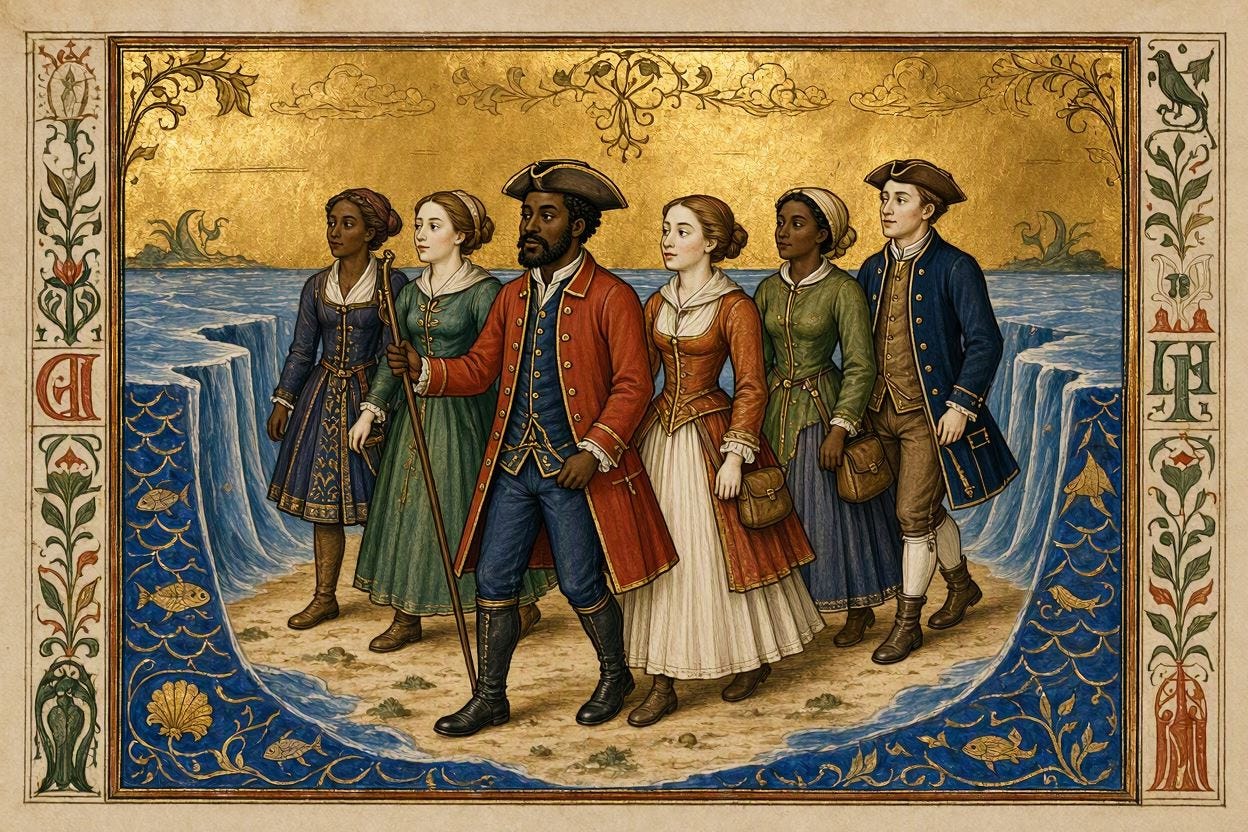
It’s like the Lord’s reference to the children of Israel, soon to flee Egypt, as “my hosts,” better today translated as “my battalions.”2 In his translation’s notes, Robert Alter seems amused by the Lord’s first use of this plucky moniker: Israel’s “battalions,” he points out, are “a mass of wretched slaves who will be fleeing from their taskmasters.”3 Where’s the order that “battalions” suggests?
Despite conditions on the ground (or in Israel’s case, also in the sea), lasting deliverance is orderly. As if to substantiate the Lord’s view of his people as hosts, Exodus prefaces his “my hosts” pronouncement with a brief genealogy. This genealogy, covering three tribes and a few families, is much like the longer biblical genealogies that account for Israel’s families, clans, and tribes.4 Though incomplete, this genealogy is enough to signify, Rabbi Umberto Cassuto says, that Israel will leave “not like slaves who flee from their master’s house, but as a free people that goes on its way in ordered hosts.”5
Israelite slaves meeting in families, clans, and tribes, like American colonists meeting in committees of safety and committees of correspondence to manage their local affairs,6 suggests the practice of political freedom before that freedom is won.
There’s more on order, both in Egypt and in Philly. Remember all the times Moses and Aaron petition Pharaoh on YHWH’s behalf to “let my people go”?7 That long petition process is part of revolution’s order, too.
Like the Red Sea crossing, the Declaration of Independence marks the end of a long petition procedure. The Declaration comprises the third and final document in the American colonists’ petition process. It announces the failure of the British monarch to redress the colonists’ grievances set out in two petitions, the first drafted in October 1774 in the First Continental Congress and the second in July 1775 in the Second Continental Congress.
Those petitions gave the Continental Congresses cover. Pre-revolutionary committees of safety and of correspondence served as precedents for the Continental Congresses.8 Still, members of the Continental Congresses wanted no one to mistake them for legislators: under colonial law, a rump legislature would have constituted an unauthorized assembly. In fact, they called themselves a “congress” because the word in its context denoted not a legislature but an assembly of the king’s subjects.9 Under English law, while no person or group of people could presume to pass a law, any person or group of people could petition the king or Parliament.10
Petitions address matters outside of the standard legal process. They are a kind of last legal resort, reserved for infringements of rights and other injuries that “the ordinary course of law is too defective to reach,” as William Blackstone, the English world’s premier jurist of the Revolutionary period, puts it.11 These rights outside the “ordinary course of law” include constitutional claims.12 All of the grievances listed in Congress’s 1774 petition to King George rested on constitutional rights,13 such as the sole right of the legislative branch to pass laws, the right to be free of standing armies in time of peace, and the right to peaceable assembly.
An assembly was an acceptable locus for drafting a petition. In fact, as Hannah Arendt puts it, in America’s Revolutionary era “the right to assemble [existed] in order to petition.” Assembling to petition rulers is a negative liberty—that is, a right stemming from liberation but, Arendt says, “by no means the actual content of freedom.” In the years following the American Revolution, however, assembly as “participation in public affairs” has “come to be the most important positive political freedom.”14
But petition remains important under any form of rule, whether the rulers in question are God’s elect or the people’s elected. To circumscribe that rule, petitions include bills of rights. Because these bills of rights focus on constitutional law, they sometimes became restatements of constitutional law or, in the case of the 1628 Petition of Right after it was singed by King Charles I, became part of the English constitution itself. The British constitution, of course, is unwritten—or, more accurately, is contained in a series of written documents dating back to Magna Carta in 1215.
The Declaration of Independence, which is also in the form of a petition, has a petition’s bill of rights in its preamble. After its famous declaration that “all men are created equal, that they are endowed by their Creator with certain unalienable rights, that among these are Life, Liberty, and the pursuit of Happiness,” the Declaration declares a right that makes possible “these ends”—these other, more famous unalienable rights: “whenever any Form of Government becomes destructive of these ends, it is the Right of the People to alter or to abolish it.” In other words, the right of revolution itself is in the Declaration’s bill of rights.
The right of revolution is essentially why petitions merit First Amendment status. Under that amendment, Congress shall make no law abridging the right “to petition the government for a redress of grievances.” When compared with the First Amendment’s right to the free exercise of religion and its right to free speech, the First Amendment’s right to petition, listed last, seems least. But the petition can serve as the procedural mechanism for reaching the foundation for all other rights—the right of revolution.
The Continental Congress’s two petitions got the colonists to the place where they were authorized under English law, as they understood it, to exercise their right of revolution through the Declaration of Independence.
Just as the American revolutionaries under John Locke’s political theory followed an appeal process, so also the revolutionaries under English law followed a petition process. Both procedures—one philosophical, one legal—lead to the same revolutionary end.
The colonists’ exercise of their right of revolution was not “indiscriminate or uncontrolled,” as political theorist Harry Jaffa points out.15 In the Declaration of Independence, proper theory follows proper procedure—an order of revolution.
The short footnotes below refer to the full citations in my earlier manuscript’s and this Substack’s bibliography.
Wills, Inventing America, 63.
“And Pharaoh will not heed you, and I shall set My hand against Egypt and I shall bring out My battalions, My people the Israelites, from the land of Egypt . . .” Exodus 7:4. Alter, Hebrew Bible, Vol. 1, 238-39. Starting in the first chapter of 1 Samuel, the Bible uses the term “the Lord of hosts” (or “YHWH of the Heavenly-Armies,” as Rabbi Everett Fox renders it) over two hundred times. Fox, Give Us a King!, 6n3.
Alter, 239n4.
Exodus 6:14-27.
Cassuto, Commentary on Exodus, 88.
Wills, 56-57.
Exodus 7:8-11:10.
Wills, 56-57.
Wills, 56. “Congress” is from the Latin “congressus,” and the Oxford English Dictionary defines “congress” as “going or coming together, meeting.”
Wills, 57. This distinction between petition and legislation hasn’t always existed. Before Parliament gained greater power in the seventeenth century, all bills in Parliament were in the form of petitions, “which were entered upon the parliament rolls, with the king’s answer thereunto subjoined,” according to William Blackstone. Blackstone, “Amendment I (Petition and Assembly).” But the seventeenth century took the petition out of the legislative realm and made it the sole means by which a royal subject or a group of subjects could address the king himself. Wills, 54. This later, non-legislative sense of petition was in operation when the Continental Congresses convened.
Blackstone, “Amendment I (Petition and Assembly).”
Wills, 54-55, 59.
Wills, 59.
Arendt, On Revolution, 22.
Jaffa, New Birth of Freedom, 231.