


Three Vanderbilt students discuss perspective and judgment from the standpoint of their concentrations: Acton (theater and literature), Divya (divinity), and Phil (philosophy).1
Divya: How did the Frist get the David Hockney show?2 Nashville’s kind of off Broadway.
Acton: The Frist gets big shows.
Phil: Here’s a clue. Hockney’s a painter, but these walls are covered with nothing but photo collages.
Acton: Hockney’s collages show what photography taught him about perspective.
Phil: Two years ago, friends dragged me to a Van Gogh exhibit in D.C. It turned out to be like 90% drawings.
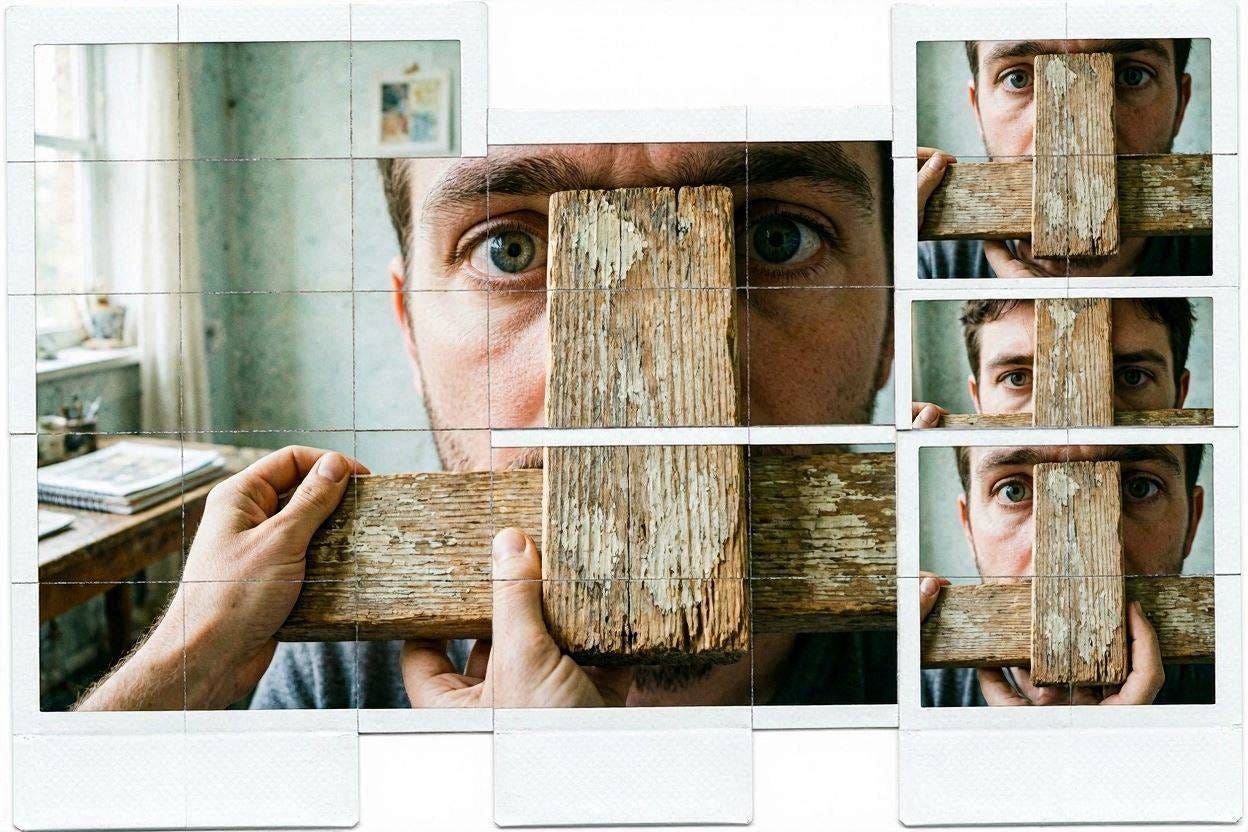
Divya: I thought photography’s perspective was obvious—a single perspective taken in a split second.
Acton: Hockney thought so, too, and he didn’t like it.3 But one day a curator friend left his Polaroid at Hockney’s place with several dozen packs of film.4
Phil: I would’ve been really pissed if it hadn’t been free.
Divya: Yeah, film’s expensive. They had Polaroids back then?
Acton: Today’s Polaroids are retro. So’s this show. Hockney put on Drawing with a Camera in 1982 with collages like this just four months after he requisitioned the camera.5
Phil: He must’ve requisitioned his show’s title from Van Gogh’s curator.
Divya: This seems like an insider show for sure. Who else but other painters would care about a painter’s process involving cameras?
Phil: Yeah, there’s a reason juries are excluded from in camera hearings.
Divya: I’m pretty sure that’s a different camera.
Phil: Check out this guitar in a blue case. Still Life Blue Guitar.6 The guitar’s not blue, though. Why the misleading title?
Divya: The collage looks like hand-fired bathroom tile. A bunch of Polaroid prints, including the white borders, that add up to fruit, sheet music, and guitar.
Acton: I think the “Blue Guitar” title is a nod to Picasso. The sheet music, too. Picasso’s The Old Guitarist was all blue except the guitar itself.7
Phil: They’re more guitar squares than there should be.
Acton: “Hand-fired” works for me. The Polaroid’s flash in some of the photos focuses my eye on the photos’ centers. Its effect is like that of a Cubist painting of a face that’s somehow both head-on and a profile. Each aspect stands out.
Phil: Hockney’s not that distorted, but he’s working on it.
Divya: I love how half of the “Half and Half” is in one square and the other half of the “Half and Half” is in another square. Then there’s a third half in a third square?
Phil: Refresh my memory: what’s Picasso’s point? Or Hockney’s?
Acton: Hockney reads a Cubist painting as an invitation to explore how we see. When we look at a guitar, say, we’re not conscious of how our brain accumulates details over time. Time gives us different perspectives to put together, and we see a guitar.8
Phil: Artists’ shop talk. I come to a museum to see beauty.
Divya: Beauty is supposed to be in the eye of the beholder, Phil.
Acton: But Hockney found beauty in the beholder’s brain. The struggle we have between the woman’s frontal view and the woman’s profile makes us aware of what the brain does behind the scenes to help us see.9 Looking at a Cubist painting, we have to consciously and imaginatively make her beautiful.
Divya: This painting—I mean this collage—is playful, anyway.10 So why did Hockney hate cameras before his Polaroid obsession?
Acton: A photograph leads you to believe in single-point perspective. That misleading concept, in turn, leads us to believe in the neutral, objective observer.11
Phil: What, did Hockney believe in the Uncertainty Principle?
Acton: Actually, yes. He brought it up in a conversation about Cubism.
Divya: What’s that?
Phil: Cubism is this stuck-up, intellectual art movement . . .
Divya: Phil. Chill.
Acton: Heisenberg’s Uncertainty Principle says that, at the quantum level, you can’t know a particle’s velocity and location at the same moment. That’s the uncertainty.12
Divya: Does that work for bicycles? I don’t need to know my speed and location at the same time, but I never can measure my bike’s tire pressure without lowering it.
Phil: That’s the bigger point—for philosophers anyway. Heisenberg showed that the observer affects what she’s observing.13 There’s no such thing as good judgment.
Divya: I think there’s good judgment, just not objective judgment.
Phil: What’s the difference?
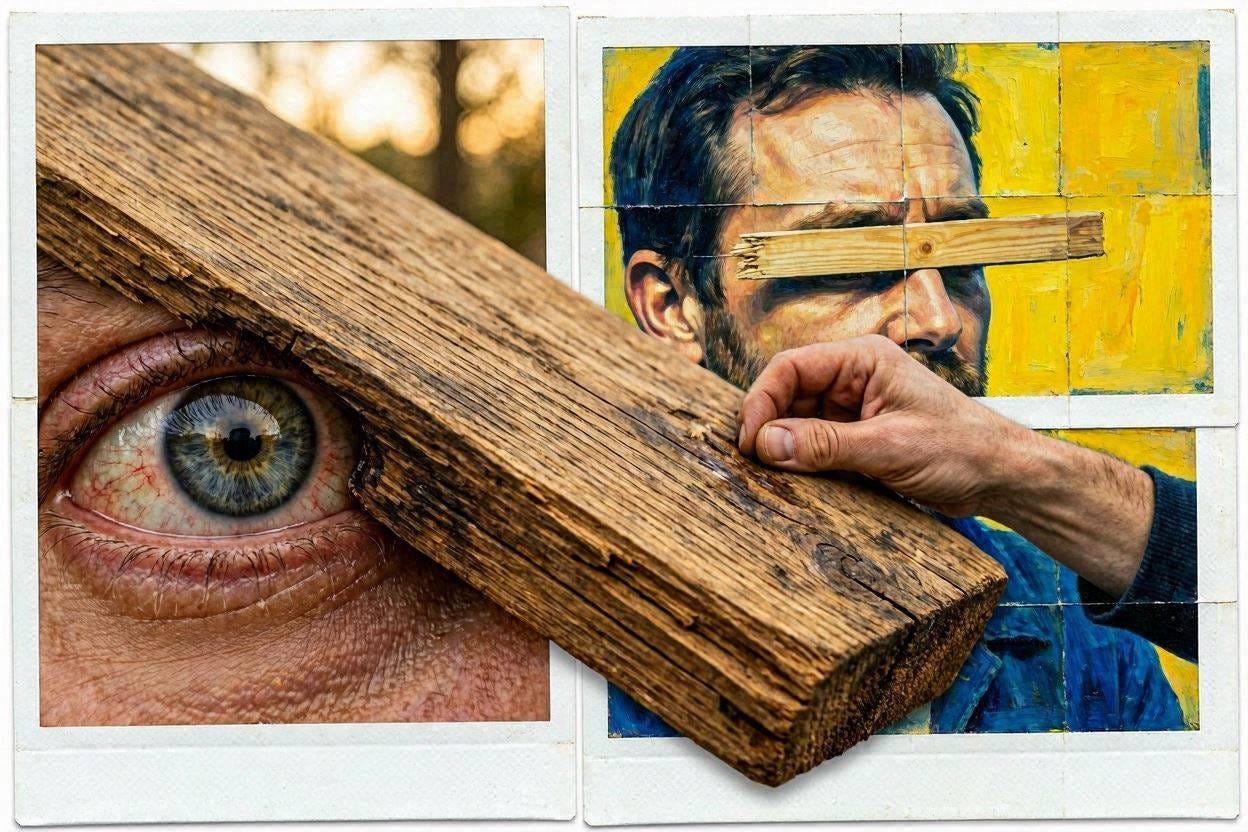
Divya: The uncertainty. Look at Jesus’ remarks about judging people. We try to remove a mote in someone’s eye, but we have a beam in our own eye.14
Phil: Like a two-by-four sticking out of my eye? That would affect what I was observing.
Acton: An eye surgeon’s bedside manner would be bad, too. Hey, doc, stop nodding your head!
Phil: I’m getting a pounding headache.
Divya: Some modern translations refer to a speck of sawdust versus a plank.15
Phil: So I guess my faults are worse than those of the person I judge.
Divya: Maybe, but I don’t think that’s Jesus’ point. I think he’s talking about perspective and judgment. We think we can see the other as a camera does—objectively. But something distorts our judgment.
Phil: Hume.
Acton: Beam. Hume beam? Human beings? Am I getting warmer?
Phil: Well, yes. David Hume. His Treatise on Human Nature.
Divya: Okay . . .
Phil: Hume said that we can’t learn about “the science of man”—about human nature—with scientific objectivity. If I put myself in an experiment about human nature, my “reflection and premeditation” would disturb my judgment and make the results unjust.16
Acton: I guess each “reflection and premeditation” would amount to a separate Polaroid. Hume’s concerned that any experiment would stitch together the pics and create an unjust collage of the Other.
Divya: I have a proposal. What if Jesus is channeling his inner David Hockney? What if his speck and plank are the same size?
Phil: Then why would Jesus call them a speck and a plank?
Acton: Perspective, maybe. If the speck is in the eye of the person judging someone else, it’ll distort their vision of the Other while remaining invisible to themselves.
Phil: Ah. The closer it is to your eye, the bigger the speck becomes.
Divya: And the more invisible. Our eyes aren’t macro lenses. We can’t see things on our lenses that distort our vision. So our faults stay invisible as we focus on the same faults in others.17
Acton: Jesus’ speck and plank don’t amount to a frozen image. Just like a Cubist painting’s frontal view and profile shouldn’t be viewed as a single, frozen image. They’re bizarre invitations to uncover how one-point perspective can fool us.
Phil: Montaigne can simplify all this. He said that every man likes the smell of his own shit.18
Acton: Well said.
Phil: Farts, too, if I may extend the analogy.
Acton: Montaigne also wrote as if our mistaken objectivity were our greatest foe.
Divya: Montaigne wanted us to smell our poo as others smell it?
Acton: I’d say so. He challenges our assumed objectivity with his loose-knit essays. Each essay is like a Hockney collage. It focuses on lots of fragments, and it somehow stitches the fragments together. My first impression after reading one is, hey, despite a lot of asides, he never really got off topic.
Divya: How does that strategy help us become conscious of how we judge?
Acton: Montaigne’s essays ask us to see many perspectives on an issue as parts of a conversation with the reader rather than as parts of an argument. That way, his essays make us less quick to judge.19 One sociologist points out that Montaigne’s essays are more dialogic than dialectic. In other words, they don’t argue. They don’t even seek common ground. Instead, they try to make people more conscious of how they think—how they see.20
Divya: “. . . and then you will see clearly to take the speck out of your brother’s eye.”21
Acton: I guess that’s the hope. Where are you going?
Phil: The gift shop.
Divya: After seeing one artwork?
Acton: One snapshot, as it were?
Phil: I need Motrin. You guys gather up the fragments that remain, that nothing be lost.22
Divya: Will do.
Acton: I guess he’s not buying the catalog.
The short footnotes below refer to the full citations in my earlier manuscript’s and this Substack’s bibliography.
The same Vanderbilt crew conducted an earlier dialog, “The paradox of hypocrisy.” The audio version is again from ElevenLabs and its speech synthesis software. The speech acting, I admit, leaves a lot to be desired, but I’ve grown accustomed to their voices.
It’s interesting to consider the audible version’s “acting” in terms of the dialogic, as discussed in footnote 20 below. ElevenLabs articulated each of the dialog’s 57 lines without reference to any other line, and a patch Claude made for me sewed the lines into the dialog you hear. So the speech “actors” don’t really hear the context we hear listening to the sewn-together version. Michael Holquist describes dialogics as “the characteristic epistemological mode of a world dominated by heteroglossia.” He defines “heteroglossia” as “that which insures the primacy of context over text.” The meaning of any word uttered is always contextual, so “all utterances are heteroglot in that they are functions of a matrix of forces practically impossible to recoup . . .” Systematic linguists, Holquist points out, always suppress heteroglossia. So does, in the case of this dialog’s audio version, artificial intelligence. Michael Holquist, “Glossary,” in The Dialogic Imagination: Four Essays, by Mikhaïl M. Bakhtine, ed. Michael Holquist, trans. Caryl Emerson and Michael Holquist, University of Texas Press Slavic Series 1 (University of Texas Press, 1994), 426, 428.
For a more positive reading of the audible version in the context of the dialogic, one might look at each line so generated as if it were a Polaroid snapshot, as our students discuss in this dialog. The audible version as a whole can thus be seen as a kind of Hockney composite Polaroid, providing with its awkward stitching an invitation to thought about how we use language in dialog.
My thanks to BBC Sound Effects for the audio version’s background.
Nashville’s Frist Art Museum has no permanent collection, but it brings in major touring exhibitions. The museum occupies Nashville’s former main post office, and it showcases striking Art Deco and “stripped” classical architecture styles. But the Frist hasn’t yet put on a dedicated Hockney exhibition.
Hockney died on June 11, 2026, a month before I published this dialog.
Hockney expressed some of his antipathy to photography this way to Lawrence Weschler: “I mean, photography is all right if you don’t mind looking at the world from then point of view of a paralyzed cyclops—for a split second. But that’s not what it’s like to live in the world, or to convey the experience of living in the world.” Weschler, True to Life, 6-7 (italics in the original).
Weschler, 7-8.
Weschler, 10-14.
I don’t have permission to display an image of Still Life Blue Guitar, but the link in the text will get you to one on David Hockney’s website. To see a larger image of the work, click the fifth thumbnail from the left on the same page.
Here’s a link to an image of The Old Guitarist on the Art Institute of Chicago website.
Hockney: “I’ve recently been reading a lot of books about cubism, and I keep coming upon discussions of intersecting planes and so forth, as if cubism were about the structure of the object. But really, it’s rather about the structure of seeing the object. If there are three noses, this is not because the face has three noses, or the nose has three aspects, but rather because it has been seen three times, and that is what seeing is like.” Weschler, 23 (italics in the original).
Hockney: “Working on these collages . . . I realized how much thinking goes into seeing—into ordering and reordering the endless sequence of details which our eyes deliver to our mind. Each of these squares [in his composite Polaroids] assumes a different perspective, a different focal point around which the surroundings recede to background. . . . It’s the very process of looking at something that makes it beautiful.” Weschler, 20-21.
Hockney: “If art isn’t playful, it’s nothing. Without play, we wouldn’t be anywhere. Play is incredibly important; it’s deeply serous as well. It’s hardly a criticism of my work to call it playful; on the contrary, it’s flattering!” Weschler, 63.
Hockney: “Photography hankers after the condition of the neutral observer. But there can be no such thing as a neutral observer. For something to be seen, it has to be looked at by somebody, and any true and real depiction should be an account of the experience of that looking.” Weschler, 66.
Weschler, 68.
Hockney puts it this way: “Heisenberg showed that the observer, in effect, affects that which he is observing, so that some of those old borders and boundaries begin to blur, just as they do in cubism.” Weschler, 68.
“And why beholdest thou the mote that is in thy brother’s eye, but considerest not the beam that is in thine own eye? Or how wilt thou say to thy brother, Let me pull out the mote out of thine eye; and, behold, a beam is in thine own eye? Thou hypocrite, first cast out the beam out of thine own eye; and then shalt thou see clearly to cast out the mote out of thy brother’s eye.” Matthew 7:3-5 KJV.
See, e.g., Matthew 7:3-4 REB.
David Hume, A Treatise of Human Nature: A Critical Edition, ed. David Fate Norton and Mary J. Norton, The Clarendon Edition of the Works of David Hume 1–2 (Oxford University Press, 2011), 6; Morton White, Philosophy, “The Federalist,” and the Constitution (Oxford University Press, 1987), 107.
In the Bible’s pages, people sometimes unjustly judge the faults in others that they suffer from themselves. Perhaps the best summary of this practice comes from Paul: “Therefore you have no excuse, everyone of you who passes judgment, for in that which you judge another, you condemn yourself; for you who judge practice the same things.” Romans 2:1 NNAS.
Montaigne says that this line, translated by Donald Frame as “Every man likes the smell of his own dung,” was adapted from Erasmus. Michel Eyquem de Montaigne, The Complete Essays of Montaigne, trans. Donald M. Frame (Stanford Univ. Pr., 1979), 709.
Richard Sennett points out that Montaigne’s essays “bounce from subject to subject, seeming to wander at times, yet the reader finishes each with the sense that the author has opened up a topic in unexpected ways, rather than narrowly scored points.” Writing “in bits and pieces,” Sennett says, helps Montaigne dissipate the reader’s “emotional temperature” and “suppress readerly aggression.” Richard Sennett, Together: The Rituals, Pleasures and Politics of Cooperation (Yale University Press, 2012), 276.
Sennett, the sociologist to whom Acton refers, compares the dialectic and the dialogic. “In dialectic, as we learned in school, the verbal play of opposites should gradually build up to a synthesis . . . The aim is to come eventually to a common understanding.” The object of the dialogic, by contrast, is that “through the process of exchange people may become more aware of their own views and expand their understanding of one another.” Sennett, 18-20.
Montaigne, in his essay “Of the Art of Discussion,” points to Socrates as a practitioner of what Sennett calls the dialogic: “It is my opinion that in Plato and Xenophon Socrates argues more for the sake of the arguers than for the sake of the argument, and to instruct Euthydemus and Protagoras rather in their own impertinence than in the impertinence of their art. He takes hold of the first subject that comes along like a man who has a more useful aim than to illuminate it: to wit, to illuminate the minds that he undertakes to manage and exercise.” Montaigne, 708. Sennett points to another aspect of Socrates’ approach—his listening skills evident in his restatements of his companions’ positions—as dialogic: “The antithesis of a thesis [in Socratic dialogues] is not 'you dumb bastard, you are wrong!’ Rather, misunderstandings and cross purposes come into play, doubt is put on the table; people then have to listen harder to one another.” Sennett, 19.
Sennett acknowledges the Russian literary critic Mikhaïl M. Bakhtin as having coined the term “dialogic.” Sennett, 19. In his helpful glossary at the end of an English translation of Bakhtin’s The Dialogic Imagination, Michael Holquist describes the world in which dialogism serves as the chief epistemological mode: “Everything means, is understood, as a part of a greater whole—there is a constant interaction between meanings, all of which have the potential of conditioning others. Which will affect the other, how it will do so and in what degree is what is actually settled at the moment of utterance. This dialogic imperative, mandated by the pre-existence of the language world relative to any of its current inhabitants, insures that there can be no actual monologue.” Holquist, 426.
Matthew 7:5 NNAS.
Phil alludes to John 6:12 KJV.
Bryce, this is really wonderful. Learned and entertaining. The best kind of didacticism. Nice work. Do you know Lawrence Wrenschler? A talented SAS.M mmm mmm 🇹🇩
This observation in Amor Towles's A Gentleman in Moscow, which I've been reading since posting this dialog, gave me pause: "Just when a carefully crafted bit of dialogue is about to deliver a crystal-clear message, a hint of sarcasm or the raising of an eyebrow can spoil the entire effect. In fact, it can give credence to a notion that is the exact opposite of that which was intended." Of course, Phil can't take a hint, much less give one. But Towles is speaking of art in general, and in Soviet Russia in particular, as "the most unnatural minion of the state" (192-93).