


David Ost has written two histories of the Solidarity trade union, one in 1990 soon after Solidarity took power in Poland, and the other in 2005 soon after Solidarity’s final defeat. As you might imagine, the two books take strikingly dissimilar tones.
Ost’s first book, Solidarity and the Politics of Anti-Politics, focuses on Solidarity’s goal of creating “a political system centered on neither the state nor the market, but on the public sphere of a strong, pluralist, and independent civil society.”1 Solidarity didn’t try to challenge or to displace the Communist government (hence, its “politics of anti-politics”). Instead, it ignored the state and focused on creating public spaces.
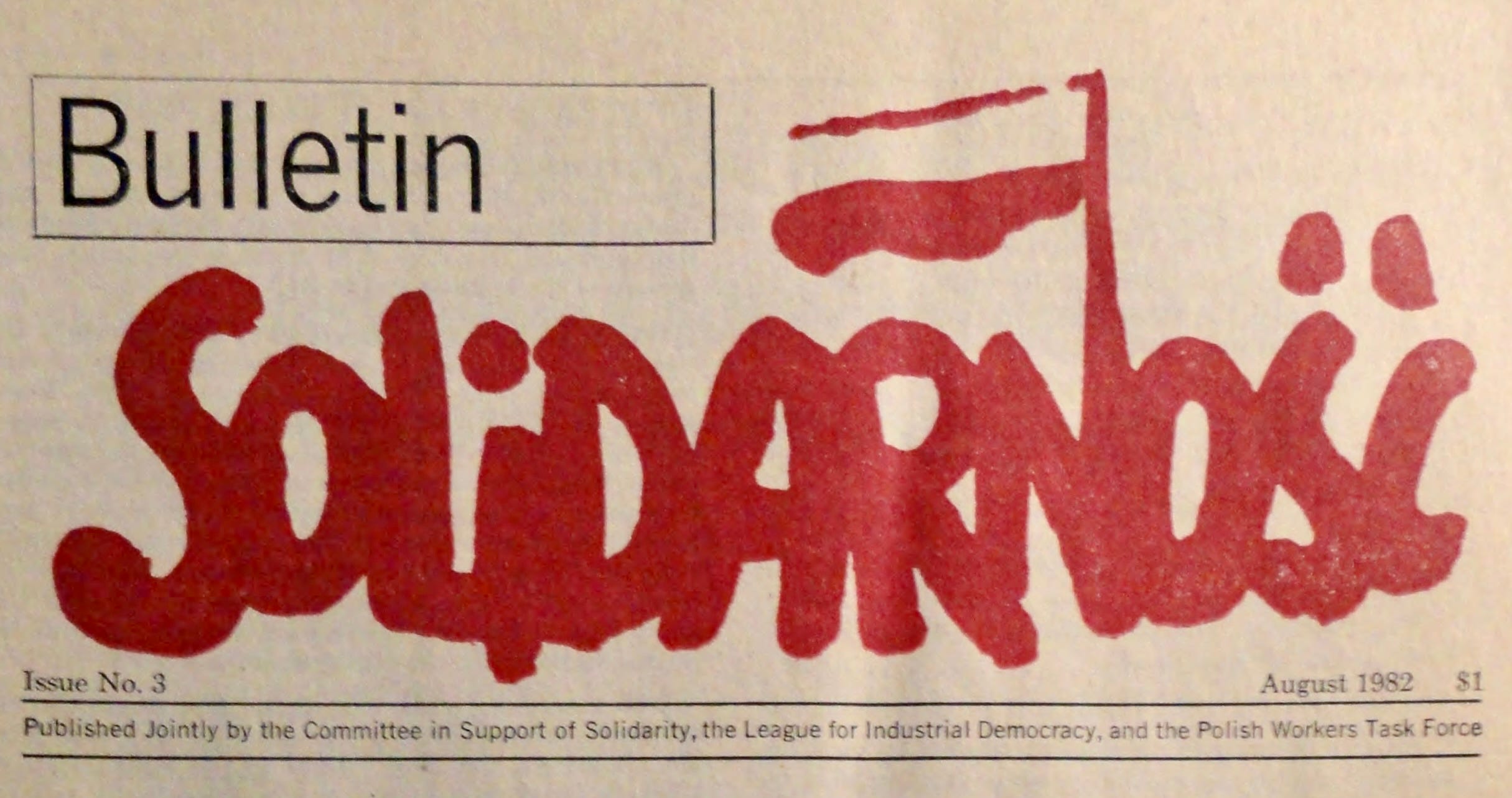
Above: Masthead of Solidarność Bulletin, Issue No. 3, August 1982.
Ost’s second book, The Defeat of Solidarity, chronicles how things went wrong when Solidarity came to power and focused on matters of state and market. During the 1990s, Solidarity turned into “a self-proclaimed Catholic right-wing movement with a union membership less than one-tenth its 1981 size.”2
In its introduction, The Defeat of Solidarity ruefully quotes from the end of Solidarity and the Politics:
. . . I ended on a somewhat pessimistic note. Solidarity’s grand program, I wrote, had failed due to its “lack of an institutional model for political interaction [between state and society].”3
The Defeat focuses on how Solidarity paid the consequences of not finding an institution for what Solidarity and the Politics calls a politics “that focused on civic activity within society rather than on policy outcomes within the state.”4
In this regard, the first book reminds me of Hannah Arendt’s account of the American Revolution and its aftermath in her book On Revolution. Arendt’s frequent references to the town-hall meetings that preceded the Revolutionary War and the Constitution’s ratification remind me of Ost’s descriptions of Solidarity’s actions to create public spaces:
They created places to meet; they organized interest groups; they convened open forums for education and discussion of public policy; and they defined political engagement to include social activism and cultural creation. Solidarity’s early goal was somewhat utopian. It sought to create an engaged citizenry in a free society.5
Just as Solidarity set up an alternative civil society—with the Polish Communist government’s blessing, at least for a while—in the trade union’s first months, so also the American colonists set up their own civil societies—with England’s blessing—for most of the decades leading up to the French and Indian War.6
But when the former colonists defeated Great Britain, the new nation’s Constitution served as “a death sentence” for the townships and town-hall meetings that had made the revolution possible in the first place, Arendt says:
It was precisely because of the enormous weight of the Constitution and of the experiences in founding a new body politic that the failure to incorporate the townships and the town-hall meetings, the original springs of all political activity in the country, amounted to a death sentence for them. Paradoxical as it may sound, it was in fact under the impact of the Revolution that the revolutionary spirit in America began to wither away, and it was the Constitution itself, this greatest achievement of the American people, which eventually cheated them of their proudest possession.7
This “revolutionary spirit,” Arendt says, began to “wither away” because it “failed to find its appropriate institution.”8 Arendt found models for such an institution in Jefferson’s proposed “little republics,” the Paris communes, the Russian soviets, and the citizens’ councils that sprung up during the Hungarian Revolution of 1956.9
Among each of these four countries’ local councils, including Jefferson’s imaginary ones, the councils generated power by relating federally to one another. The three historical systems of councils threatened the regimes and professional revolutionaries in France, Russia, and Hungary. Solidarity’s power also grew to such an extent that it seemed to have no choice but to take over the existing governmental institutions.
So within a decade of Solidarity’s birth, its leaders traded true power for zero-sum power—power as a means of control. How could this have happened?
Lani Guinier and Gerald Torres summarize Ost on the tradeoff that Solidarity made when it "won”:
. . . Solidarity’s very success changed its approach. Once the government relented and held formal elections, over 250 Solidarity leaders successfully ran for Parliament in 1989. Their departure helped engineer a reconsideration of their original idea of “many publics.” Now, in order to maintain their own credibility as leaders, the interest of Solidarity officials shifted, according to Ost. They no longer encouraged workers to protest. They no longer worried about creating a free society; their election presumably embodied it. Yet their very electoral success depleted Solidarity’s ability to organize and mobilize and left efforts at social change exclusively in the hands of public officials, albeit officials with historic sympathies to the movement. Those officials began to define their goals in terms of what can be done rather than what should be done. And they began to see their own political survival as paramount.10
Solidarity traded expansive power that results from citizens acting together for zero-sum power as a means of control.
Power as a means of control has three dimensions, according to Guinier and Torres: “. . . there are ‘winners’; there is a bias in the rules that defines ‘winning’; and there is a narrative that justifies both the winners and the rules by which they win.”11 These three dimensions form concentric circles of societal vision. We are trained to focus on the center circle—on who wins and who loses. We are less focused on the bias that defines “winning,” though most members of marginalized groups focus on this more marginal dimension of power, too.
The third and most peripheral dimension of power—the narrative that justifies the winners and the rules—is almost invisible to us. We tend to accept power’s narrative uncritically.
Zero-sum power uses contests like eye candy. People watch campaigns and elections, and many people think elections alone will change the game—will change, in some cases, the bias that tends to exclude many people from public life. They cheer when their candidates win, but they don’t understand that more zero-sum power exists in the second dimension than in the first, that the “less visible rules are more important to the allocation of power than are more visible individuals.”12
As a result of this second dimension, the newly elected representatives find themselves separated from the true power—the power generated by the movement that (ironically) may have helped to elect or appoint them. The dynamics work like this:
Once a space is made for critics within the dominant institutions, any failure to deliver substantive goods is not a failure of the institution but their own personal failure. External critics are encouraged to blame the internal players; the community from which the critics emerged is demoralized.13
Meanwhile, the third dimension of power creates the narrative that the contests and the system they perpetuate are fair due to their inclusive results. This narrative, like the seduction of elective office, is based on an individual notion of power, a notion tied to the “meta-narrative of American individualism: When individuals get ahead, the group triumphs.” This false narrative, combined with the ultimately disappointing results of elections, causes “many who would be inclined to support continued reforms [to] withdraw from civil society or at least remain aloof.”14
This false narrative also detracts from true power. Arendt warns against ends (victories) that eclipse means, which is power: “. . . the innermost meaning of the acted deed and the spoken word is independent of victory and defeat and must reman untouched by an eventual outcome, by their consequences for better or worse.”15
Speaking of narratives, if Solidarity and the Politics resembles On Revolution by celebrating its subject’s successes in public spaces and warning of its potentially fatal flaw—not finding “an institutional model for political interaction” among citizens—what parallel to The Defeat of Solidarity might later be written of us?
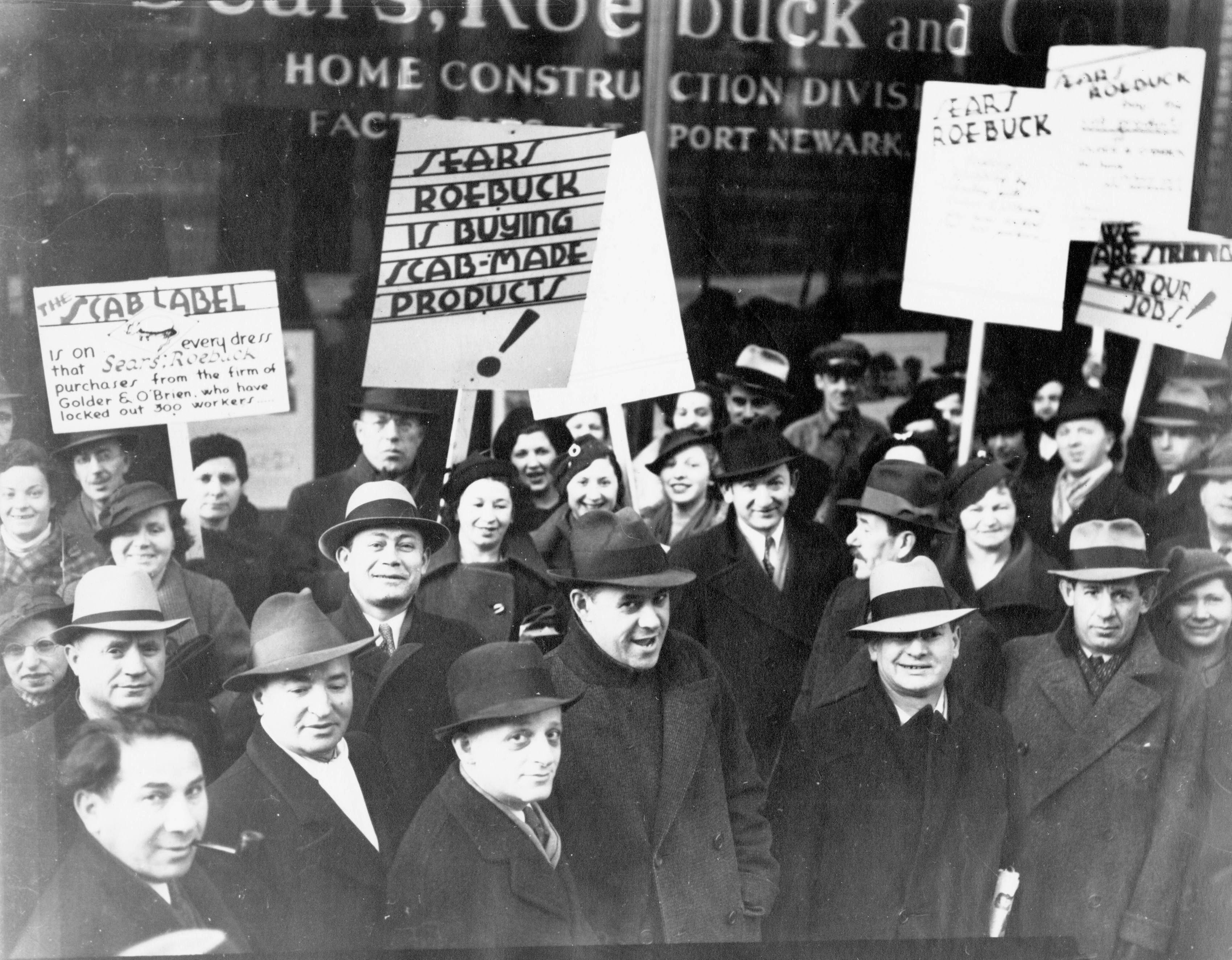
Above: Sears Roebuck workers strike outside the company Home Construction Division. Cornell University Library. Used by permission.
The short footnotes below refer to the full citations in my earlier manuscript’s and this Substack’s bibliography.
Ost, Solidarity and the Politics, 15.
David Ost, The Defeat of Solidarity: Anger and Politics in Postcommunist Europe (Cornell University Press, 2005), 3.
Ost, 4, citing Ost, Solidarity and the Politics, 203.
Ost, Solidarity and the Politics, 2.
Ost, 1.
Bailyn, Ideological Origins, 203-204.
Arendt, On Revolution, 230-31.
Arendt, 272.
Arendt, 240-54.
Guinier and Torres, Miner’s Canary, 124.
Guinier and Torres, 110.
Guinier and Torres, 114-15.
Guinier and Torres, 129.
Guinier and Torres, 115.
Arendt, Human Condition, 205.
Thanks for the reminder that political freedom grows through shared work, mutual obligation, and institutions that teach strangers to regard one another as fellow citizens. Trade unions, churches, neighborhoods, and civic associations help form the democratic character that elections can only register.
My one reservation concerns the sharp contrast between “true power” and governmental power. Democratic communities must do more than create public spaces; they must govern, distribute goods, restrain domination, and make binding decisions. Solidarity’s mistake was not entering politics but failing to carry its civic practices into political institutions—to build, as your essay recognizes, a durable bridge between movement and state.
Ahh, Bryce: thanks for provoking important thought!