


A series preface. Calendars, Walter Benjamin notes, are instruments of revolution. Because dates extend revolutions through acts of remembrance, a calendar can function like an institution for revolution that Benjamin’s friend Hannah Arendt seeks in her 1963 book On Revolution. That book contains her fullest treatment of the American Revolution, now 250 years old. Milestone anniversaries may be said to extend the work of calendars the way years of Jubilee extend the rests of Sabbaths. Like the Sabbath’s recollection of God’s first creation, this year’s sestercentennial calls us to our beginnings, to what Arendt calls “the revolutionary spirit.”1
The title of this series of occasional essays, The Spirit of Revolution, takes Arendt’s term. The essays will focus on what her book calls “the problem of beginning,” a concern she shares with Benjamin in the context of revolution. As a potential solution, Arendt’s concept of natality more than resembles Benjamin’s concept of “a weak Messianic power.” The interplay of these concepts fuels these essays.
Apropos of a sestercentennial, this first series essay concerns calendars.
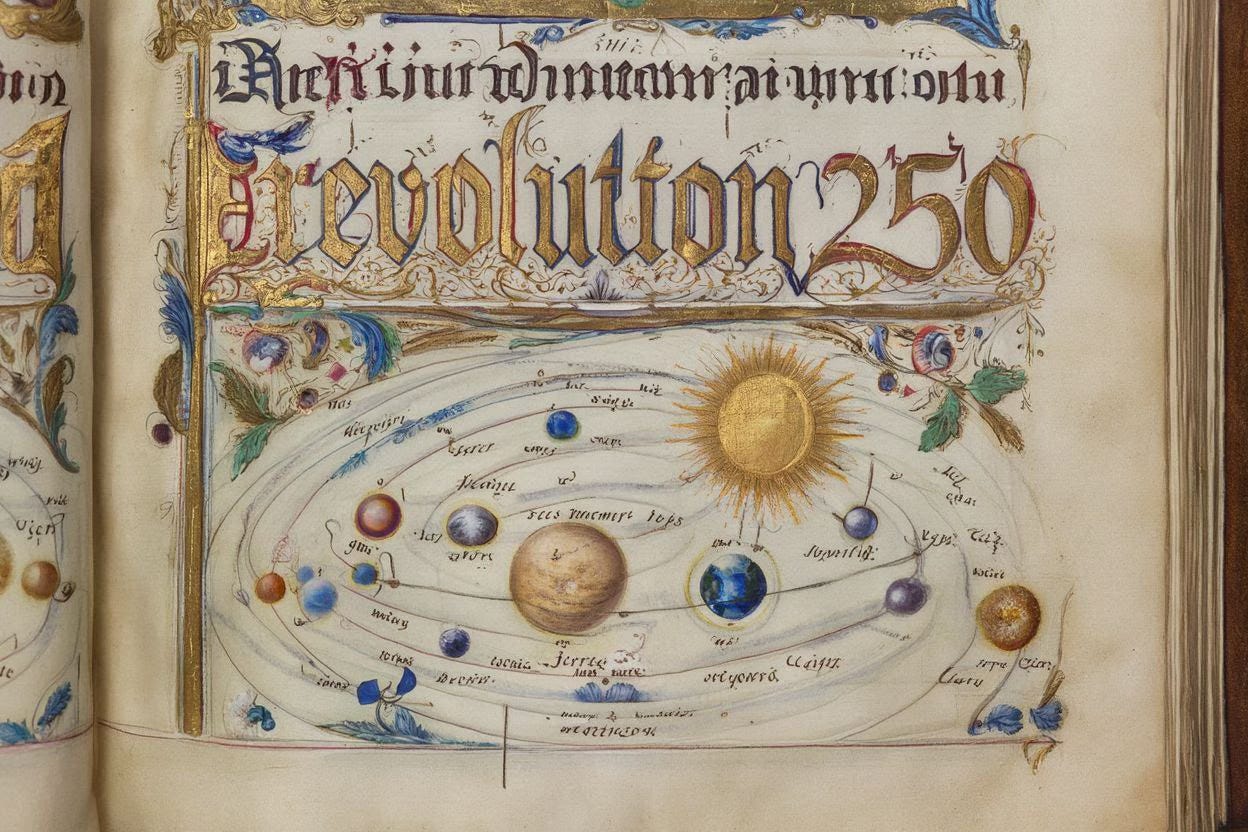
Winter, Spring
At the other end of a telescope, if the Big Bang’s distant past were to peer back at us, New Year’s Day might seem to it an arbitrary holiday. Why January First? Any day could start a revolution. Why not July Fourth?
To associate the two holidays, of course, is to conflate two senses of the word “revolution.” The first English use of “revolution,” as historian Garry Wills points out, referred to the stars’ paths across the night sky and the planets’ paths around the sun.2 The English started using the word in this sense early in the seventeenth century, when Johannes Kepler fixed the planets’ revolutions.
Later in the same century, English politics appropriated the scientific term, describing two big changes to their government—the royalist victory when Charles II was restored to the English throne in 1660 and Parliament’s victory when William and Mary ascended the throne in 1688—as revolutions.3 (The latter revolution is the “Glorious Revolution” and is usually what is meant by references to the “English Revolution.”)
Proponents of these two opposed political upheavals called them revolutions because, in their view, something long missing was restored to English government, just as the earth is restored each year to some arbitrary place in its revolution around the sun. For these proponents, ancient liberties had been restored and history, like the planets, had come full circle.
Even a century later, England’s founder of conservatism supported revolutions. To Edmund Burke’s way of thinking, a revolution is the necessary exception that makes continuity in government possible. As a conservative, Burke reasoned that “a state without the means of some change is without the means of its conservation.”4
For Burke, flexibility means strength. On the ground, so to speak, revolution is the wobble, or maybe the detour, that permits the state to continue its course, which in England’s case includes the hereditary succession of monarchs. Burke saw each succession as a revolution:
[Hereditary succession] is the spirit of our constitution, not only in its settled course, but in all its revolutions. Whoever came in, or however he came in, whether he obtained the crown by law or by force, the hereditary succession was either continued or adopted.5
Some English kings usurped the throne, Burke admitted, but England, imbued with its constitutional spirit of hereditary succession, resumed its governmental circuit after each usurpation. Revolution is the exception that makes the rule of succession.
Burke understood the French Revolution differently, though. He saw it not as a change that permitted a return to France’s “settled course” but as a change that would start France on a new and dangerous course. The word “revolution” would lose its meaning in such a context, Burke thought. Proponents of the French Revolution, he believed, “take the deviation from the principle for the principle.”6 The revolution’s English proponents, whom Burke warned his readers against in his famous book Reflections on the Revolution in France, wished to bring France’s perverted notion of revolution to England. They wished to substitute France’s deviation for England’s settled course by eliminating hereditary succession as well as other institutions that kept England in its fixed political orbit.
Burke’s understanding of revolution, then, is circular and sempiternal. However, the new understanding of revolution brought by the French Revolution—the understanding we’re now more familiar with—is rectilinear, grounding government not in a return to longstanding institutions but in a new conformity to the rights of man or to the people’s “general will” or both.7
Was the American Revolution a revolution in the English or in the French sense? Was it a circular return to ancient liberties or a rectilinear experiment based in large part on John Locke’s natural rights theory, which also influenced the French Revolution? Burke argued in 1775 that the Americans based their claims against English policy on a desire to restore to themselves the liberties of the English Constitution. The Americans are, he claimed, “not only devoted to liberty, but to liberty according to English ideas, and on English principles.”8
In asserting independence a year later, of course, the erstwhile American colonies could no longer base their position on the English Constitution. But even the Americans’ reliance on abstract theory—on John Locke’s doctrines of natural right and revolution—was indirectly grounded in English constitutional law, according to John R. Stoner, Jr.:
. . . at least as much as Locke ever intended, into [his] theory were integrated doctrines and practices of English common lawyers and their notion of an ancient constitution—an unwritten constitution subject to development as well as decay but ultimately aimed at protecting English liberties.9
Just as the American revolution, from a temporal standpoint, came between the English and French revolutions, so also the American Revolution seemed to adopt both the continuity Burke saw in the English Revolution and the new start that the French revolutionaries set out to make in 1789. As Hannah Arendt summarizes it, speaking of the American revolutionaries,
What they had thought was a restoration, the retrieving of their ancient liberties, turned into a revolution, and their thoughts and theories about the British constitution, the rights of Englishmen, and the forms of colonial government ended with a declaration of independence.10
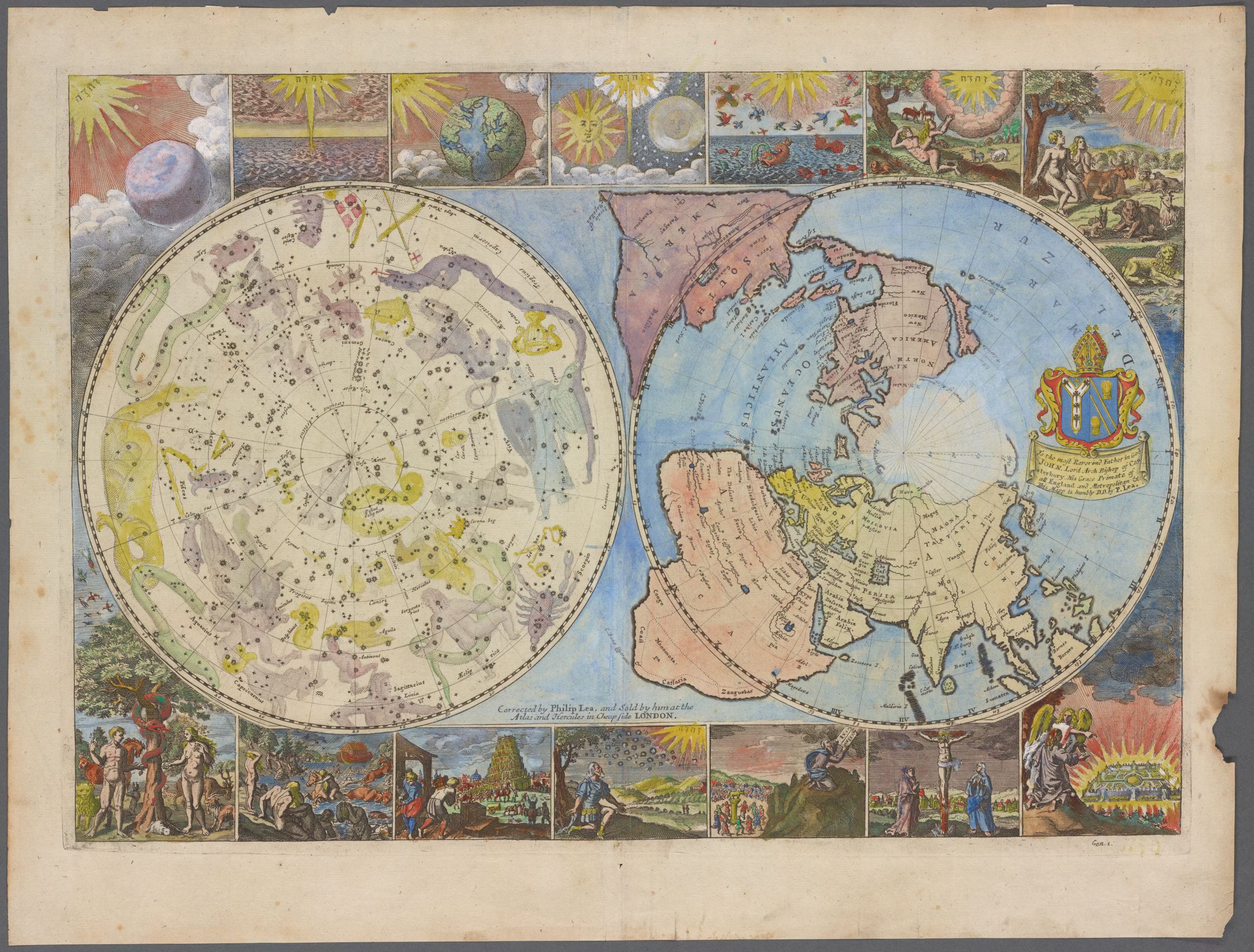
Above: Map of Heavens and Earth. From the New York Public Library. Public domain.
Summer, Fall
So far we’ve enjoyed a kind of springtime, dear reader, finding symmetry in the American Revolution reminiscent of a French garden. Guided by the English etymology of “revolution,” we’ve discovered that the American Revolution is both English and French, both cyclical and rectilinear.
It would’ve made a good essay, too, I’ll venture, if I’d venture no further. But our assay of the American Revolution’s mettle hasn’t completed its circuit. True, we’ve walked through the sources of American liberation. Now that I’ve brought up Hannah Arendt, though, we must look at the American Revolution also for its late-season bloom, the political flowering that often needs the heat of our fights for liberation. We must look for public freedom.
Arendt’s 1963 book titled, appropriately enough, On Revolution, focuses mostly on the American Revolution and its aftermath. The book casts the French Revolution as the American Revolution’s wayward, younger sister. When Arendt looks at both revolutions’ first years—and she focuses more on the American Revolution’s beginnings than on its sister’s—she’s more interested in the process of independence than in its products. Regarding the former revolution, Arendt is more interested specifically in the experiences and interactions of the delegates to the Second Continental Congress than in the Declaration of Independence that resulted from them.
As the delegates labored in Philadelphia for liberation, she says, they stumbled upon the delights of something different from liberation. While they were founding a nation, they found public freedom. Compared to this freedom, liberation from “taxation without representation” seems . . . well, banal:
Whatever the merits of the opening claim of the American Revolution—no taxation without representation—it certainly could not appeal by virtue of its charms. It was altogether different with the speech-making and decision-taking, the oratory and the business, the thinking and the persuading, and the actual doing which proved necessary to drive this claim to its logical conclusion: independent government and the foundation of a new body politic. It was through these experiences that those who, in the words of John Adams, had been “called without expectation and compelled without previous inclination” discovered that “it is action, not rest, that constitutes our pleasure.”11
Few eighteenth-century revolutionaries sought this public happiness, though, because few knew of its existence before they began to act together for liberation:
The men of the eighteenth-century revolutions had a perfect right to this lack of clarity [between liberation and freedom]; it was in the very nature of their enterprise that they discovered their own capacity and desire for the “charms of liberty,” as John Jay once called them, only in the very act of liberation.12
Genuine revolution, Arendt says, must involve both a new beginning and this public freedom. Consequently, every coup d’état or civil war, ancient or modern, doesn’t amount to a revolution.13 Political freedom and beginning something new, she says,
are at the root of the enormous pathos which we find in both the American and the French Revolutions, this ever-repeated insistence that nothing comparable in grandeur and significance had ever happened in the whole recorded history of mankind, and which, if we had to account for it in terms of successful reclamation of civil rights [i.e., liberation], would sound entirely out of place.
Only where this pathos of novelty is present and where novelty is connected with the idea of freedom are we entitled to speak of revolution.14
In a real revolution, before liberty bells ring, public freedom must ring inside the citizens’ assemblies, as it did in the Second Continental Congress.
But does that mean we’ve left revolution’s orbit? That is, has revolution in modern times become only rectilinear, concerned as it is with novelty “connected with the idea of freedom”?
Arendt’s entire book may be considered a search for modern revolution’s orbit, a search for the American Revolution’s missing institution that would serve as a kind of temple for the return of revolution’s spirit. After the American Revolution ended, Arendt laments, “the spirit of revolution—a new spirit and the spirit of beginning something new—failed to find its appropriate institution.”15
The new revolution’s revolution would cycle differently than would the restorations claimed by the supporters of Charles II or William and Mary. These early modern revolutions claimed the restoration of only civil liberties. In Arendt’s orbit toward restoration, civil liberties wouldn’t be restored, or at least not at first. Instead, citizens themselves would be restored, and restored to public life.
A modern revolution, Arendt suggests, would not be out of bounds if it promulgated a new calendar to aid in public life’s restoration. The French Revolution’s calendar, which made 1789 its Year One, attests to a country’s new political start, Arendt says, but also to something greater. It signaled “an entirely new era” that discovered in revolution something beyond the sempiternal cycles of governments among the one, the few, and the many typical of ancient and even early-modern revolutions.16 Theoretically, citizens living in this newly mapped time would imbibe revolution’s spirit as they practiced public freedom.
A new calendar certainly gives witness to a new beginning. In an American calendar, July Fourth could become January First. But does a new calendar suggest, in each year’s revolution of witness, the kind of institution that would keep the spirit of revolution among us?
Arendt’s good friend Walter Benjamin thinks so. Benjamin points to the same revolutionary calendar as evidence that ordinary time can be interrupted by remembrance just as it can, on Day One, be interrupted by revolution itself:
The initial day of a calendar serves as a historical time-lapse camera. And, basically, it is the same day that keeps recurring in the guise of holidays, which are days of remembrance.17
A time-lapse camera confounds ordinary time and links the past with the present. As we view its film, our July 4, 2026 would not just remind us of July 4, 1776. Instead, our first July 4 would be present among us, disguised as our present July 4. A calendar—frankly, even our present calendar, and this year’s sestercentennial to boot—could serve as an archetype of the revolutionary spirit’s temple. But as an archetype, it only draws something of the true temple’s contours.
Woodrow Wilson came closer than a calendar to Benjamin’s kind of living historical consciousness. Wilson observed that the U.S. Supreme Court is “a kind of Constitutional Assembly in continuous session.”18 America’s momentous 1787 Constitutional Convention and all of its ratifying conventions appear in the guise of nine robed justices each time they deliberate on a Constitutional question.
The Supreme Court serves—or at least was designed by the Founders to serve—as the institution for the spirit of America’s 1787 Constitution. But what would serve as the institution for the spirit of America’s 1776 revolution?
Arendt points to another president’s conception of bringing the past into a living present. Thomas Jefferson traced his love of public freedom to his past as a delegate to the Second Continental Congress.19 After his presidency, he wrote at least eight letters advocating for Virginia (and by extension, for other states) to make his and his fellow delegates’ experiences in Congress available to all citizens. His plan was this: divide Virginia’s counties into wards, each with around a hundred citizens. Jefferson wanted direct democracy at the local level. In each ward-republic, all citizens would govern the local areas where they lived and, in the process, would develop and maintain face-to-face, public relationships.20
American citizens’ practice of daily, local public freedom, Jefferson believed, would keep America from falling into the hands of an autocrat:
Where every man is a sharer in the direction of his ward-republic, or of some of the higher ones, and feels that he is a participator in the government of affairs . . . when there shall not be a man in the state who will not be a member of some one of its councils, great or small, he will let the heart be torn out of his body sooner than his powers wrested from him by a Caesar or a Bonaparte.21
The inverse is also true: if Americans don’t practice public freedom, they’ll lose even the liberation they won during their revolution.22
Public freedom can be practiced in limitless ways, including updated versions of Jefferson’s local assemblies, direct action, community organizing, mutual aid, public lamentation, street liturgy, hospitality to strangers, indigenous public traditions, community art centers, carnivals, intentional communities, and anticipatory democracy.
Arendt calls the American Revolution a “simple fact.” But even simple facts can be forgotten:
. . . facts are stubborn; they do not disappear when historians or sociologists refuse to learn from them, though they may when everybody has forgotten them. In our case, such oblivion would not be academic; it would quite literally spell the end of the American Republic.23
Arendt isn’t concerned that we will forget that the American Revolution happened. She is concerned that we have no institution that would restore the living presence of the revolution to us. She describes an oblivion that begins without presence and ends without liberty. In that case, the spirit of revolution would find no purchase. It would hover over America’s dark, oligarchic waters indefinitely.
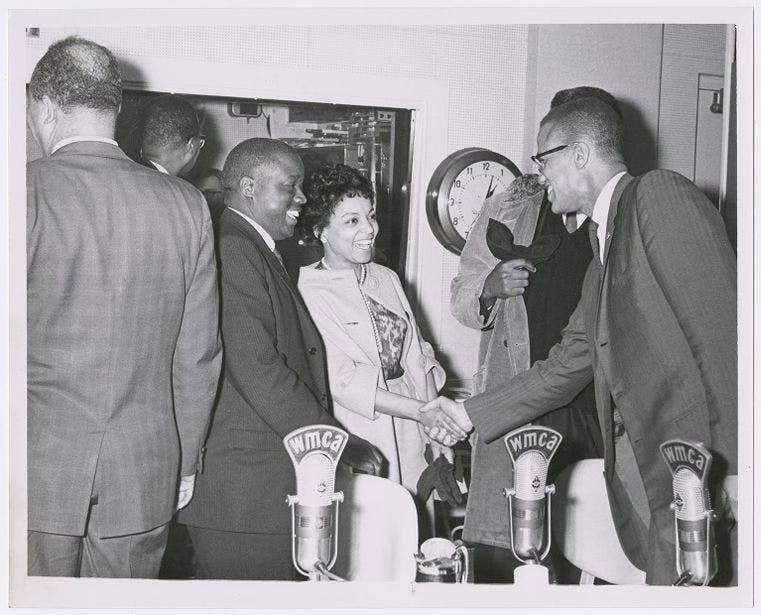
Above: “Gloster B. Current, Ruby Dee, and Malcolm X at radio station WMCA.” From the New York Public Library. The short footnotes below refer to the full citations in the earlier manuscript’s and this Substack’s bibliography.
Arendt, On Revolution, 14, 25, 31, 36, 133, 165, 213-18, 223-24, 230-31, 242, 258, 269, 272.
Wills, Inventing America, 51. Hannah Arendt points out the same Latin etymology. Arendt, 32.
Wills, 51 - 52, 94. Arendt, 33.
Edmund Burke, Reflections on the Revolution in France, ed. John G. A. Pocock (Hackett Pub. Co, 1987), 19-20.
Burke, 20.
Burke, 20-21.
Arendt points out that “There is no period in history to which the Declaration of the Rights of Man could have harkened back. . . . But inalienable political rights of all men by virtue of birth would have appeared to all ages prior to our own as they appeared to Burke—a contradiction in terms.” Arendt, 36.
Quoted in Stoner, Common Law and Liberal Theory, 183-84.
Stoner, 189.
Arendt, 34.
Arendt, 24.
Arendt, 23.
Arendt, 24-25.
Arendt, 24.
Arendt, 272.
Arendt, 19.
Walter Benjamin, “Theses on the Philosophy of History,” in Illuminations, by Walter Benjamin, ed. Hannah Arendt, trans. Harry Zohn (Schocken Books, 1986), 263.
Quoted in Arendt, 192.
On April 11, 1823, Jefferson closed his letter to John Adams with a brief foray into public eschatology: “May we meet there again, in Congress, with our antient Colleagues, and receive with them the seal of approbation ‘Well done, good and faithful servants.’” [594]
Arendt discusses Jefferson’s plan for ward-republics on pages 240-47 and page 271 in On Revolution.
Thomas Jefferson, “Letter to Joseph C. Cabell; Monticello, February 2, 1816,” in Thomas Jefferson, Political Writings, by Thomas Jefferson, ed. Joyce Appleby and Terence Ball, Cambridge Texts in the History of Political Thought (Cambridge University Press, 1999), 205.
Arendt puts Jefferson’s reasoning just as succinctly: “Jefferson thought the absence of such a subdivision of the country constituted a vital threat to the very existence of the republic.” Arendt, 241.
Arendt, 15.
This promises to be a fascinating series--letting Arendt's and Benjamin's ideas interplay here, as you put it. After all, we surely live in revolutionary times, even if the surfaces of life seem unchanged. Eager to read what you've got coming next!