


This Revolution 250 series article considers the Declaration of Independence and its Equality Clause in the context of tradition’s relationship with truth.
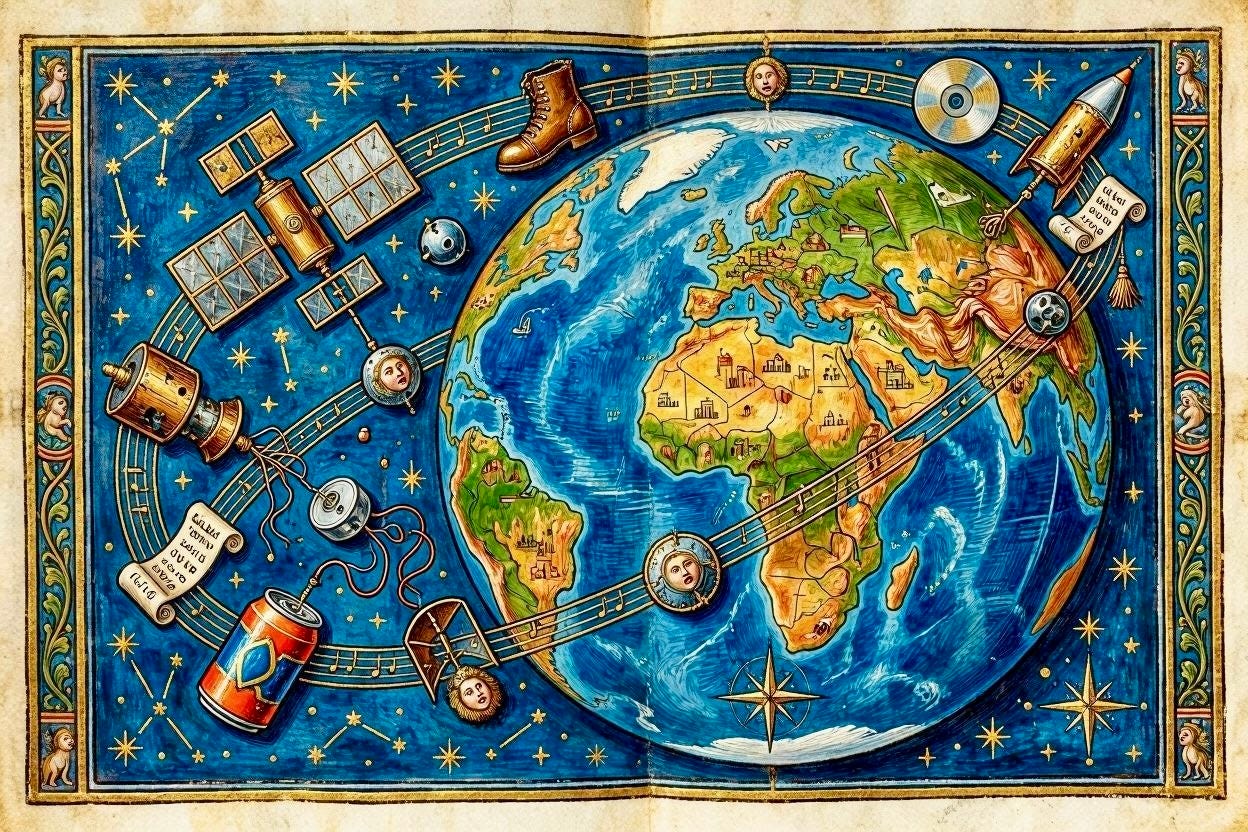
As an older American, I often find myself singing jingles for brands or products that no longer exist. I’m a carrier with expired cargo. When I start singing, say, “Carrol’s / the home of / the unforgettable edibles”—you don’t remember it?—I feel like a piece of space junk. It’s not the chain’s hamburgers, which as a teen I found indistinguishable from McDonald’s, that turned out to be unforgettable.
My meaningless memory emissions help me relate just a little to Franz Kafka. Philosopher and literary critic Walter Benjamin, a big fan of Kafka’s, says Kafka can be understood as jettisoning, in a way, all content just to keep the transport going. Kafka’s parables, short stories, and novels demonstrate transmissibility without truth, a kind of haggadic tradition with no discernible halachic content.
Benjamin shines his flashlight into Kafka’s literary shipping containers and finds them empty and swept clean:
But do we have the doctrine which Kafka’s parables interpret and which K.’s postures and the gestures of his animals clarify? It does not exist . . .1
Kafka’s work is . . . well, Kafkaesque in part because he provides the mediation, the transmissibility, but with no pretense of transmitted truth.2
A caveat, though. When I say, “Kafka can be understood as,” I don’t claim that Kafka can be understood, at least in the conventional sense. Kafka, Benjamin points out, “took all conceivable precautions against the interpretation of his writings.”3
But part of Kafka’s obscurity makes his point: in our age, truth and tradition have pretty much kicked each other to the curb. Truth has become fundamentalized—assented to but inhabiting no tradition. Or truth has become historicised—contextualized and objectified into irrelevance.
Kafka develops his world using our modern world as his negative. Or, better, Kafka presents his world as a mirror image of ours: he presents tradition devoid of truth as a lateral inversion of our world’s habit of proclaiming truth devoid of tradition. To help with this inversion, Kafka’s stories and characters make over-the-top but meaningless gestures, each of which “is an event—one might even say, a drama—in itself,” Benjamin points out.4 Each gesture acts like a tradition, but it doesn’t do tradition’s work. It doesn’t transmit meaning.
In The Trial, for instance, a priest speaks to the protagonist Josef K. alone from a pulpit, and he amplifies this gesture by insisting that K. come to the base of the pulpit and crane his neck to hear him. But no sermon—no content—ensues.5 Another gesture, this time in Kafka’s short story “A Fratricide,” involves a simple doorbell that inexplicably rings across town and up to heaven,6 where it finds me humming and circling the earth.
Abraham Lincoln seems to find himself in something like Kafka’s world. Throughout his public life, Lincoln understands his mission as entrusting the Founders’ truths, particularly the truth that “all men are created equal,” to the next generation. He understands his entire generation’s task, in fact, as transmitting the Founders’ “political edifice of liberty and equal rights . . . to the latest generation that fate shall permit the world to know.”7
But the Founders’ truths are propositional, and in the contentious lead-up to the Civil War, they seem to lack an adequate tradition to transmit them to any future generation.
Lincoln, in his most famous line—the opening words of his Gettysburg Address—describes “all men are created equal” as a “proposition”—that is, as a truth outside of a tradition.8 Jefferson in the Declaration of Independence likewise describes the same truth as “self-evident,” a syllogistic starting point that everyone in theory is compelled to accept and from which anyone could build various deductive arguments.9
Jefferson and Lincoln therefore find political equality axiomatic. In an 1859 letter he writes in celebration of Jefferson’s birthday, Lincoln describes the Equality Clause and the Declaration’s other self-evident truths as “the definitions and axioms of free society.” He compares them, in fact, to Euclid’s core axioms, upon which Euclid built his framework of solid and plane geometry.
But what if the next generation denies Euclid’s axioms? Geometry would collapse. Likewise, if the next generation denies that all men are created equal, free society would collapse. Those who deny it would supplant the principles of free government, Lincoln says, with principles of “classification, caste, and legitimacy.”10
Euclid, perhaps, needs no tradition to carry his propositions forward. But the Equality Clause, despite its axiomatic status—or perhaps, in part, because of it—needs one.
What to do? Lincoln tries to save the republic much earlier with an appeal to reason. In 1838, passionate mobs “from New England to Louisiana” are making the news every day. In his speech that year at Springfield’s Young Men’s Lyceum, Lincoln asks the American public to fight “this mobocratic spirit” with a new “political religion” that he defines as reverence for law.
The American Revolution used such passion—”the basest principles of our nature”—to establish and maintain liberty. But without a common enemy, Lincoln says, Americans in 1838 must put passion away in favor of its opposite:
Passion has helped us; but can do so no more. It will in future be our enemy. Reason, cold, calculating, unimpassioned reason must furnish all the materials for our future support and defense.11
At Lyceum, Lincoln wants to lower the American political temperature. Reason must seem to Lincoln a reasonable approach: he was admitted to the Illinois state bar less than a year before this speech. At Lyceum, he seems to ask his fellow citizens to join him in his new profession—in spirit, anyway—by adopting something like its “cold, calculating” reason.12
No luck. By 1859, Lincoln has long since accepted that reason alone isn’t going to do the job. Outside of courtrooms and lecture halls—and particularly from one generation to the next within a polity—reason turns out to be a poor transmitter of truth.
In his Jefferson birthday letter, Lincoln recognizes that the American Revolution itself, despite its use of what he earlier calls ”the basest principles of our nature,” provides the tradition necessary to pass on the Equality Clause’s truth. He credits Jefferson with a certain genius—not for drafting the clause, but for inserting it into the American Revolution’s most revolutionary document:
All honor to Jefferson—to the man who, in the concrete pressure of a struggle for national independence by a single people, had the coolness, forecast, and capacity to introduce into a merely revolutionary document, an abstract truth, applicable to all men at all times, and so to embalm it there, that to-day, and in all coming days, it shall be a rebuke and a stumbling-block to the very harbingers of re-appearing tyranny and oppression.13
This paragraph, in Lincoln fashion, is constructed with antonyms: “concrete” versus “abstract,” “pressure” versus “coolness,” “a single people” versus “all men at all times.” In each pair of antonyms, the first is tangible and historical, the stuff of tradition. The second is theoretical and propositional. The first becomes the vehicle for the second.
Jefferson delivers the wheels. He demonstrates the capacity to provide not only the truth, Lincoln says, but also the truth’s tradition, its means of transport.
In doing so, Jefferson—a lawyer, of course, like Lincoln—uses a different kind of “coolness” than the “cold” reason that Lincoln champions in 1838. Jefferson’s action is certainly cool, calm and collected—he keeps his head while all about him are losing theirs—but his action isn’t precisely rational. It’s perceptive and shrewd. By 1859, after all, history bears Jefferson out: Americans only a year after independence begin annual celebrations of the Declaration’s signing. Lincoln seems to credit Jefferson with the “forecast” to insert the Equality Clause’s truth into this then-future tradition and into the country’s veneration of the Revolution that the tradition taps into.14
But notice how Lincoln in the letter’s “All honor to Jefferson” paragraph downplays the Declaration and, with it, our entire revolutionary tradition. The Declaration becomes “a merely revolutionary document”—merely the carrier of the proposition that all men are created equal. The concrete struggle for national independence becomes a truck—or a satellite—with cargo greater than the struggle itself or than even the “single people” involved in that struggle.
Lincoln therefore whittles his contrast between truth and transmission to a fine point with his stunning oxymoron, his compound adjective “merely revolutionary.” With “merely revolutionary,” Lincoln’s pairs of antonyms reach their ironic zenith.15
Like Kafka, Lincoln recognizes the need for truth’s transmission. Unlike Kafka, though, Lincoln doesn’t amplify empty gestures to suggest tradition’s ultimate necessity. Instead, Lincoln downplays America’s revolutionary gestures to emphasize, by explicit comparison, the revolutionary tradition’s precious cargo and the tradition’s potential for carrying that cargo to succeeding generations—generations that may face dangers similar to America’s just before the Civil War.
Generations like our own.
The priest’s sermon—or really, his parable—comes only after he climbs down from the pulpit and while he and K. are pacing together up and down a cathedral aisle. “Before the Law,” Kafka’s most famous parable, involves a man seeking the Law (in one sense, the Halacha) but meets a doorkeeper who, while not keeping him from entering the Law, refuses him permission to enter. For years, based on this refusal and the possibility of future permission, the man stands outside the Law and never ventures in, though it appears he could have. As the man is dying of old age, however, the doorkeeper finally closes the door to the Law against him.16
In the parable, legal procedure is both intimidating and vague, but the law’s content is absent. As he considers the parable, K. puzzles over a haggadic tradition with no discernible halachic content. What could it mean?
The priest and K. discuss the parable at length in talmudic fashion, as if the parable itself were the Law, but arrive at no conclusions. In his Kafka essay, Benjamin points out that this parable unfolds, but not to one specific meaning:
[The parable comes] at such a significant moment [in The Trial] that it looks as if the novel were nothing but the unfolding of the parable. The word “unfolding” has a double meaning. A bud unfolds into a blossom, but the boat which one teaches children to make by folding paper unfolds into a flat sheet of paper. This second kind of “unfolding” is really appropriate to the parable; it is the reader’s pleasure to smooth it out so that he has the meaning on the palm of his hand. Kafka’s parables, however, unfold in the first sense, the way a bud turns into a blossom. This is why their effect resembles poetry.17
We want parables that unfold into truth that we can hold onto, but Benjamin claims that Kafka offers poetry in place of clarity. The paper boat—truth’s erstwhile vessel—no longer unfolds into content. In Kafka’s work, parables, as traditions devoid of discernible truth, become poetry. As a vehicle, poetry may offer ambiguities, uncertainties and contradictions as a kaleidoscope offers new arrangements of broken glass.
And indeed, K.’s kaleidoscopic, talmudic discussion of the parable with the priest wearies K. Reflecting on the discussion, K. believes that “The simple story had become misshapen.”18 Still, Benjamin’s distinction between unfolding paper and unfolding blossoms suggests a promising approach to recovering tradition in a modern republic that seeks to practice democracy.19
Benjamin corresponds frequently about his Kafka essay with his close friend, Gershom Scholem, who is probably the greatest historian of Jewish mysticism. Scholem disagrees with Benjamin about why, for Kafka, the Law (or any propositional truth) is inaccessible to moderns. For Benjamin, tradition’s limitations begin with Adam and Eve’s exile. For Scholem, tradition’s limitations begin after Moses’ reception of the Law.20
Despite what Anson Rabinbach, a historian of twentieth-century European thought, calls this “inter-messianic dispute,”21 Scholem is impressed with Benjamin’s Kafka essay.22 Long after Benjamin’s death, Scholem writes a full essay about the relationship of truth and its transmission—the relationship of halachic content and haggadic tradition—in which he uses what seems to be Benjamin’s flexible metaphor of unfolding:
Tradition as a living force produces in its unfolding another problem. What had originally been believed to be consistent, unified and self-enclosed now becomes diversified, multifold, and full of contradictions. It is precisely the wealth of contradictions, of differing views, which is encompassed and unqualifiedly affirmed by tradition. There were many possibilities of interpreting the Torah, and tradition claimed to comprise them all.23
Scholem’s tradition that “becomes diversified, multifold, and full of contradictions” is much like Benjamin’s tradition in the form of Kafka’s parables. Isn’t, after all, diversity, complexity, and contradiction the stuff of poetry? The two friends differ over the Law’s availability, but they seem to understand in essentially the same way the nature of tradition that transmits the Law.
Where Benjamin and Scholem write about tradition in messianic terms, their essential agreement about tradition becomes even clearer. Scholem associates tradition’s flexibility and dynamism with the “Messianic condition”: any historical era’s unacceptable reading of Torah “anticipates a Messianic condition in which [that reading] will have its legitimate function.”24 In the Messianic era, the Law will reveal all of its manifold facets.
Scholem’s contrast of this Messianic era with “any given time within history” in which a rabbinic school’s understanding of Torah is rejected comports with Benjamin’s contrast of Messianic time with “homogenous, empty time,” including the events in a chronological account of history. Each generation has “been endowed with a weak Messianic power,” Benjamin says, and that power comes through a new insight into truth in the context of history—an insight preserved by tradition and called out by present danger:
To articulate the past historically does not mean to recognize it “the way it really was” (Ranke). It means to seize hold of a memory as it flashes up in a moment of danger.
Benjamin understands that an ostensibly objective view of history—typified for Benjamin here by historian Leopold von Ranke and typical, of course, of modern historicism—as “the way it really was” reinforces the victors’ views of history. Such views separate a truth from the tradition that would transmit a truth to people in that tradition as a memory—as bits and pieces from history—“in a moment of danger.”25
Benjamin’s philosophy of history, then, is dynamically traditional. His Theses on the Philosophy of History names only one tradition—“the tradition of the oppressed”26—because the victors themselves need no tradition to assert their truth. The victors wield historicism’s conformity and its underlying concept of “homogenous, empty time” to eliminate tradition. Hence our struggle—and Kafka’s lateral inversion of our struggle—to maintain tradition:
In every era the attempt must be made anew to wrest tradition away from a conformism that is about to overpower it.
If the ruling classes succeed in replacing tradition with conformism, we could not “seize hold of a memory” because we would no longer see it “flash up” to us from history. Without tradition, Benjamin therefore says, “even the dead will not be safe.”27
One thinks of perhaps the Bible’s first haggadic tradition that interrupts halachic content: the Torah’s interruption of the Passover narrative to institute the tradition of Passover. Just before the Torah instructs us on how to celebrate the Passover and carry it to succeeding generations, Moses leaves Pharaoh with news of the final plague, the death of all the firstborn in Egypt. The angel of death has yet to pass over the Israelites’ dwellings, and the Israelites have yet to cross the Red Sea. The truth of YHWH’s deliverance, therefore, is transmitted by the first Haggadah in a moment of danger.28
The Passover Seder’s point is never to relate events “the way it really was,” whether or not one believes that the events in the Passover narrative actually happened. Instead, the Seder understands history through the lens of a tradition, and the tradition offers collective memories that “flash up” when the community needs them.
Lincoln’s curious wording at the end of his Jefferson birthday letter doesn’t end with “merely revolutionary.” Lincoln also says that Jefferson acts “to embalm” the Equality Clause in the Declaration. Is Lincoln suggesting that Jefferson’s clause, transported to the Declaration as in a political ambulance, is dead on arrival?
Not exactly. As far back as 1828, in the pages of Noah Webster’s first dictionary, “embalm” carried both a concrete and a more abstract definition. “Embalm” had our sense of a means for preserving a dead body, but it also denoted the act of preserving anything, “with care and affection, from loss or decay.”29
Still, the concrete resonance of “embalm” suggests that Jefferson is also, in a sense, preparing equality for burial, or at least for a long moribund state. The paragraph’s context, however, suggests that Jefferson is also anticipating equality’s episodic resurrection in Lincoln’s day “and in all coming days” in which people would find themselves endangered by “re-appearing tyranny and oppression.”
Lincoln’s notion, which he attributes to Jefferson, of history as buried truths made accessible to later generations facing political peril comports with Benjamin’s notion that the true historian must “seize hold of a memory as it flashes up in a moment of danger.”
Can our revolutionary tradition, including its contradictions—its injustices and its past appeals to “the basest principles of our nature”—still transmit our greatest truth? Is it still strong enough to contain and to call forth the Equality Clause again in our moment of danger?
Will we work to find out? As a nation, we praise transport while jettisoning its cargo. We pledge allegiance to the flag but not to the form of government—the republic—for which it stands. Our national celebrations, including those planned for this week’s 250th anniversary of the Declaration, likewise have become empty gestures—mere transmissions, empty of their erstwhile propositional payloads. We’re living in a Kafkaesque moment.
Generations of ancient Israel neglected the Law, but three times in the Bible’s pages rededication to the covenant began with Passover’s reinstitution.30 Lincoln in 1854 makes a similar call for us to reinstitute our revolutionary tradition, including the Declaration of Independence, and the truth it carries:
Our republican robe is soiled, and trailed in the dust. Let us repurify it. Let us turn and wash it white, in the spirit, if not the blood, of the Revolution. . . . Let us re-adopt the Declaration of Independence, and with it, the practices, and policy, which harmonize with it. . . . If we do this, we shall not only have saved the Union; but we shall have so saved it, as to make, and to keep it, forever worthy of the saving.31
Let’s weed out empty, nationalistic gestures. Let’s tend the Declaration of Independence until diversity, complexity and equality unfold again.
The short footnotes below refer to the full citations in my earlier manuscript’s and this Substack’s bibliography.
Walter Benjamin, “Franz Kafka: On the Tenth Anniversary of His Death,” in Illuminations, by Walter Benjamin, ed. Hannah Arendt, trans. Harry Zohn (Schocken Books, 1986), 122.
“It is this consistency of truth that has been lost. Kafka was far from being the first to face this situation. Many had accommodated themselves to it, clinging to truth or whatever they happened to regard as truth and, with a more or less heavy heart, forgoing its transmissibility. Kafka’s real genius was that he tried something entirely new: he sacrificed truth for the sake of clinging to its transmissibility, its haggadic element.” Walter Benjamin, “Some Reflections on Kafka,” in Illuminations, by Walter Benjamin, ed. Hannah Arendt, trans. Harry Zohn (Schocken Books, 1986), 142-44.
Benjamin, “Franz Kafka,” 124.
Benjamin, 121.
Benjamin, 121. Franz Kafka, The Trial, trans. Mike Mitchell (Oxford University Press, 2009), 151.
Benjamin, “Franz Kafka,” 120. Franz Kafka, “A Fratricide,” in The Complete Stories, by Franz Kafka, ed. Nahum Norbert Glatzer, trans. Edwin Muir, The Schocken Kafka Library (Knopf Doubleday Publishing Group, 2012), 403.
Lincoln, Lincoln: Speeches and Writings, 1832-1858, 28.
“Four score and seven years ago our fathers brought forth on this continent, a new nation, conceived in Liberty, and dedicated to the proposition that all men are created equal.” Abraham Lincoln, Lincoln: Speeches and Writings, 1859-1865: Speeches, Letters, and Miscellaneous Writings, Presidential Messages and Proclamations, ed. Don E. Fehrenbacher, with Alfred Whital Stern Collection of Lincolniana (Library of Congress), Library of America 46 (Literary Classics of the United States : Distributed by Viking Press, 1989), 536.
Jefferson’s wording in the Declaration’s first draft was “We hold these truths to be sacred and undeniable”—diction in a more religious and less syllogistic register. But he amended the wording to “self-evident” before he reported a draft to Congress. Wills, Inventing America, 237-38.
Lincoln, 18-19.
Lincoln, Lincoln: Speeches and Writings, 1832-1858, 32, 36.
I get it. I spent the first few years of my law practice arrogantly complaining that there were too many non-lawyers in the world.
Lincoln, Lincoln: Speeches and Writings, 1859-1865, 18-19.
That veneration also leads to Jefferson’s birthday celebration, an invitation to which Lincoln, due to previous commitments, has to decline by means of his letter. Lincoln’s letter, occasioned by a celebration associated with the Republic’s founding, transmits its reasserted truth that all men are created equal not only through the concrete means of mail (of course) but also through Jefferson’s concrete and accurately forecasted tradition.
Garry Wills argues persuasively that Lincoln “remade America.” See gen. Wills, Lincoln at Gettysburg. Admittedly, in the process, Lincoln to some extent remade Jefferson. “Lincoln is no longer able to think of the Declaration as Jefferson did. Jefferson, a philosophical materialist, did not believe in metaphysical abstractions. For him, the right to equality and happiness was an empirically treated and measurable law of nature, inherent in the workings of society.” Wills, 103. Lincoln, by contrast, influenced his age’s Transcendentalism, believed with George Bancroft that “The heart of Jefferson in writing the Declaration, and of Congress in adopting it, beat for all humanity; the assertion of right was made for the entire world of mankind and all coming generations, without any exceptions whatever.” Wills, 104-105 (Bancroft’s words).
Benjamin, The Trial, 153-55.
Benjamin, “Franz Kafka,” 122.
Benjamin, The Trial, 155-59.
Ann E. Berthoff, in discussing Louise Rosenblatt’s version of “reader-response” theory, points out “the political importance of learning to tolerate not only other people’s opinions but ambiguity itself . . . in conjunction with belief in democratic values.” Berthoff, “Democratic Practice, Pragmatic Vistas,” 134.
Benjamin’s Kafka points to truth’s dissipation after “the Adamic state.” Benjamin’s Kafka suggests “a ‘gestural’ or ‘physiognomic’ mode of knowledge in which the ‘bits and pieces’ of historical experiences offer more in their dissipation than does the most coherent philosophical system in its completeness,” according to Anson Rabinbach. By contrast, Scholem’s Kafka points to the “inherent nihilism” of Jewish tradition, according to Rabinbach: “. . . the cosmic exile of the Jews is also an exile from the meaning of the Law, but not from the Law itself.” Anson Rabinbach, “Introduction,” in The Correspondence of Walter Benjamin and Gershom Scholem, 1932-1940, 1st American ed, by Walter Benjamin and Gershom Scholem, ed. Gershom Scholem (Schocken Books, 1989), xxxi-xxxii.
The two friends find different ways, though, in which modern people can access some truth through tradition. For Benjamin, danger can call up “‘bits and pieces’ of historical experiences” from tradition, according to Rabinbach. According to Scholem, the “mystical totality of ‘truth,’ whose existence disappears particularly when it is projected into historical time, can only become visible in the purest way in the legitimate discipline of commentary . . .” Commentary, Rabinbach points out, is Scholem’s idea of the Jewish “esoteric tradition” that “restores and transforms” orthodoxy’s meaning. Rabinbach, xxxi.
Rabinbach, xxxii.
See gen. Walter Benjamin and Gershom Scholem, The Correspondence of Walter Benjamin and Gershom Scholem, 1932-1940, 1st American ed, ed. Gershom Scholem (Schocken Books, 1989), 122-23.
Gershom Scholem, “Revelation and Tradition as Religious Categories in Judaism,” in The Messianic Idea in Judaism and Other Essays on Jewish Spirituality, by Gershom Scholem, trans. Michael A. Meyer (Schocken Books, 1995), 290.
Scholem, 290-91.
Walter Benjamin, “Theses on the Philosophy of History,” in Illuminations, by Walter Benjamin, ed. Hannah Arendt, trans. Harry Zohn (Schocken Books, 1986), 254-55.
Benjamin, 257.
Benjamin, 255.
Exodus 11-12.
“Webster English Dictionary 1828 PDF Volume 1,” Original Bibles, OriginalBibles.com, accessed June 19, 2026, https://www.originalbibles.com/webster-english-dictionary-1828-pdf-volume-1/.
After three instances of the Law’s generational neglect, Passover is celebrated under King Hezekiah (2 Chronicles 30:1–27), under king Josiah (2 Chronicles 35:1–19), and after the Babylonian exile (Ezra 6:19–22).
Lincoln, Lincoln: Speeches and Writings, 1832-1858, 339-40.
The title of Oliver Nelson’s excellent 1961 record comes to mind, The Blues and the Abstract Truth. A truth that is not at all axiomatic, more, like a democratic republic, both hard fought and hard won. An epistemology of struggle. Thank you, Bryce— and readers— for an excellent essay and following discussion. Benjamin, Kafka, Jefferson, and Lincoln all on the same page is kind of fun. Yielding insights that are by no means “self evident.“ It has been said that the blues “ain’t nothing but the truth. Your essay gives me much to think about this Independence Day— a holiday I have long found difficult.
I'm celebrating the 4th by catching up on several of your recent pieces--including the exchanges with your engaged reader, William! This one fascinated me in the way it used themes from Kafka and Benjamin to help unveil what has become our performative reading of the Declaration. Much to ruminate on here--gratitude!