


I spend my early mornings in the mulch, sitting against the air-conditioning unit. I have my smoothie, and I have my cat.
Our house sits at the end of a cul-de-sac, but one back corner faces our neighborhood’s main drag. Our neighbors, in the cool of the day, walk their dogs along this drag. The cat and I have learned to ignore the dogs. Stretched out on the mulch, the cat no longer even flinches when the unit’s fan cuts on.
But what do the neighbors think? We’ve partially hidden the unit with tall, willowy Pampas grass, but it’s easy to see us between the tall tufts. To complete the picture, I’ve thought about returning the neighbors’ discreet glances with the field glasses I’ve stored somewhere.

Above: Cat-Cat among the Pampas. (Tyger! Tyger! burning bright)
The mulch is our cat’s idea. He had a rough upbringing, growing up with a hundred other strays in Nashville. When we got him in February, the shelter made us sign papers that we’d accompany him if we let him outside. The cat, for his part, wants our company constantly and won’t stray ten yards from our doors. He signals each morning when it’s mulch time.
Together, Cat-Cat and I are getting domesticated.
My world is contracting. I spend time in Birmingham and Nashville, but I spend most of my days in between, in the small town of Columbia. In my mulch. I feel like Jonah in that last chapter on the outskirts of Nineveh, that great city. It’s just him and his gourd and his God.
Things are still happening in Nashville. ICE continues to persecute its Coptic residents. After a recent Coptic Orthodox service, one of the parishioners explained to me—in my capacity as a podcaster? Or as a white American?—that he and his people just want to live in peace.
To the Orthodox Copts, I’m a member of a privileged class. Maybe Jonah, as a member of an oppressed people, doesn’t fit my predicament. I’m more like the aristocrat in A Gentleman in Moscow, a book I’m reading that my brother, also recently retired, recommended. In the novel’s first pages, the Bolsheviks sentence the Count to life in a Moscow hotel. The well-traveled Count spends several of the subsequent pages in the company of the hotel’s one-eyed cat.
My world’s contraction has recently expanded. You’ve heard that Katie Couric had a several-hour memory-loss episode last month? So did I. When asked who was president, she thought it was Joe Biden? So did I.1
My episode came two days before hers. My siblings call her a copy cat.
Like Couric, I was diagnosed with transient global amnesia.2 But because last month’s was my second episode, and because most TGA episodes are “one and done,” I’m seeing a specialist at Vanderbilt in September to (hopefully) rule out seizures.
Meanwhile, I’m not allowed to drive. Never mind that I drove fine during my first episode fifteen months before. Never mind that Couric, by all accounts, acquitted herself well as a panelist during her episode, though she doesn’t remember saying a word. She’s jet-setting all over the place, I’m sure, while I’m spending more time in the mulch. There’s only so many times I can bum rides from Victoria or my dog-walking neighbors.
First I was mulched. Now I’m also grounded.
What if I found those field glasses? I could become a kind of suburban flâneur. Would that satisfy my public itch?
The eighteenth-century flâneur, of course, didn’t hide behind tall grass but walked the streets. Flâneurs were jostled by the crowds, but their movements, unlike the crowds’ movements, weren’t hurried or purposeful. The flâneurs’ very aimlessness made “things reveal themselves in their secret meaning,” as Hannah Arendt describes the idea.3 Flânerie remains an urban epistemology,4 a kind of shell collecting cum conchology along the city’s shore.
Walter Benjamin, though, for whose writings, according to Arendt, “the flâneur became the key figure,”5 references a fictional character stationed at home like me to describe the flâneur’s attitude. The protagonist “cousin” in an E. T. A. Hoffmann short story watches people at market day from his apartment window.6 Looking at them through his opera glasses makes him feel superior. He is the subject, and his neighbors are his objects.
But the difference between the cousin and the flâneur doesn’t end with the cousin’s opera glasses. The story’s mise-en-scène is all wrong, Benjamin says. The cousin’s not in Paris or London, where he wouldn’t have focused on particular people but on the masses and the peculiar world that frames them. And he’s looking from home, like me.7
Still, the cousin and I make a point. Even on the city street, the nineteenth-century flâneur participates in the public sphere’s domestication. She feels at home, Benjamin suggests, because the streets feel like home. On the street, she recognizes various rooms at home that reflect her work and domestic life:
. . . he is as much at home among house façades as a citizen is within his four walls. To him, a shiny enameled shop sign is at least as good a wall ornament as an oil painting is to a bourgeois in his living room. Buildings’ walls are the desk against which he presses his notebooks; newsstands are his libraries; and café terraces are the balconies from which he looks down on his household after his work is done.8
Note the silence of Benjamin’s flâneur among his urban “rooms.” The flâneur sees and records, but he doesn’t speak. He represents what sociologist Richard Sennett finds dispositive in nineteenth-century public life: the gregarious, convention-following (and convention-transgressing) eighteenth-century public person has devolved into a silent spectator.9 As a result, “Observation and ‘turning things over in your mind’ take the place of discourse.”10
Our neighbors are friendly. One of my walking companions—someone with a vast capacity for friendship—has introduced me to any number of people. My walks with him are enjoyable social explorations. It’s a great neighborhood.
But when I walk in my neighborhood, have I really left home? Does my conviviality with my neighbors make me less silent?
All of the people I’ve interviewed for the Public Spaces podcast act locally. Many act to create communities in neighborhoods that have been ravaged by capitalism or racism or both. Other people denigrate some of these efforts, claiming that organized political action itself tends to encroach on the turf of family, neighborhood, and/or organized religion.11
Whether the localism in question feels more conservative or progressive, it may not go far enough in reviving the city. Sennett argues that, in the nineteenth century, localism was introduced to circumscribe people, particularly the working class, within ghettos. In Paris, “the intermixing of classes within districts was reduced by design”—often by physical walls and differences in prices for food and homes. During the same century, London created the same class-conscious localism but through distance between neighborhoods of different classes.
City planners who champion localism may be inadvertently reinforcing this breakup of the city, Sennett warns:
The celebration of localism and of the small-scale neighborhood on the part of well-meaning planners today is an unwitting reinforcement of a new form of domination, a deprivation of the city, imposed on workers in the [nineteenth] century.12
Sennett’s ideal city is a cosmopolis, a public space which people from many nations—and, by extension, many backgrounds—access and in which they associate. Compartmentalizing forms of localism deprive citizens of this city. Segmentation-as-localism stunts a vital aspect of citizenship necessary for the city’s flourishing, Sennett argues:
Now precisely what gets lost in this celebration [of the ghetto] is the idea that people grow only by processes of encountering the unknown. Things and persons which are strange may upset familiar ideas and received truth; unfamiliar terrain serves a positive function in the life of a human being. The function it serves is to accustom the human being to take risks. Love of the ghetto, especially the middle-class ghetto, denies the person a chance to enrich his perceptions, his experience, and learn that most valuable of all human lessons, the ability to call the established conditions of his life into question.13
As a volunteer at our town’s regional hospital, I try to learn something about people while escorting them to different parts of the campus. Around half of those I’ve escorted—and most of those I escort are older people—haven’t lived outside of southern Middle Tennessee.
People in both my white neighborhood and my Black church sometimes talk about how this local phenomenon narrows people’s experience and keeps people from questioning their locale’s pervasive ideologies and mindsets.
I often find a pervasive inability to identify privilege and systemic injustice particularly in “middle-class ghettos”—white, suburban neighborhoods. To discover the existence, much less the power, of invisible systems, those of us with privilege must take steps to transgress this and similar forms of localism.
People who transgress these local boundaries are Sennett’s cosmopolites. He defines the term in the context of a far more sociable public age than our own:
A cosmopolite, in the French usage recorded in 1738, is a man who moves comfortably in diversity; he is comfortable in situations which have no links or parallels to what is familiar to him.14
Surely this comfort level comes from making a habit of seeking out these unfamiliar situations. Or in being forced into such situations:
Without inherited wealth or inherited feudal obligation, the cosmopolitan, whatever his pleasure in worldly diversity, of necessity must make his way in it.15
People who find the need to code switch or to speak one language at home and another at school or work are often cosmopolites by necessity.
Maybe Jonah is my guy after all. God bids him to transgress national boundaries, and even when fleeing this God, Jonah transgresses them anyway. Robert Alter captures the cosmopolitan theme of Jonah’s journey:
Jonah engages with no Israelites in the story. First he has an exchange with the polytheistic mariners, then he addresses the Ninevites, and his closest connection is with two presumably insensate living things, a very large fish and a leafy plant. The God with whom he has such difficulties because of his Israelite nationalist mind-set is not chiefly the God of Israel but the God of the whole world, of all creatures large and small.16
Perhaps the balanced polity finds its spirit in the book of Psalms, a God faithful to Israel as well as a God concerned with the entire world.17 I might also suggest as a model Benjamin’s account of the storytellers he imagines in a medieval guild. The resident master craftsman and the traveling journeyman, who worked together, would share stories, one from long ago and the other from far away:
In it was combined the lore of faraway places, such as a much-traveled man brings home, with the lore of the past, as it best reveals itself to natives of a place.18
Benjamin’s vision of storytelling involves an openness to both a place’s tradition and the stranger’s new perspectives. Perhaps this cross-pollination spawns a healthy cosmopolis, too.
YHWH is the God of tradition and of the stranger. He’s the God of the local and of the international. He’s the God of cattle in sackcloth19 and of Cat-Cat in mulch. But in the Christian Bible’s pages, he’s chiefly the God of the bride, the New Jerusalem of every nation and tongue, the cosmopolis coming to earth.20
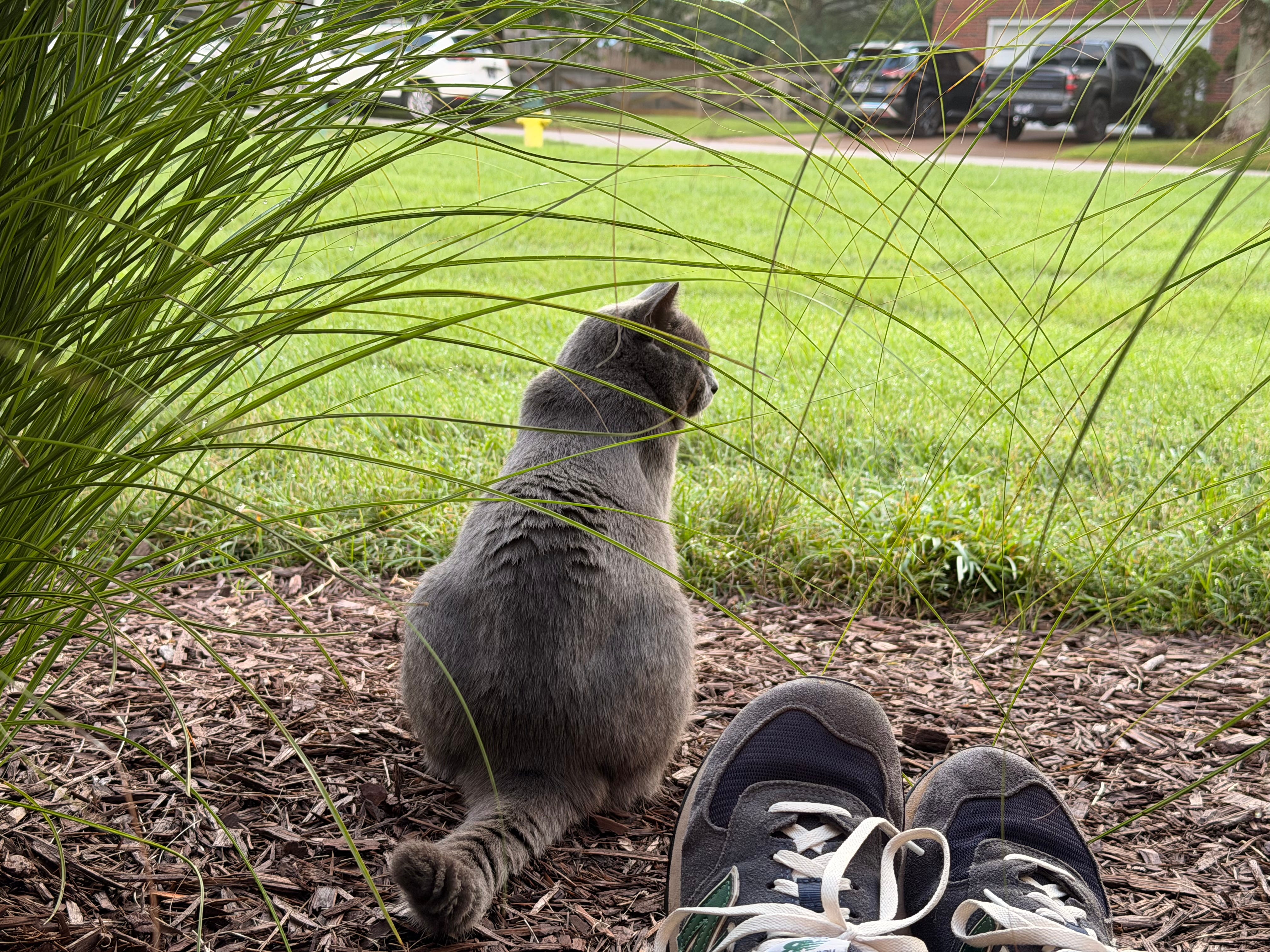
Above: Our view from the air-conditioning unit. Do you really consider this essay an elaborate excuse for posting cat pics?
The short footnotes below refer to the full citations in my earlier manuscript’s and this Substack’s bibliography.
My siblings pointed out other similarities of which I was unaware. (I don’t watch TV except for sports, so I know of Couric only by reputation.) We graduated U.Va. the same year. We spent first year there in the same set of “Old Dorms.” Since correlation is causation, it’s fair to ask: was it something we ate at the meal hall? Something we both picked up in Mr. Elzinga’s Micro Econ class, where I earned a gentleman’s C+?
A New England Journal of Medicine article on TGA reports that “During an episode, anterograde amnesia occurs, with an inability to retain new information for more than a few seconds, and retrograde amnesia extends backward for several hours, days, or longer.” Allan H. Ropper, “Transient Global Amnesia,” New England Journal of Medicine 388, no. 7 (2023): 635–40, accessed July 24, 2026, https://doi.org/10.1056/NEJMra2213867. Apparently, the “or longer” applied to both Katie and me regarding the president.
Hannah Arendt, “Introduction: Walter Benjamin: 1892-1940,” in Illuminations, by Walter Benjamin, ed. Hannah Arendt, trans. Harry Zohn (Schocken Books, 1986), 12.
The main character in Teju Cole’s 2011 novel Open City, for instance, can be understood as a flâneur.
Arendt, 21.
Hoffmann’s short story is “The Cousin’s Corner Window.” The story’s protagonist, like Hoffmann himself when he wrote the story, was paralyzed. Benjamin discusses the story in “On Some Motifs in Baudelaire.”
Walter Benjamin, “On Some Motifs in Baudelaire,” in Illuminations, by Walter Benjamin, ed. Hannah Arendt, trans. Harry Zohn (Schocken Books, 1986), 173-74.
Walter Benjamin, “The Paris of the Second Empire in Baudelaire,” in Walter Benjamin Selected Writings, Volume 4: 1938 - 1940, 1st pbk. ed, vol. 4, by Walter Benjamin et al., Selected Writings (Belknap Press of Harvard Univ. Press, 2006), 19.
Sennett, The Fall of Public Man, 260-61.
Sennett, 212-13.
Robert Nisbet, for instance, decries “the decline in functional and psychological significance of such groups as the family, the small local community, and the various other traditional relationships that have immemorially mediated between the individual and his society.” He fears, though, that “a great deal of the peculiar character of contemporary social action comes from the efforts of men to find in large-scale organizations the values of status and security which were formerly gained in the primary associations of family, neighborhood, and church.” Robert Nisbet, The Quest for Community: A Study in the Ethics of Order and Freedom (Oxford Univ. Press, 1953; repr., Regnery Publishing, 2010), 42-43.
Sennett, 133-37. See also 294-301.
Sennett, 295.
Sennett, 16-17.
Sennett, 17.
Alter, Hebrew Bible, vol. 2, 1287.
Robert Alter’s notes to his translation of Psalms often addresses when a verse or a psalm is national or universal in its emphasis. One of my favorite notes involves Psalm 33: “The viewpoint of this poem manages to be at once national (‘the people He chose as estate for Him’) and universalist: The God of creation surveys the deeds of men and women throughout the world.” Alter, Hebrew Bible, vol. 3, 92n13.
Benjamin, “The Storyteller,” 84-85.
Jonah 3:8; 4:11.
Revelation 21:9-10. “I saw no temple in the city, for its temple was the sovereign Lord God and the Lamb. The city did not need the sun or the moon to shine on it, for the glory of God gave it light, and its lamp was the Lamb. By its light shall the nations walk, and to it the kings of the earth shall bring their splendour.” 21:22-24 REB.
I love the clarity and personableness of Bryce’s writing. This humane, self-questioning post holds together what Roger Scruton and Simone Weil sometimes pull in different directions: attachment to home and obligation beyond it. Scruton helps explain the claims of neighborhood, tradition, and belonging. Weil explains why rootedness becomes corrupt when it excludes the stranger. What emerges is a cosmopolitanism rooted in fidelity, reaching from mulch and Cat-Cat to Nineveh and New Jerusalem.
Thanks, Bryce. What a pleasure to read and respond to.
Oh my brother, Bryce! Sorry you are facing down this TGA with earlier memories of hope in Biden’s administration come to your current reality. Thank you for taking the opportunity to relax with Cat Cat and quasi-engage your walk by neighbors, as you are at home in your black church and your Columbia place. The Lord is With You. And the whole of the world.