


This Revolution 250 series article claims the Civil War Amendments as America’s second, “more perfect” founding. It does so by demonstrating the relationship among three national covenants and by using Paul’s arguments about the relationship among ancient Israel’s three similar national covenants.
Montgomery last Saturday was hot. Early in the program, a member of the Georgia state legislature, someone who had marched in the 1960s, apparently fainted, probably due to the heat. Deanna Reed, the rally’s emcee, stopped the program, called for the medics, and reminded us to visit the hydration stations.1
And of course we prayed. We lifted hands toward the stricken legislator. And while the medics were attending to her, someone in the audience started us on the Amen song. It’s like we became aware of ourselves as a congregation, a congress. We felt showered in the spirit. I thought of the praise that God prepares for himself, the Psalmist says, that stills the enemy and the avenger.2
And I wondered if the Alabama State Capitol grounds had ever experienced such godly warfare before, inadvertently brought on by a medical emergency.
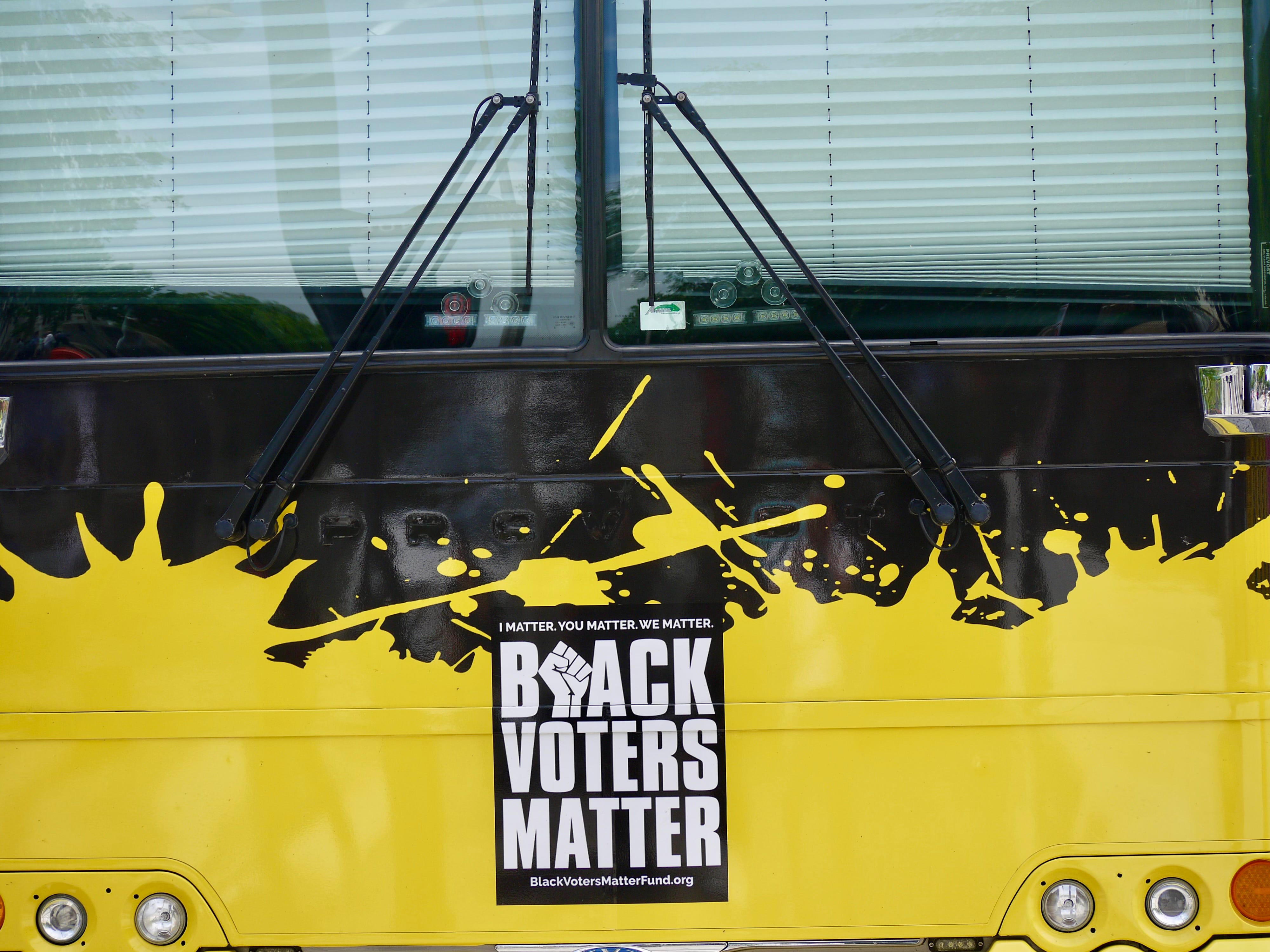
The All Roads Lead to the South rally itself is a response to an emergency, and it was organized in a single week. It felt, though, as if the planning had gone on for months. Over 160 organizations came together to plan or support the rally. The hydration stations, of which I availed myself after the medical emergency, were all over the capitol grounds. The water bottles were free, and everyone also got a voucher for lunch good at any of the many food trucks. Lots of us waved “The March Is Not Over” fans. Security was tight, and the security attendants at the check points were friendly, all thanks to trained volunteers and the city police. In all respects, we were treated like fellow citizens.
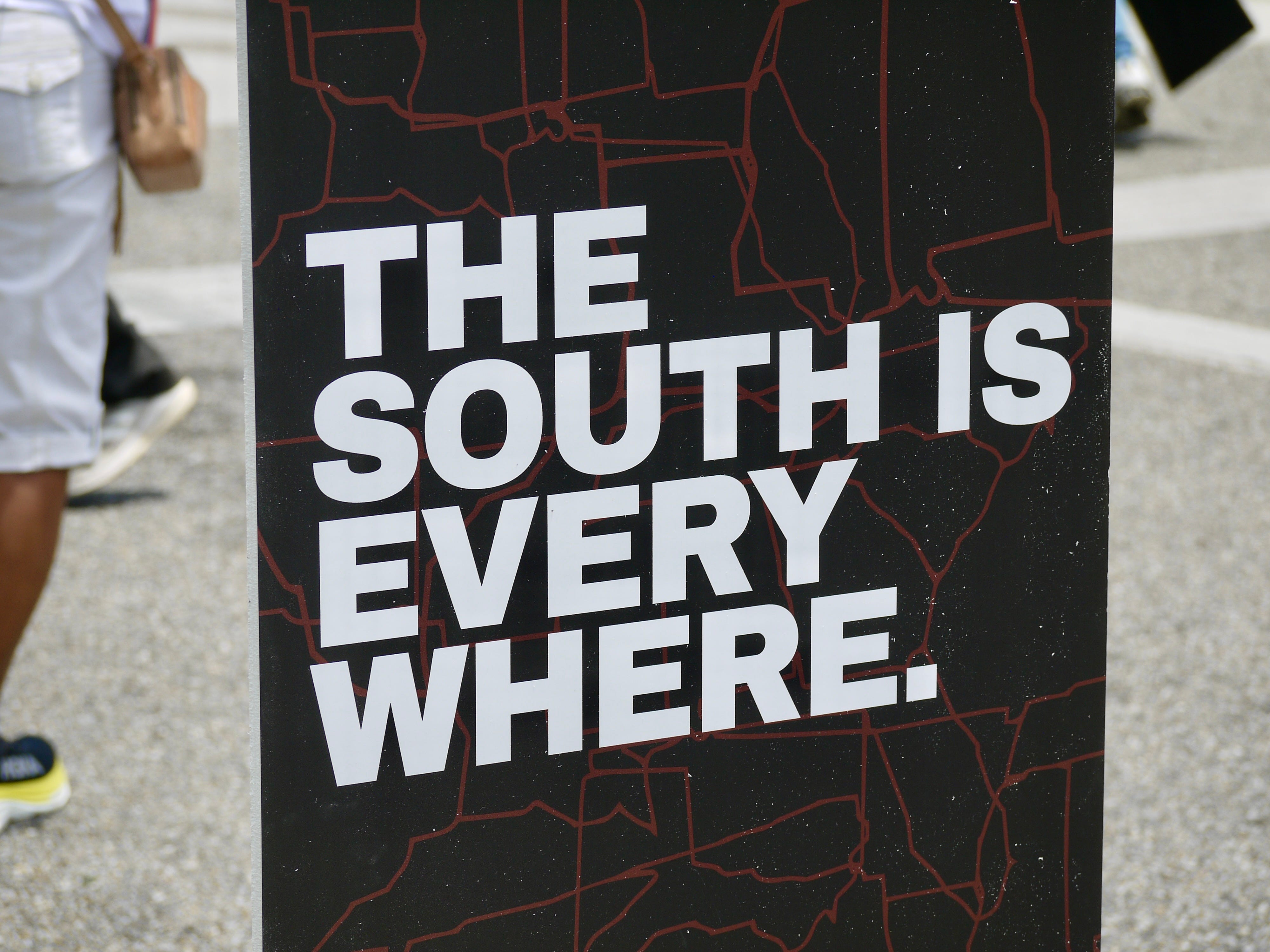
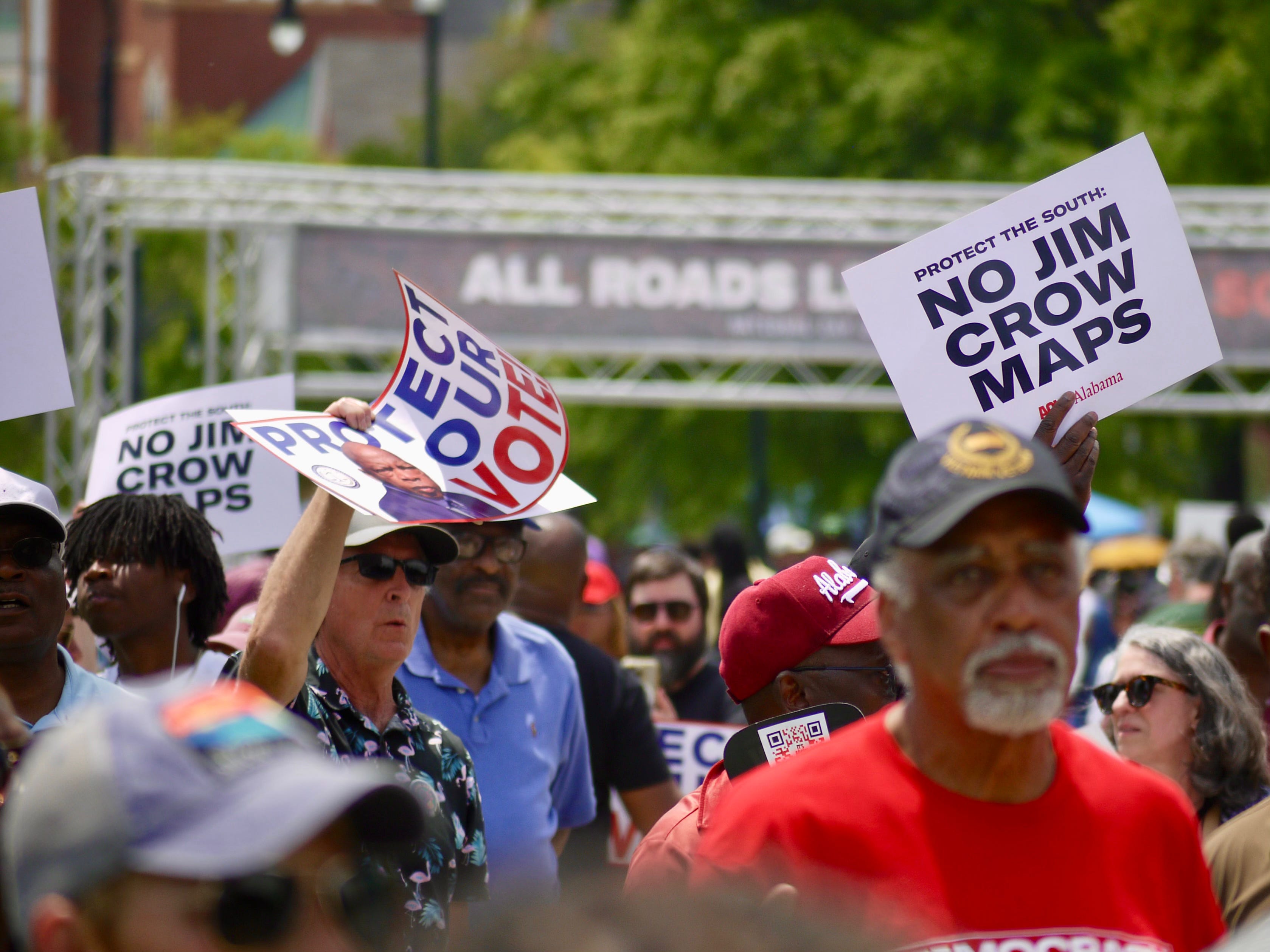
The thirty-some kiosks, with their common black, white and red theme, seemed both differentiated and coordinated. I picked up one of the many available free signs, this one from ACLU Alabama: “Protect the South: No Jim Crow Maps.” My favorite sign, not reproduced for distribution, suggested the regional and national reach of the emergency: “The South Is Everywhere.”
The emergency the rally addressed stems from U. S. Supreme Court’s April 29 Louisiana v. Callais decision. In its aftermath, legislatures across the South are racing to eliminate Black state and federal districts, to turn Blacks out of office, and to dilute the Black vote. Many Southern states are redrawing districts to eliminate, in the aggregate, 15 to 20 African-American Congresspeople and probably over 190 African-American state legislative seats over the next six or eight years.
As a street marker in front of what was the rally’s stage indicates, the Alabama State Capitol building marks the end of the 54-mile-long Selma to Montgomery Historic Trail. It also now marks the end of what the marches commemorated by that trail led to: the Voting Rights Act of 1965. Alabama has rushed to do its part. Almost as soon as the Supreme Court handed down Callais, the Alabama legislature changed the state’s congressional and state senate maps. They did so even though voting for primary elections under the earlier maps had already begun.
This emergency, in Alabama and across the South, leaves the Fifteenth Amendment without any enforcement power to defend the Black vote against white majorities’ actions to dilute it, and without any enforcement power to defend Black legislators against white legislatures’ actions to eliminate them.
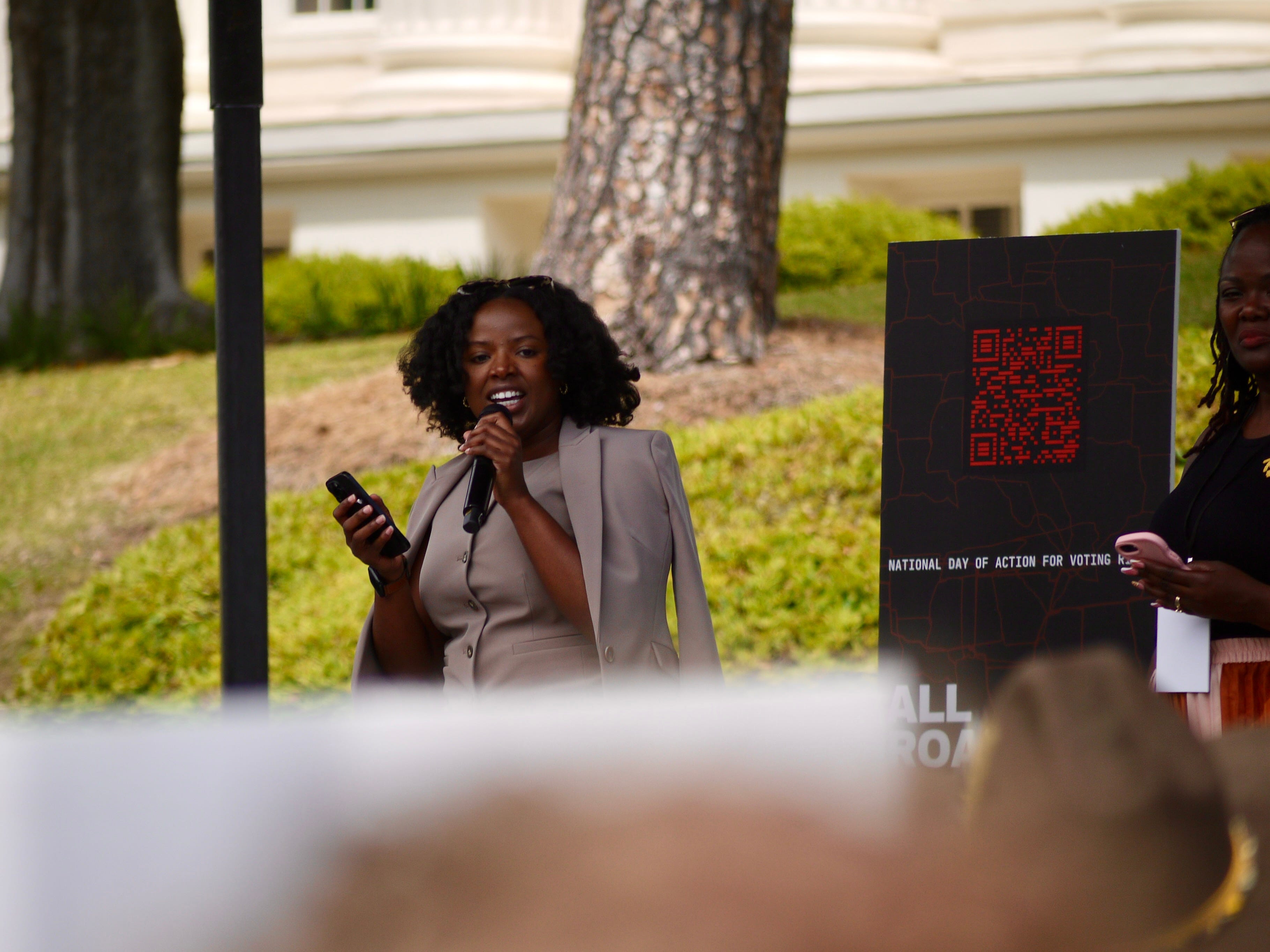
How can we counter this? Before the medical emergency, Reed quoted a Bible verse about warfare: “For we wrestle not against flesh and blood, but against principalities, against powers, against the rulers of the darkness of this world, against spiritual wickedness in high places.”3
Until the Civil War, the principality Reed referred to held power on Southern cotton plantations and in Northern mercantile houses and financial institutions that benefitted from the cotton trade.4 Abolitionists and opponents of slavery’s expansion often referred to this principality and the moneyed interests and politicians allied to it collectively as the Slave Power. A more current term for the same or a similar principality and its human enablers is white supremacy. I’m sure that, by whatever name, the Slave Power is connected with patriarchalism and capitalism—certainly racism—dark forces that amount to high places themselves, but I’m more reticent than are many Southern legislatures about mapping out their domains.
By whatever name or names, this Slave Power is still at work in the United States.5 Labeling forces as “powers,” though, doesn’t mean there’s no way to counter them. That’s the point of Paul’s catalog of our weapons that follows the verse Reed quoted.
That’s also the point of Paul’s letter to the Galatians. Galatians offers help in our emergency because it describes the nature and relationship of three covenants similar to the three that the Supreme Court mangles in Callais and other Fifteenth Amendment cases—the Declaration of Independence, the Constitution, and the Constitution’s three Civil War Amendments. Getting the covenants’ relationships right brings freedom, Paul claims. Getting them wrong, as the Galatians were being taught to do in Paul’s absence, leads back to slavery. According to J. Louis Martyn in his Galatians Anchor Bible, Paul believed that this teaching placed the Galatians “in a life-and-death crisis.”6
The book of Galatians comes across as both drama and argument, Martyn claims.7 Galatians argues less than it performs. Galatians is “more revelatory and performative than horatory and persuasive,” he observes.8 The emergency Paul addresses is more elemental than what argument alone can reach. Galatians wasn’t written against the Law or against Judaism, as many mistakenly believe, but against an entire enslaving cosmos and the forces that perpetuate it. Revelation—Martyn prefers revelation’s synonym “apocalypse”—and performance are necessary to announce a new cosmos, a new world right down to its roots.
This apocalypse of Jesus the Messiah brought freedom that needs to be recognized, defended, and lived, Paul says: “The Anointed freed us for freedom; stand fast, then, and do not again be restrained by slavery’s yoke.”9 This freedom is similar to what Lincoln at Gettysburg anticipates as “a new birth of freedom,” the Civil War Amendments to the Constitution, something the nation was encouraged to work toward winning, drafting, and ratifying.
In celebrating their new covenants and their freedom, Lincoln and Paul had to deal carefully with what Rabbi Moshe Weinfeld calls treaty covenants—covenants that set out a community’s or an alliance’s rights and duties with respect to one another. In Lincoln’s case, the treaty covenant was the pre-Civil War Constitution. In Paul’s case, it was the Mosaic Law, or Mosaic covenant.10
These treaty covenants make silent allowances for human frailty. The Mosaic covenant, for instance, permitted divorce only “because of the hardness of your hearts,” Jesus said, but “from the beginning it was not so.” From the perspective of ancient Israel’s national covenant, the “beginning” wasn’t Eden, which Jesus cites, but God’s covenant with Abraham.
Paul in Galatians fleshes out Jesus’ impulse to go back in time before the treaty covenant. Paul says that the Mosaic Law, “promulgated through angels,” doesn’t void God’s earlier promise through his covenant with Abraham, the promise that through Abraham’s seed “all the gentiles will be blessed.”11
Lincoln also makes the same move. The Constitution permitted slavery because of the hardness of our hearts, but from the beginning it was not so. The United States’ covenantal beginning was the Declaration of Independence, and it contains the promise that “all men are created equal,” a promise that Lincoln cited at Gettysburg and that was to be fulfilled in America’s “new birth of freedom.”
Lincoln defended the Constitution as the Declaration’s picture frame because it preserved the Declaration’s Equality Clause (“all men are created equal”) for a day when it would be accessible to all people.12 Likewise, in Galatians Paul defended the Mosaic Law as a “schoolmaster” because it preserved the earlier, Abrahamic covenant’s blessing (“in you shall all the peoples of the earth be blessed”) for a day when it would be expanded to all peoples.13
So both the United States and ancient Israel, “all” and “all,” began with what Weinfeld calls “grant” covenants that promised to one day include everyone—Blacks and Gentiles, respectively.
Lincoln painted a vivid picture of how the nations of the world in the form of emigrants to America had come to be grafted in because of the Declaration’s Equality Clause. Though the emigrants have no blood relation with the founders, he said, they can look
. . . through that old Declaration of Independence [and] find that those old men say that “We hold these truths to be self-evident, that all men are created equal” . . . they feel that moral sentiment taught in that day evidences their relation to those men, that it is the father of all moral principle in them, and that they have a right to claim it as thought they were blood of the blood, and flesh of the flesh of the men who wrote that Declaration, and so they are.14
This grafting in, this finding by outsiders that they are, because of the promise in the founding grant covenant, the “blood of the blood, and flesh of the flesh” of the founding generation, is this not Paul’s Good News to the Galatians? As Gentiles, they are no longer excluded from covenant but are, in some mystical but real sense, “Abraham’s seed, heirs according to a promise.”15
Of course, Paul argues to the Galatians that Israel’s third national covenant, in which Gentiles and Jews are equals, is a second grant covenant—one between God the Father and his Son Jesus. Jesus fulfills the first covenant as “Abraham’s seed” through which all the peoples of the world are blessed.
Similarly, America’s third national covenant, the one that fulfills the promise of the first covenant’s “all men are created equal,” is the Civil War Amendments. Through these amendments, Blacks are freed from slavery, including the “badges and incidents” of slavery, and given the right to vote. Historian Eric Foner calls the Civil War Amendments America’s “Second Founding.” Carl Schurz, tasked by President Andrew Johnson in 1865 to research and report on the condition of the defeated South, later called the Amendments a “constitutional revolution” that
found the rights of the individual at the mercy of the states . . . and placed them under the shield of national protection. It made the liberty and rights of every citizen in every state a matter of national concern.16
Of course, this “constitutional revolution” would last for only a dozen years before its betrayal at the end of Reconstruction.
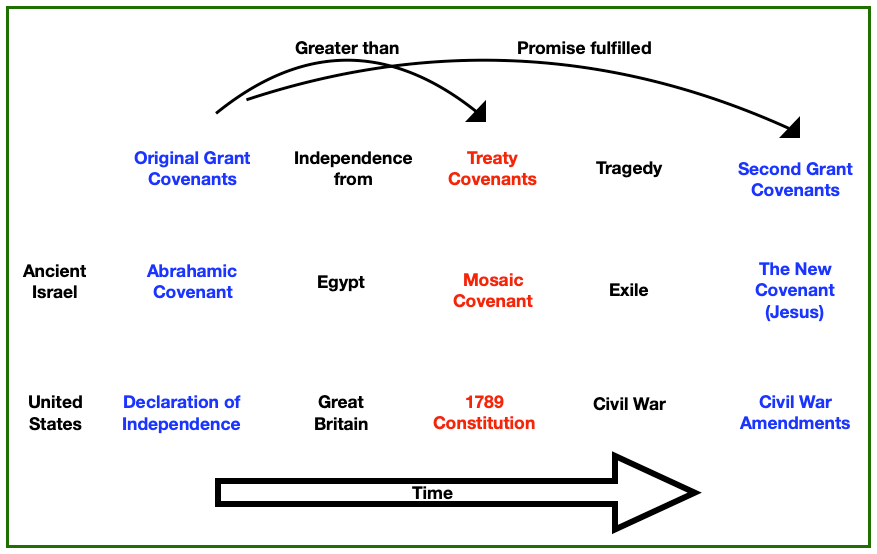
Above: diagram suggesting the similar ways in which the national grant and treaty covenants entered into by ancient Israel and the United States interrelate
In Galatians, Paul’s emergency stems from the Galatians’ betrayal of Jesus and his grant covenant. The Galatians were “bewitched,” he says, returning to forces that had, before their baptism, enslaved them. By converting to a practice of observing the Mosaic law, Paul says, the Galatians were returning to their original state of slavery as Gentiles to “elemental spirits of the cosmos.”17 This seems to us an odd argument. In Jewish tradition, these elemental spirits were associated not with law but with pairs of opposites—air versus earth, fire versus water—that the Gentiles were believed to worship. But Paul, mixing performance and argument, associates these elemental spirits with religious opposites, as Martyn points out:
Specifically, the cosmos that was crucified on the cross is the cosmos that was founded on the distinction between Jew and Gentile, between sacred and profane, between the Law and the Not-Law.18
The Gentiles would not become free, Paul argues, by simply switching polarities—that is, by moving from Not-Law to Law, from profane to sacred, from Gentile to Jew. If they merely switched polarities, they’d be stuck in the same cosmos and its polarities that they renounced at baptism, Martyn points out:
Citing an early Christian baptismal tradition, Paul emphatically says that the cosmos, founded as it was on religious pairs of opposites, does not any longer exist:
“For when all of you were baptized into Christ, you put on Christ as though he were your clothing.
There is neither Jew nor Greek;
There is neither slave nor free;
There is no ‘male and female’;
For all of you are One in Christ Jesus (3:27-28)”19
Paul bid the Galatians remember their association at baptism with Jesus’ crucifixion, by which, in Paul’s words, “the cosmos has been crucified to me and I to the cosmos.”20
Of course, the Galatians’ dangerous teachers wouldn’t have made this connection between Gentiles keeping Law and Gentiles returning to elemental spirits. Instead, the teachers gave lip service to the new covenant in Jesus but insisted that Gentiles, brought into Israel’s covenant with God through Jesus, had the privilege of following, and the responsibility to follow, Moses’ law to the letter.
The Supreme Court wants to do something similar. It gives lip service to the Civil War Amendments, in this case the Fifteenth Amendment concerning voting rights, but insists that Black votes blend in with white votes so that as many whites as possible hold public offices, much as they did under the pre-Civil War Constitution.
To accomplish this, the Court wants Blacks, and with them the entire country, not to speak in public spaces of slavery or even of race. In this respect, public discourse would mirror that earlier Constitution, which never mentions race or slavery while many of its provisions work to perpetuate slavery.21 The Court requires that any remedy for racial inequality on a political level must not be based on race or even mention race. For the Court, the actual problem—racial discrimination—isn’t the problem. Instead, the statement of the problem is the problem.
But treating all groups the same without regard to their historical relations keeps the formerly excluded group functionally excluded. In Acts, Peter was instrumental in bringing the first Gentiles, slave and free, into the Jesus fold, but later he refused to eat with the Gentile Jesus people at Antioch. Paul tells the Galatians that, in confronting Peter about his snub, he traced Peter’s behavior to his desire to erase differences through conformity: “. . . how is it you require the gentiles to become Judaean?”22 Paul warns the Galatians about why the teachers would have them keep the Mosaic law: “. . . they want to shut you out . . .”23
At the Jerusalem conference recorded in Acts, Peter advocated for the position that the Gentiles need not keep Moses’ law. Peter wanted to erase ethnic differences as an outcome, to break down, in Paul’s words, “the barrier of the dividing wall” between Jew and Gentile.24 Eliminating ethnic inequities in the public life of the congregation would be outcome-oriented and would follow Paul’s elimination of Jews and Gentiles as polarities in the broken cosmos. But at Antioch, while shutting out the Gentiles at table, Peter passively used conformity to erase ethnic differences not as an outcome but as categories: Gentiles must live like Jews.
For the Supreme Court, too, it’s all about the categories. It’s racist to speak of race. In its 1978 decision in Regents of the University of California v. Bakke, the Supreme Court struck down a race-conscious remedial program irrespective of its effect in chipping away at a badge and incident of slavery. It struck the program down because it was race-conscious in the first place.25
Remedies for racism therefore face the same higher scrutiny as does a state’s or a municipality’s expressly acknowledged racial discrimination. What flies under the Court’s ahistorical radar, though, is racial discrimination itself, which as the framers of the Civil War Amendments well knew, even at the outset of Reconstruction, is almost never couched in racist language or categories. For the Court, any conceivable remedy, because it must use the r-word, is worse than the disease of racial discrimination. But this equality under the pre-Civil-War-Amendment Constitution—as opposed to the equity under the Second Founding—works like equality for Gentiles under the Mosaic Law: “. . . they want to shut you out . . .”
The Supreme Court’s imposed silence about race, then, leads to conformity and to political invisibility. In that respect, America’s future public sphere under the Supreme Court resembles antebellum America’s public sphere, as Foner describes it: “Slavery rendered blacks all but invisible to those imagining the American community.”26
One can hear this silence and see this invisibility at work in Callais, which found that Louisiana’s voting map requiring a second Black congressional district was an unconstitutional racial gerrymander. Under Callais’s reasoning, the creation of any Black district under the Voting Rights Act is discriminatory because the creation will always be explicitly based on race. The court claims to protect any valid remedy to an instance of racial discrimination, but it finds that it must strike down any remedy that claims to address an instance of racial discrimination. The demanded silence makes all remedies unenforceable.
The result is invisibility. A minority community may now be cracked—that is, they may be split up among majority white communities—“so that it loses all its electoral influence,” as Justice Kagan points out in her dissenting opinion:
Members of the racial minority can still go to the polls and cast a ballot. But given the State’s racially polarized voting, they cannot hope—in the way the State’s White citizens can—to elect a person whom they think will well represent their interests. Their votes matter less than others’ do; they translate into less political voice.
A different kind of silence—an historical silence—pervades the Supreme Court’s other recent Voting Rights Act case. In its 2013 Shelby County v. Holder decision, the Court declared unconstitutional the Voting Rights Act’s formula for judging whether a state or locality could be subject to the act’s remedial precondition requirement, making the jurisdictions gain federal approval before implementing changes to their election laws and procedures. The Shelby County decision requires Congress to pass a new formula, not based on history but on present values, to accompany what even the Court acknowledges as Congress’s ample present findings of voter suppression. But while a present-formula requirement seems reasonable, it silences any acknowledgement of the past that the Voting Rights Act and the subsequent acts extending it find active in the present.
In support of its decision, the Shelby County Court conjures the displaced federalism of the pre-Civil War Constitution. Under it, states must be treated equally, and the Voting Rights Act’s preclearance regime would be highly suspect. But as Foner points out, the Civil War Amendments constitute a new federalism:
Federalism endured, but a deeply modified federalism, which recognized the primacy of national citizenship and saw the states, not the national government, as most likely to infringe on Americans’ fundamental rights. This point can be appreciated simply by comparing the first words of the Bill of Rights (“Congress shall make no law”) with the beginning of the final sentence of each Reconstruction amendment (“Congress shall have the power”). The first constrains the federal government; the second . . . authorizes it to combat “the abuses of state power.”27
Applying pre-Civil War federalism to legislation authorized by the same Civil War Amendments that deeply modified that federalism begs the question. It also, in effect, partially and effectively repeals these Amendments that make up the nation’s second founding.28
A community can expressly break covenants. It can also ignore covenants until they are forgotten, which the Supreme Court’s decisions encourage us to do. But covenants themselves are acts of memory. The opposite of covenant isn’t anarchy but amnesia. “The past is never dead,” the lawyer Gavin Stevens says in Faulkner’s Requiem for a Nun. “It’s not even past.” Covenants acknowledge this. But in Callais and Shelby County, the Supreme Court acts as if forgetting our nation’s past will make the past, with its badges and incidents, go away.
Paul concludes his letter to the Galatians with a call to remember, to renew their baptismal vows based on the apocalypse that is still leading to a new cosmos:
May I, however, boast in nothing except the cross of our Lord Jesus the Anointed, through whom the cosmos has been crucified to me and I to the cosmos. For neither circumcision nor having a foreskin means anything, but rather a new creation. And as many as proceed in line with this rule, peace and mercy upon them, and upon the Israel of God.29
Lincoln’s Gettysburg Address is, of course, also a covenant renewal speech, also as much performative as persuasive. Lincoln begins with the nation’s founding grant covenant, quoting its Equality Clause. He ends with the nation’s anticipated second founding. And he reminds us how the promise of the first calls for our participation in the second:
. . . that we here highly resolve that these dead shall not have died in vain — that this nation, under God, shall have a new birth of freedom . . .
The nation’s highest court of law should be, above all, a court of covenant. In Galatians, Paul offers guidance that would allow the Supreme Court, in Voting Rights Act and other Fifteenth Amendment cases, to begin again.
Along these lines:
“Yes, but can it preach?” adapts the content of “Galatians and the Voting Rights Act” for another genre and audience: a sermon in a southern, Black church.
“How to renew America’s covenants” sets out more fully and theoretically the relationships among the grant and treaty covenants entered into by ancient Israel and by the United States.
How to renew America's covenants

America’s story can be told through three national covenants—the Declaration of Independence, the Constitution, and the Constitution’s Civil War Amendments. This national story bears a striking resem…
The short footnotes below refer to the full citations in my earlier manuscript’s and this Substack’s bibliography.
This video of the rally is cued to start with the medical emergency.
Psalm 8:2, with Jesus’ gloss at Matthew 21:16.
Ephesians 6:12 KJV
See gen. Edward E. Baptist, The Half Has Never Been Told: Slavery and the Making of American Capitalism (Basic Books, 2016).
See gen. Avidit Acharya et al., Deep Roots: How Slavery Still Shapes Southern Politics (Princeton University Press, 2020).
J. Louis Martyn, Galatians: A New Translation with Introduction and Commentary, First Yale University Press impression, The Anchor Bible, volume 33A (Yale University Press, 2010), 42.
Martyn, 13-15, 23.
Martyn, 23.
Galatians 5:1; Hart, New Testament, 376.
I admire a similar approach to covenants in the Bible’s book of Hebrews in my article “How to Renew America’s Covenants.” That article has my citations to Weinfeld’s work.
Galatians 3:1-20; Hart, 372-73.
Lincoln, “Fragment on the Constitution.”
Galatians 3:19-25 KJV.
Lincoln, Speeches and Writings, 1832-1858, 456.
Galatians 3:29; Hart, 374.
Foner, Second Founding, xxviii.
Galatians 4:3, 4:9; Hart, 393, 411.
Martyn, 403-406.
Martyn, 570. See also 400-406.
Galatians 6:14; Hart, 379.
The original Constitution’s provisions supporting slavery include the Three-Fifths Clause, the Slave Trade Clause, the Fugitive Slave Clause, and the domestic insurrection and militia provisions.
Galatians 2:11-14; Hart, 371.
Galatians 4:17 NNAS.
Ephesians 2:12-18 NNAS.
“John Marshall Harlan’s dictum, ‘our Constitution is color-blind,’ hurled at the majority in Plessy as a reminder of the egalitarian purposes of the second founding, has lately been invoked by conservative justices to challenge any consideration of race whatsoever. The Court appears to view ‘racial classifications,’ whether remedial or oppressive, not inequality, as the root of the country’s race problems. This outlook, rooted more in modern-day politics than the actual history of the Reconstruction era, has helped to fuel a long retreat from race-conscious efforts to promote equality.” Foner, 174.
Foner, 3.
Foner, 85.
Foner points out that “In affirming a commitment to federalism, the Shelby County decision took no note of how the second founding had altered the original federal system. Indeed, to this day, when conservative jurists discuss federalism, they almost always concentrate on the ideas of eighteenth-century framers, ignoring those of the architects of Reconstruction.” Foner, 170-71.
Galatians 6:14-16; Hart, 379.
Cf Eddie Glaude’s book on JBaldwin, Begin Again. An interesting parallel/counterpoint.
Galatians, Gettysburg, and the Civil War Amendments placed in one field of vision without flattening their differences. Nice retrieval.
Yes! >To forbid race-conscious remedies in the name of equality is not neutrality; it is a form of forgetting with legal force. The line that stays with me is this: “The opposite of covenant isn’t anarchy but amnesia.” That feels like the hinge of the whole piece.
Another thoughtful piece.