


Preamble: We hear a lot about the state of our Union. This year’s sestercentennial, though, invites us to look at the state of our Revolution.
In 1763, Britain began to assert sovereignty over its American colonies. In response, the colonists began, historian Bernard Bailyn says, “to state in the language of constitutional theory, the truth of the world they knew.”
This week’s Revolution 250 essay examines what that language got right, what it got wrong, and how we might form a more perfect Revolution.
In the violent seventeenth century, home of the English Civil War and the overthrow of three English governments, history wasn’t turning out well. In response, political theorists sought a way to ground government in something non-historical.1
Two of these theorists, the great proto-liberal thinkers Thomas Hobbes and John Locke, describe states of nature to explain the fundamental relationships among individuals, societies, and governments. These states of nature aren’t historical or even prehistorical accounts. In fact, as a later political theorist, John Dunn, points out, they’re deliberately and “crudely anti-historicist.” These states of nature don’t add up to anthropology or myth, either.2 Instead, they are simple means of getting across the age’s social-contract theory.
These states of nature remind one of the Bible’s Garden of Eden, but they don’t have Genesis’s narrative character. In fact, by the time Locke sets out his state of nature in his famous Second Treatise of Government, he has, in his less famous First Treatise of Government, dismissed an earlier attempt to ground government in the Garden of Eden. In his First Treatise, Locke attacks the Patriarchalism of Robert Filmer, who traces the Divine Right of Kings back to Adam.
Locke’s state of nature is peaceful and rational, but it’s also insecure. Consequently, governments are formed to secure individuals’ rights. By contrast, Hobbes’s state of nature amounts to a state of war. Without an absolute ruler, Hobbes reasons, individuals would destroy one another.
Hobbes and Locke describe different worst-case scenarios depending on the outcomes they want, as Professor Ruth Grant points out:
By identifying the state of nature as the worst case, Hobbes teachers obedience to civil government. By identifying the state of war as the worst case, Locke justifies resistance.3
One key phrase in Locke’s justification for resistance to government is “appeal to heaven.” During the Revolutionary War, George Washington had the phrase placed on his cruisers’ ensigns. We can see how Locke constructs his state of nature and his social-contract theory by observing how we Americans applied it in our revolution.
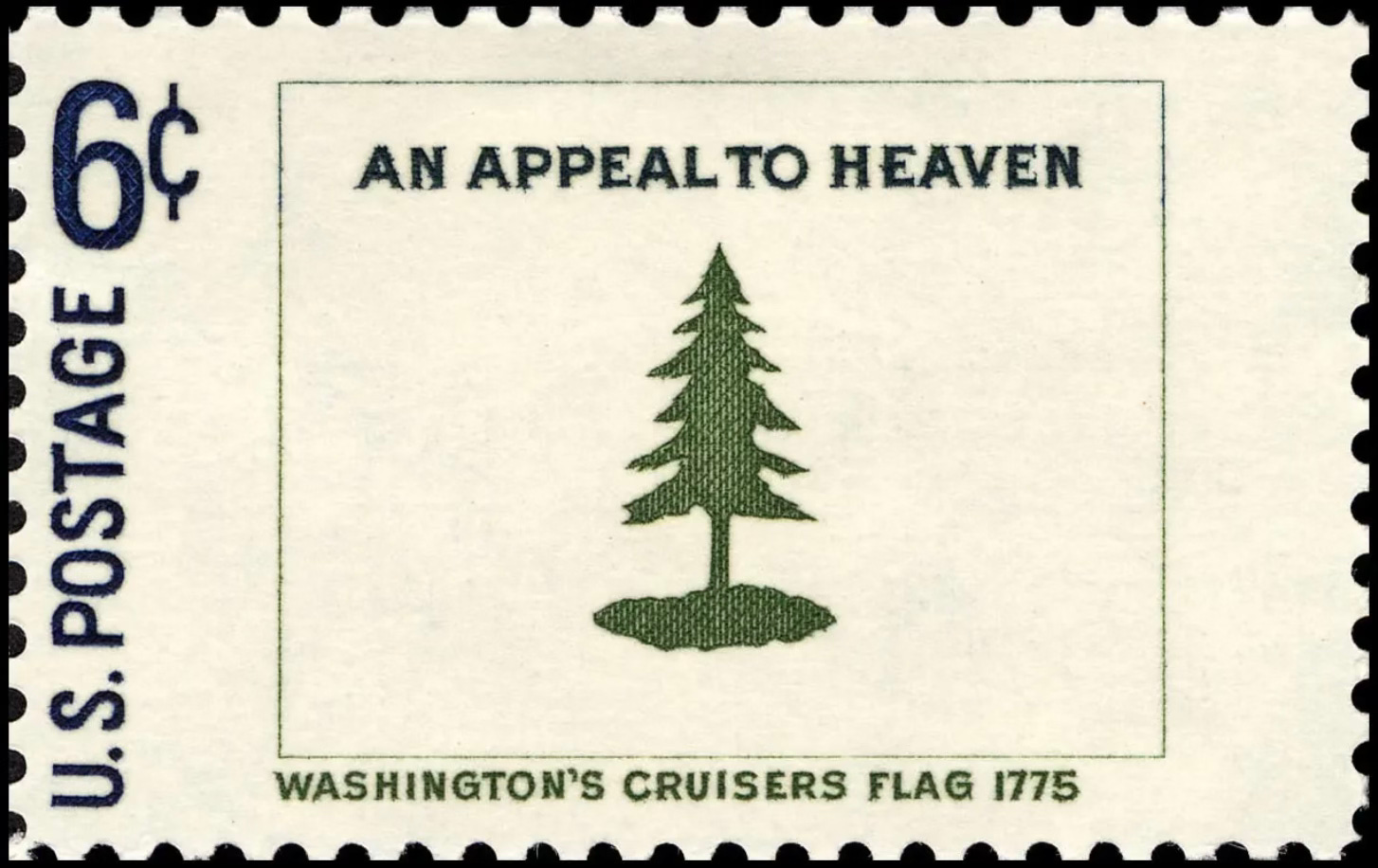
In a letter to Congress dated October 20, 1775, Washington suggested a modification for the ensign that several new American cruisers would fly. The ensign is a green pine tree—a stylized version of New England’s Liberty Tree—on a white field. Washington wanted “An Appeal to Heaven” on the ensign, and he got his way. The next year, the ensign also became the Massachusetts Navy’s ensign, and Massachusetts kept “An Appeal to Heaven” on its naval ensign until 1971, long after the state’s Navy itself was destroyed by the British.4
Most Americans, I imagine, have seen the flag. The flag’s “appeal to heaven” is a prayer, as many today assume, but it’s principally a declaration of American independence based on Locke’s theory of resistance.
Locke’s “appeal to heaven” is part of his effort not only to supplant Filmer’s Patriarchalism but also to justify the 1688 English Revolution. The American patriots frequently cited the 1688 revolution in support of their own revolution. Locke’s Second Treatise, which revolutionary America consulted as a central text on political theory, uses “appeal to heaven” several times as a term of art.
Here’s how the phrase “appeal to heaven” fits into Locke’s account of the state of nature. Suppose two people or two towns or two countries become aware of each other.5 If they coexist “according to reason,” they share a “state of nature.” If they are individuals, this state of nature includes “a title to perfect freedom, and an uncontrolled enjoyment of all the rights and privileges of the law of nature.” But if one person or town or country uses “force, or the declared design of force” on the other, the state of nature becomes a state of war.
Individuals may create a “political society” to avoid this state of war. Those societies allow the majority to have its way on any given question.6 However, those political societies may create governments such as democracies, oligarchies, and monarchies, all with legislative power chiefly for “the preservation of the society.” By creating political societies and governments, however, individuals surrender their power to settle and punish infractions of their natural rights to “life, liberty, and estate.” Instead, “the community comes to be umpire” of these infractions, and individuals appeal to their political societies for redress.7
But even in political societies created by these social contracts, a state of war can occur between a people and its government if the rulers exercise “a power the people never put into their hands.” Because there is no “common superior” to both a people and their rulers to appeal to in such a state of war, the people as an aggrieved party may appeal to heaven. That is, the people may resist their rulers based on an unwritten, God-given law superior to the rulers’ law, Locke says:
. . . where the body of the people, or any single man, is deprived of their right, or is under the exercise of their power without right, and have no appeal on earth, there they have a liberty to appeal to heaven whenever they judge the cause of sufficient moment. And therefore, though the people cannot be judge, so as to have by the constitution of that society an superior power to determine and give effective sentence in the case, yet they have, by a law antecedent and paramount to all positive laws of men, reserved that ultimate determination to themselves, which belongs to all mankind, where there lies no appeal on earth, viz. to judge whether they have just cause to make their appeal to heaven.8
Such an appeal would be ineffective if heaven were bound by the rulers’ laws, Locke here suggests. Instead, heaven judges the people’s case “by a law antecedent and paramount to all positive laws of men”—that is, by natural law.
The distinction between natural law and humankind’s positive law (law “posited” by human lawmakers) reinforces the governmental distinction between God and man. If a ruler’s decrees cannot be checked by any higher authority, then he or she becomes as arbitrary as God could be if he hadn’t limited his own rule by covenant.9
Locke isn’t the first philosopher in the Western Christian tradition to find that in proper cases, natural law justifies not only civil disobedience but also a ruler’s overthrow. The thirteenth century philosopher Thomas Aquinas writes that
A tyrannical government is not just because it is directed not to the common good but to the private good of the ruler, as the philosopher [Aristotle] states. Consequently there is no sedition in disturbing a government of this kind . . . indeed it is the tyrant rather that is guilty of sedition, since he encourages discord and sedition among his subjects.10
Aquinas here summarizes what later became known as the right of revolution, the foundation of all other rights.
So two of our nation’s first navies sailed under a flag that asserted a right of revolution against the British. Specifically, it asserted the stage in which America found itself in John Locke’s political appeals process. The Americans had petitioned the British king to no avail. It was time to appeal to heaven. In other words, it was time for revolution.
But I’m not sure how revolutionary Locke’s right of revolution really is. After all, the right of revolution assumes the need for rulers. People may assert their right of revolution, Locke says, only if the ruler is bad enough and only if the revolution works to secure a new ruler:
Such revolutions happen not upon every little mismanagement in public affairs. Great mistakes in the ruling part, many wrong and inconvenient laws, and all the slips of human frailty will be born by the people without mutiny or murmur. But if a long train of abuses, prevarications, and artifices, all tending the same way, make the design visible to the people, and they cannot but feel what they lie under, and see whither they are going, ‘tis not to be wondered that they should then rouse themselves, and endeavour to put the rule into such hands which may secure to them the ends for which government was at first erected . . .11
Despite his attack on Filmer’s Patriarchalism, and even at the end of his theoretically successful revolutions, Locke still props up patriarchs who can promulgate and enforce “many wrong and inconvenient laws” which should be “born by the people without mutiny or murmur.”
I’m also not sure how different Hobbes’s and Locke’s states of nature are at bottom. Even though Hobbes’s state of nature teaches obedience to rulers and Locke’s state of nature justifies resistance, their theories share the right of revolution’s central assumption: we need rulers.
Hannah Arendt sniffs this out. She highlights Locke’s predisposition to sovereignty as she explores a contradiction in Locke’s account of the state of nature. Locke’s account, Arendt says, is really a combination of two mutually exclusive social contracts. Here’s a summary of Arendt’s explanation of how the two social contracts, one creating society and the other creating government, differ in terms of power, political involvement, and principles:12
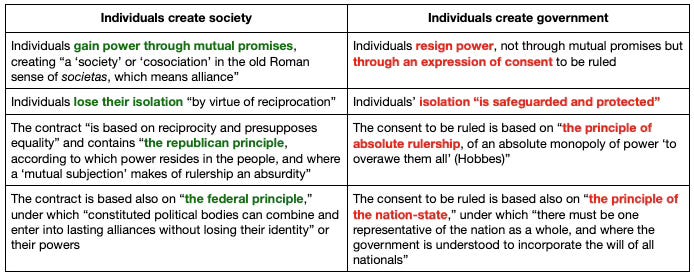
Arendt’s analysis of Locke’s mutually contradictory contracts pits “the republican principle” of the first contract against the “principle of absolute rulership” of the second. It pits the “federal principle” and its balance of powers, associated with the first contract, against the “the principle of the nation-state” undergirding the second contract.
Are we not, as a country, currently moving from the first contract’s principles to the second contract’s principles? From republicanism and federalism to absolutism and nationalism?
The tendency of our nation’s founders to express our nation’s founding in Locke’s contradictory terms suggests that our revolution, at its current stage, is both promising and flawed. Our revolution is incomplete, and our work in this hour is to complete it.
What would that work be like? Arendt doesn’t argue for a liberal notion of progress under which more and more categories of people would receive the franchise to vote for their rulers, as important as the franchise is under a Constitution that makes elections—that is, the regular surrender of power to rulers—the hallmark of its civic life.13
Instead, Arendt argues that America should return to its greatest contribution to political history: its rediscovery of power generated among people through mutual promises and the living out of those promises in local and federal assemblies.
American colonists practiced this power for 150 years. Locke may have taught the American founders his second social contract, Arendt admits, but she posits that, by their experiences, the American colonists taught Locke his first. Locke constructed the first part of his social compact account, Arendt suspects, based on what he had heard and read about the colonists’ experiences from the Mayflower Compact forward. Long before Locke wrote his Second Treatise, Americans were entering into covenants.14 As soon as the American colonists got to what would become their settlements—even beforehand, during their voyage to America, in the Mayflower’s case—they entered into covenants to create the power they would need to survive and prosper. They learned that action “can be accomplished only by some joint effort” and not in individual isolation.15 Arendt summarizes their experience:
The unique and all-decisive distinction between the settlements of North America and all other colonial enterprises was that only the British emigrants had insisted, from the very beginning, that they constitute themselves into “civil bodies politic.” These bodies, moreover, were not conceived as governments, strictly speaking; they did not imply rule and the division of the people into rulers and ruled. . . . These new bodies politic really were “political societies”. . .16
Arendt terms the Americans’ exercise of their newfound power in these assemblies a rediscovery because of “the Puritans’ reliance on the Old Testament, and especially their rediscovery of the concept of the covenant of Israel . . .”17 Ancient Israel, and not seventeenth-century political theorists, taught the first American colonists about covenants.
As we all know, however, the “republican principle” isn’t alone in adopting the logic of monotheism. The principle of absolute rulership, Arendt points out, often makes a kind of appeal to heaven: its “absolute monopoly of power . . . is liable to be construed in the image of divine power, since only God is omnipotent . . .”18 One can see also in Locke’s appeal process this easy association of kings with God. To gain redress for the violation of their rights, the people first appeal to the king. Only when this fails do they appeal to heaven—that is, they appeal to a greater king.
But if the people learn how to covenant and live out those covenants effectively, Arendt points out, then the covenant members do their political work without sovereignty or rule: “. . . the notion of covenant presupposes no-sovereignty and no-rulership. . .”19 In fact, in America’s case, these colonial covenants were “made without any reference to king or prince,” Arendt says. Subsequent English royal charters merely “sanctioned and confirmed an already existing system of government.” Therefore, “the Revolution liberated the power of covenant and constitution-making as it had shown itself in the earliest days of colonization.”20
Aided as they were by this colonial heritage of self-governing assemblies, why did the American founders frame the revolution partly in Lockean terms, including “an appeal to heaven”? The founders’ reasoning “both in style and content was formed by the Age of Enlightenment,” Arendt says. As a result,
. . . Jefferson could speak of the consent by the people from which governments ‘derive their just powers’ in the same Declaration which he closes on the principle of mutual pledges, and neither he nor anybody else became aware of the simple and elementary difference between ‘consent’ and mutual promise, or between the two types of social-contract theory.21
But the Enlightenment framing that conflated consent and mutual promise had no grounding in the American heritage of townships and similar popular institutions.22
Beyond their blinders borrowed from the Age of Enlightenment, why were revolutionary-era Americans attracted to Locke’s self-contradictory state of nature? It may be because Colonial America had lived both sides of Locke’s contradiction. For the most part, from the last years of the seventeenth century until the French and Indian War, the king and Parliament were content to let the colonists govern themselves, and the colonists mostly did so pursuant to the covenants they had entered to create distinct polities.23 Matters handled by the British legislature touched “only the outer fringes of colonial life,” historian Bernard Bailyn points out.24
During this period, the English didn’t tax the colonists. Instead, the colonists taxed themselves, and they did so with English encouragement. But by the end of the French and Indian War, which moved Britain to tax her colonies, the colonies began to live a contradiction, maintaining local and colony-wide power structures inside “an empire presumably ruled by a single, absolute, undivided sovereign,” Bailyn says.25 The living contradiction Bailyn identifies mirrors the contradiction Arendt identifies in Locke’s state of nature.
When the British began to assert their rule against the colonies in 1763, the colonists found their settled forms of government challenged. They began to advance arguments, Bailyn says, “to state in the language of constitutional theory, the truth of the world they knew.”26 One such theory, Locke’s social contract examined by Arendt, gives theoretical voice to both sides of the colonists’ contradictory experience with government.
Locke’s state of nature describes today’s contradictory governmental expectations, too. We want government to defend our rights to life, liberty, and property, but we also want government to leave us alone. We want good government, but we don’t want to spend time governing together. We’d rather not attend to public life ourselves. We prefer rulers.
So we appeal to heaven for a better ruler, a better patriarch. We long for what the Ukrainian essayist and psychoanalyst Jurko Prochasko terms a psychologically immature revolution. Reflecting after the 2013-2014 Maidan Revolution on his country’s 2004-2005 Orange Revolution, Prochasko realizes that the earlier revolution, considered a success in its immediate aftermath, had merely swapped one ruler for another:
We concluded the revolution in three weeks, delegated everything to [Viktor Yushchenko], and went away. In that sense Yushchenko’s betrayal was a very, very valuable experience. . . . At the time we thought there was a bad father, and we had to replace the bad father with a good father. And now we no longer believe in a father at all.27
In our dark hour, we must ask ourselves which half of Locke’s self-contradictory compact theory we want from the American Revolution. Do we merely want a better ruler? Or do we want to live “the republican principle, according to which power resides in the people, and where a ‘mutual subjection’ makes of rulership an absurdity”?

This essay is the second in the series The Spirit of Revolution, which commemorates our nation’s sestercentennial. An explanation of the series serves as the preface to the series’s first essay.
The short footnotes below refer to the full citations in my earlier manuscript’s and this Substack’s bibliography.
John Dunn states that the contamination of morality by history caused liberal theorists “to find some criterion for human morality which is outside history.” Dunn, Political Thought of John Locke, 97. Hannah Arendt suggests that the violence that accompanies politics drew theorists to “the assumption of a prepolitical state” in order to reconstitute politics without history’s intrusion. Arendt, On Revolution, 9-10.
Dunn, 97.
Grant, John Locke’s Liberalism, 72.
Preble, Origin and History, 227; Fischer, Liberty and Freedom, 32.
Note the non-historical and scalable premises of Locke’s state of nature. Whether the units involved are individuals, towns, or nations, Locke’s fundamentally individualistic and dualistic approach always posits their relationship as one unit against another.
John Locke, Second Treatise on Government, chap. 7, sec. 99 in Locke, Political Writings of John Locke, 311.
John Locke, Second Treatise on Government, chap. 7, sec. 87 in Locke, Political Writings of John Locke, 304.
John Locke, Second Treatise on Government, chap. 14, sec. 168 in Locke, Political Writings of John Locke, 348.
Gratian, a twelfth-century monk from Bologna, seems to have been the first to explicitly assert “a natural principle of judicial review by which an appeal to natural law could annul positive law.” Koterski, Natural Law and Human Nature, 51-52.
Quoted in Rosenthal, Crown under Law, 235.
John Locke, Second Treatise on Government, chap. 19, sec. 225 in Locke, Political Writings of John Locke, 376.
The table’s quotes and summaries are extracted from Arendt, 160-65.
Arendt would have the United States govern itself through republican and federal principles. Whoever wished to would become active in something like Jefferson’s small “elementary republics.” This shift, she admits, “would spell the end of general suffrage as we understand it today.” Arendt, 271.
Arendt’s emphasis on the colonists’ covenants, of course, while justified, presents an idealized and incomplete picture of the colonial experience, a picture that crops out slavery and genocide, among other things. To gain a fuller picture, one might start with examining the Virginia colonists’ early years from a Native perspective.
Arendt, 165.
Arendt, 159.
Arendt, 163.
Arendt, 162.
Arendt, 297n56.
Arendt, 159, 168.
Arendt, 168.
See Arendt, 157: “What was lacking in the Old World were the townships of the colonies, and, seen with the eyes of a European observer, ‘the American Revolution broke out, and the doctrine of the sovereignty of the people came out of the townships and took possession of the state’.” (Arendt’s “European observer” is Tocqueville. Arendt, 295n46.)
Arendt points out that, by the time of the American Revolution, Americans have “a hundred and fifty years of covenant-making behind them, rising out of a country which was articulated from top to bottom—from provinces or states down to cities and districts, townships, villages, and counties—into duly constituted bodies, each a commonwealth of its own . . .” Arendt, 167.
Bailyn, Ideological Origins, 203.
Bailyn, 204.
Bailyn, 204.
Shore, Ukrainian Night, 24-28.
This thoughtful series-including your exchanges with Willilam Green!--is perfectly timed for digestion by myself and Brother Pete as we prep for a Lost Prophets episode on the topic "What Is the Fourth of July to the Podcaster?". (Little joke there.) Actually, the topic is something about the 250th and the idea of reconstruction. Gratitude!
Another of Bryce’s rigorously thoughtful posts. A splendid recovery of the associational, covenantal, federal side of American freedom. But I think it risks making pluralism too innocent. The central state can dominate, and so can townships, churches, parties, families, and covenants. Liberal freedom exists in the uneasy tension between checking centralized sovereignty and local authority. Locke’s contradiction may be less a defect to overcome than a recurring liberal condition. We need impersonal law against patriarchs and intermediate bodies against the state. The task is not to complete the Revolution by choosing one contract but to sustain institutions that keep both dangers visible simultaneously and politically. - Thanks, Bryce, for provoking good thought.